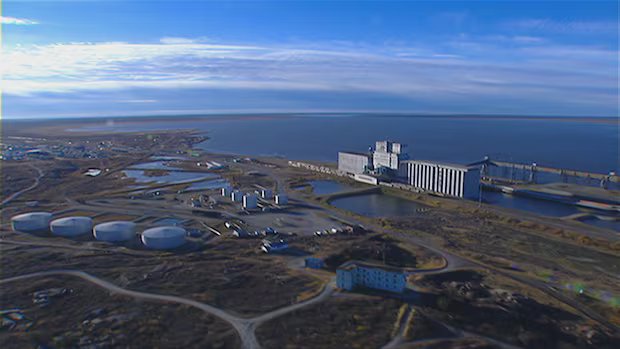
Year-round shipping is possible on Hudson Bay without the use of the most expensive icebreakers, a spokesperson for Premier Wab Kinew says.
Studies into the feasibility of extending the shipping season — a crucial aspect of the proposed expansion of the Port of Churchill — have yielded encouraging results, Amy Tuckett-McGimpsey said late Thursday.
The Manitoba government plans to reveal the results of these studies on Friday.
Arctic Gateway Group, which owns the port and the Hudson Bay Railway, partnered up with shipping company Fednav to determine what’s required to make year-round shipping possible in and out of the Port of Churchill.
The provincial and federal governments also commissioned a study by the Arctic Research Foundation, a non-profit organization founded by former Blackberry chair Jim Balsillie, to see whether it’s feasible to extend the operating season at the port.
The Fednav study is complete and the Arctic Research Foundation study will be finished in March 2027, Kinew spokesperson Rebecca Widdicombe said earlier Thursday.
Widdicombe said the premier is releasing details of both studies in advance of a September summit in Toronto, where Kinew hopes to pitch the Port of Churchill expansion to international investors.
In an interview published later Thursday in the Globe and Mail, Kinew said those studies suggest shrinking sea ice will allow icebreakers in the range of $50 million to $100 million — rather than multibillion-dollar vessels — to make Hudson Bay navigable.
CBC News has not reviewed those studies and can not confirm their contents.
The commission of icebreakers is among several components to the proposed expansion of the Port of Churchill, which currently operates during a roughly four-month ice-free season that runs from mid-July to late October or early November.
Arctic Gateway Group, which is made up of 29 First Nations and 12 remote northern Manitoba communities, plans to rebuild the Hudson Bay Railway so it can withstand higher payloads and improve both storage and loading facilities at the Port of Churchill.
It’s also eyeing the possibility of shipping commodities through Hudson Bay earlier and later in the season, utilizing both icebreakers and ice-hardened tugboats.
More ambitiously, Kinew has raised the possibility of building a natural gas or oil pipeline to Churchill and building a year-round access road to the community.
Earlier study questioned feasibility
The federal government conducted a market sounding the proposed expansion but did not release the results to the public.
An earlier feasibility study, completed by consulting firm PwC in 2023, concluded there are several short-term, relatively inexpensive opportunities to ship more goods through the Port of Churchill but was less definitive about the prospects of a more ambitious investment in a northern Manitoba trade corridor.
A heavily redacted version of the 86-page study was made public this summer after a federal access to information request and was originally reported by digital news outlet iPolitics.
The study concluded there are a “handful of strong opportunities” to transport more cargo through the Port of Churchill that could be “developed within a relatively short time frame and with minimal investment.”
Those included “readily available opportunities” to export nickel and silica sand through the Port of Churchill and further develop the port’s role as a resupply hub for remote communities in Nunavut.
The study also found there are some opportunities to ship more grain through the port and, with additional investment in the port and railway, potash as well.

It also concluded there is “low market potential” to ship crude oil, natural gas or hydrogen through Hudson Bay.
The study raised the prospect that climate change might not be a panacea for the Port of Churchill. While warmer temperatures are expected to increase the ice-free season on Hudson Day by 30 to 60 days in the coming decades, more open water will also make navigation less predictable because of ice jams and severe storms, the report stated.
PwC also warned climate change might thaw out permafrost to the point where the Hudson Bay Railway will be shut down more frequently and the Port of Churchill will become vulnerable to “reduced weight-bearing capacity, ground settlement, slope instability, warping and buckling.”
This will require constant, expensive maintenance, the consulting firm found.
An all-season road to Churchill, meanwhile, would cost up to $1.2 billion to build and $25 million a year to maintain — and also faces opposition due to the inability to control tourist traffic to an ecologically sensitive area, the report found.
Strong opposition to Arctic oil shipments
Northern Manitoba residents, the study stated, largely support a modest buildout of the port, especially if it improves service on the Hudson Bay Railway.
But those residents also raised concerns about a larger industrial development at Churchill due to the impact on the environment and the potential weakening of the town’s position as an ecotourism destination. Concerns were also raised about a mismatch between the jobs that could be developed in northern Manitoba and the existing skill set of the community, and increased competition for housing, cargo shipments and even seats on Via rail trains.
“There was significant opposition to any plans involving the movement of oil along the HBR or through the Port of Churchill, as well as any activities in which negative impacts to the environment, animals or community needs would outweigh economic benefits,” the report stated.
“This includes any development activities at the Port of Churchill with potential to impact sea ice or the marine environment that Inuit and Indigenous communities depend upon for their survival and well-being.”
In a statement, Arctic Gateway CEO Chris Avery said the 2023 PwC report was written before Canada became more urgently focused on major projects.
“It provided an assessment at a particular point in time and ultimately reinforced Arctic Gateway Group’s strategy of building a more diverse and resilient business at the port,” Avery said.
The federal government applied the label of “nationally significant infrastructure” to the Port of Churchill expansion in 2025 but did not add it to the list of major national projects given a green light to proceed.