
Listen to this article
Estimated 4 minutes
The audio version of this article is generated by AI-based technology. Mispronunciations can occur. We are working with our partners to continually review and improve the results.
A woman is recovering after being attacked by a grizzly bear while hiking in B.C.’s South Chilcotin.
Pemberton Search and Rescue (SAR) was notified by RCMP on Sunday around 3:45 p.m. PT that a grizzly bear attacked a hiker.
The woman, 72, was in an area east of Tyaughton Lake in a remote area near Gold Bridge, roughly 70 kilometres north of Pemberton, according to SAR president David McKenzie.
“The bear was batting them around in the altercation,” McKenzie said.
Search crews responded as quickly as possible to the area and coordinated with the B.C. Conservation Officer Service (BCCOS).
“They didn’t want us to enter into the scene until they had cleared it just because of safety,” McKenzie said.
The BCCOS responded immediately by helicopter with a three-member predator attack response team.

The individual was hiking in an area called Pearson Ridge, a remote hike accessible through forest service roads.
“There is a series of trails throughout that area,” McKenzie said.
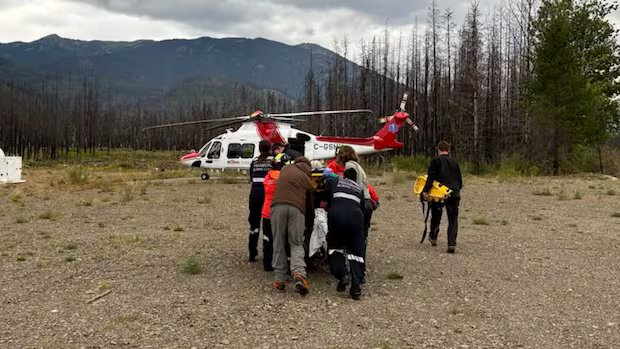
The B.C. Wildfire Service, which was fighting a wildfire nearby, found the hiker and helped rescue her.
“They met up with our team, and we had already arranged for an air ambulance,” McKenzie said.
Paramedics were waiting at the former Gun Lake Airport near Gold Bridge to transport the hiker.
“Two ground ambulances and an air ambulance attended the scene,” said Brian Twaites with B.C. Emergency Health Services.
One person was taken to hospital by air ambulance in serious condition.
“It was quite serious. They had several lacerations of the face, arms, neck, along with an actual C1 [neck] fracture,” McKenzie said.
McKenzie said the woman is recovering.
“I understand they are doing well,” McKenzie said.
Believed to be ‘defensive attack’
The Ministry of Environment said in a statement that conservation officers followed up with the woman and collecting clothing with potential “linkage” evidence.
The next day, on Aug. 3, officers returned to the site and completed an investigation and retrieved the woman’s personal items.
The ministry said the investigation has led them to believe the attack was defensive in nature, from a female grizzly with at least one cub.
The bear has not been removed or killed and no capture devices are being set up.
“COS has put up signs in the area as a precaution,” said the ministry.
‘We just have to do our best to avoid encounters’
Bear biologist and researcher Wayne McCrory has done bear risk assessments for many national and provincial parks in the province over the last 40 years.
“Lots of people are out enjoying our beautiful province and backcountry in occupied grizzly habitat,” McCrory said.
He said the recent bear attack is tragic.
“My heart goes out to the person,” McCrory said. “It’s difficult. I’ve had my own serious, very, very close near-death encounters.”
He said B.C.’s South Chilcoltin region is a large protected area for grizzly bears with lots of salmon streams for them to feed on.
“Also, lots of the subalpine and riparian areas are prime habitat for grizzly bears,” McCrory said. “It’s got a fairly good population, especially since the grizzly bear hunt was closed in 2017.”
More serious encounters tend to occur where there is an overlap of the trail and campsites in grizzly bear movement corridors, he said.
“Grizzly bears like to use park trails if their terrain is rough,” McCrory said.
He suggested mitigation measures such as not hiking during the early morning or late evening, carrying bear spray and knowing how to use it and making sure trails and campsites are not in prime feeding areas.
“We have these happen every year in British Columbia because we live in prime grizzly habitat,” McCrory said. “We just have to do our best to avoid encounters.”