Good morning. It’s Tuesday. Today we’ll look at a report that estimates it could cost $9 billion a year to fund free child care until age 5 in New York City.
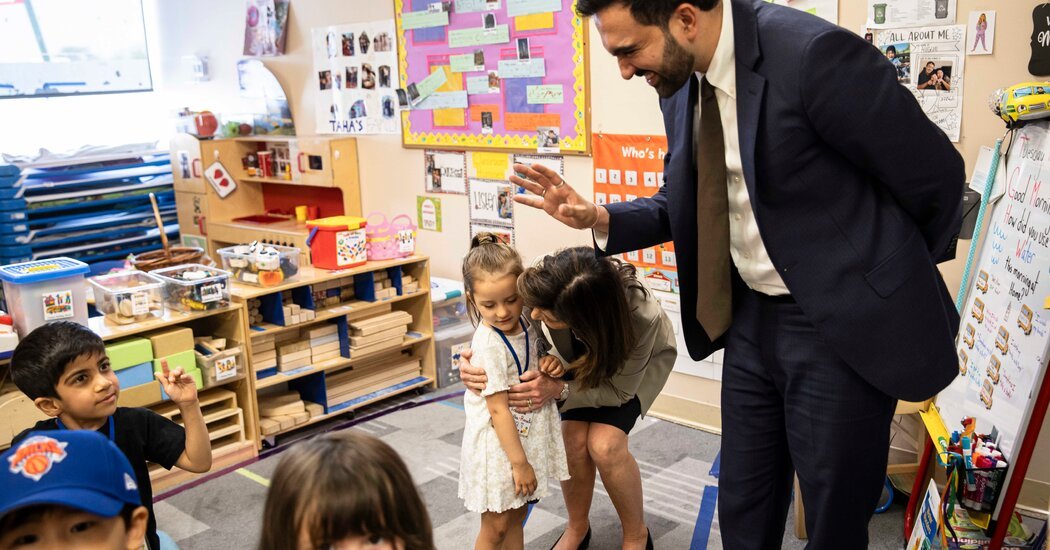
In his campaign to make life in New York City more affordable, Mayor Zohran Mamdani has promised that the city will provide free child care to all residents under the age of 5. As a candidate, he estimated that the cost of providing that benefit would be about $6 billion a year.
But a new report released on Monday suggested that Mamdani might need to come up with a few billion more than that, every year.
As my colleague Eliza Shapiro explained, a new model developed by the Center for New York City Affairs calculated that the proposed program would cost about $9 billion annually, or an average of about $27,000 per child. As she noted, that would be $5 billion more than the city spent on child care last year.
City Hall has not released its own cost model, but Mamdani has argued that the state should raise taxes on New York’s highest earners to help pay for the extension of free child care to children as young as 6 weeks, regardless of their family’s income.
The city currently offers free pre-K for 3-year-olds and 4-year-olds and plans to provide limited day care seats for 2-year-olds this fall, with the help of $1.2 billion provided in the state budget.
Free child care is by far the most ambitious and expensive piece of Mamdani’s push to expand the city’s safety net. The new projection underscores how difficult it could be to fund his broad plan and achieve his goal of lifting up low-paid workers at a moment when the city, just like many of the families who live in it, is struggling to balance its budget.
The Center for New York City Affairs, a nonpartisan research organization affiliated with the New School, said that for too long in New York, “social services like child care have been under-budgeted.” That practice has “forced workers to take a pay cut” so that policymakers can achieve their goals, according to the report, which was written by Lauren Melodia and David A. Lee.
Teacher pay accounts for most of the $3 billion gap between the report’s projection and Mamdani’s estimated annual cost. There is already a “staffing crisis” in the child-care industry statewide, the report says. Its authors recommend that the state take action to attract experienced workers by creating a fair salary scale and establish a fund to subsidize wages during the transition to universal child care.
Jenna Lyle, a spokeswoman for the mayor, did not directly comment on the center’s $9 billion estimate, but she said the city was committed to getting child care workers raises while also meeting parent demand for more free care.
“Delivering on those promises will require additional public investment, and this administration has been clear about that from the start,” Lyle said in a statement.
Mamdani has said he wants to offer universal free access without any income cutoffs, but the center’s report argues that it could be simpler and less expensive to incorporate an existing program of child care vouchers for low-income families. The city could offer subsidized vouchers, which are already funded mostly by the state and federal governments, to all families in certain low-income parts of the city, Melodia suggested.
To make its case for higher taxes in Albany, the Mamdani administration would probably need to prove that there is high demand in the city for more spots in child care. But, despite the mayor’s active encouragement, roughly the same number of parents applied this year for 3K and pre-K as last year.
City Hall currently has no plan to fund the expansion after next year, other than asking the state for more money. The governor has said she plans to continue to fund the program.
“We are grateful to Governor Hochul for her partnership and initial investment in this work,” said Lyle, the spokeswoman.
City officials said they were encouraged by parent demand for seats for 2-year-olds; enrollment data will be released on Tuesday.
“The extraordinary response to our first 2-K application season is proof the demand is there,” Lyle said. “Now our responsibility is to meet it.”
Weather
Today will be sunny. Temperatures will near 81 before dropping near 70 tonight, as clouds take over the sky.
ALTERNATE-SIDE PARKING
In effect until Aug. 15 (Feast of the Assumption).
QUOTE OF THE DAY
“I definitely do want to get married and have kids. But that just feels so unattainable. I can’t even think about affording a wedding.” — Grace Sakellario, who is single, on the barriers to dating and finding a relationship in an expensive city.
The latest New York news
METROPOLITAN diary
Beautiful baritone
Dear Diary:
My husband’s job recently allowed us to live in Midtown Manhattan. While he went to work each morning, I worked from home and explored the city on foot.
On many days, as I stepped into the hallway, I heard the most beautiful baritone voice coming from a nearby apartment. I never saw the singer, but hearing him became one of the highlights of my mornings.
Once, as my husband and I were leaving for the Whitney Museum, our mysterious, musical neighbor stepped into the hallway at the same time.
I could not resist.
“Is it your voice I’ve been enjoying all these weeks?” I asked.
He smiled.
“I hope I haven’t been bothering you,” he replied.
“Quite the opposite,” I said. “It’s been a joy.”
My husband asked if he sang professionally.
“I’m singing Marcello in ‘La Bohème’ at the Met this month,” he replied, as casually as if he were telling us he worked down the block. Then he invited us to attend the next performance.
We gladly accepted.
That evening was unforgettable. It was my husband’s first opera and my first since attending performances years earlier with my grandmother.
As the music filled the Metropolitan Opera House, I thought of how, in New York, the most extraordinary invitations can begin with a neighbor practicing behind a closed door.
— Debbie E. Miller