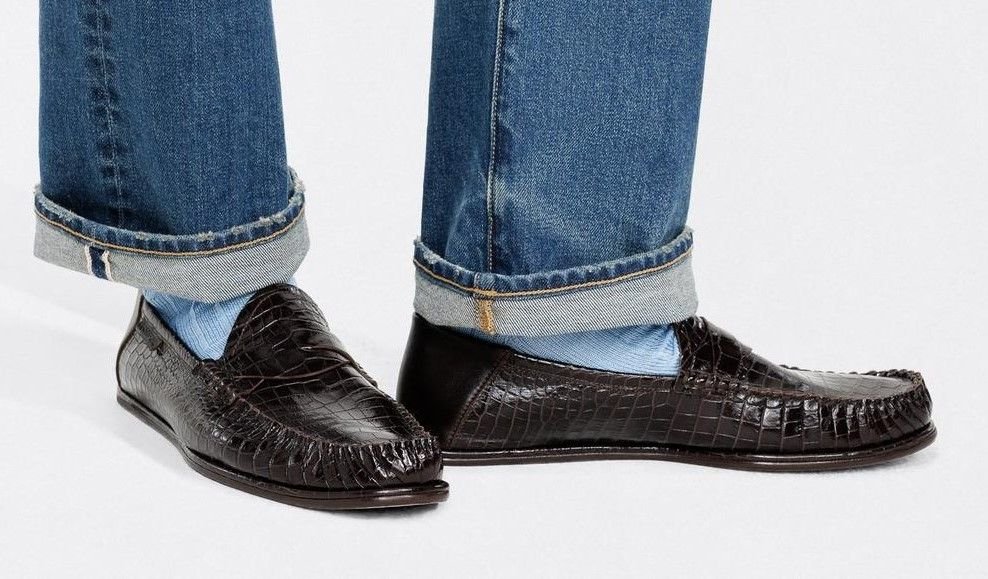
These shoes look like your lips after you’ve eaten an entire bag of Sour Patch Kids.
Known as the ruched (or puckered or scrunched) loafer, they look like a standard lithe loafer until you hit the toe, which wrinkles like a shirt in need of ironing.
Go into any boutique where the sales people are icy and the cashmere sweaters start at four figures and you’ll find these shoes, their curled toes jutting from the shelves.
“It’s kind of like the shoe trend of the era,” said Jian DeLeon, the men’s fashion director at Nordstrom.
Tom Ford’s ruched slip-ons run to US$1,190 (approximately RM4,864). Saint Laurent offers them in glossy leather and tan suede and even makes one with a collapsible heel (two unshakable shoe trends in one!).
There are versions for men and women, evidence of eroding gender fault lines in the footwear market. All of these ruched-toed shoes seem, at first search, to cost more than US$1,000 (RM4,087).
Read more: How one fashion house made ballet flats a high-low wardrobe staple
The Row is the agreed-upon originator of the scrunched toe. Its US$1,290 (RM5,272) Soft Loafer, which it introduced several years ago, has a toe that sits with an angular tilt, casting all that puckering in italic.
“It was great when The Row came out with it 10 years ago,” said Becky Malinsky, who writes the popular shopping newsletter “5 Things You Should Buy”.
Malinsky’s hyperbolic dismissal aside, the shoes continue to sell well. The Soft Loafer in brown eel leather is sold out in all women’s sizes on The Row’s website.
Still, I can see also why Malinsky would dismiss these shoes.
They have become a component in the stale starter pack of people who dress in a way that is informed by, and that reinforces, what is deemed “cool” in online fashion communities like those on Substack.
They symbolise that you’re so thorough, so attentive to each piece of your outfit, that even your loafers must be built differently. And that you’ll pay to make it so.
But, really, what is it about the wrinkly toe that evidently makes the cost worth it?
DeLeon offered that the puckering was the shoe equivalent of scrunching up your shirtsleeves.
It lends “a bit of drama and visual interest to something otherwise quotidian”, he said.
I think there’s something to that. The scrunch reflects a casualness, an openness to imperfection that shoppers find appealing.
These loafers say, “I’m untamable – you couldn’t polish me if you tried!”
Well, maybe you could with a nail-polish brush, but it sure would be time-consuming.
They’re of a piece with a moment in fashion that has wedged the door open to clothes that are knowingly a bit off – a moment in which ripped jeans have once more reared their head and polarising culottes are back.
DeLeon had another theory – the puckering is a marker of luxury, a sign that a label has the technical know-how to create those creases without crumpling the shoe’s front.
It is, he said, “a bit of a litmus test because of how hard it must be to achieve the perfect gathered effect of The Row loafers”.
In turn, it allows shoppers to think that the shoe is so well crafted that it has to be worth the money.
Read more: What are dress sneakers and why have they become integral to modern men’s style?
This theory falters when you probe more deeply. Or when you watch, as I did, TikToks that recommend alternatives (when a shoe that sells for such prices becomes popular, you can bet that there will be a fervent discussion online of where to get the look for less).
The best I clicked upon was the US$215 (RM879) version from Atorie, a label I had never heard of. In shape and scrunch, the shoe appears identical to The Row’s version.
I sent it to a colleague who agreed.
“Nearly indistinguishable,” she wrote.
I did not buy the shoes, and I imagine that were I to do so, the leather would feel less luxe and the puckering would be less precise. But on my laptop screen, they sure looked close. And for many shoppers today, that’s all that matters, isn’t it? – ©2026 The New York Times Company/Jacob Gallagher
This article originally appeared in The New York Times.