
Listen to this article
Estimated 4 minutes
The audio version of this article is generated by AI-based technology. Mispronunciations can occur. We are working with our partners to continually review and improve the results.
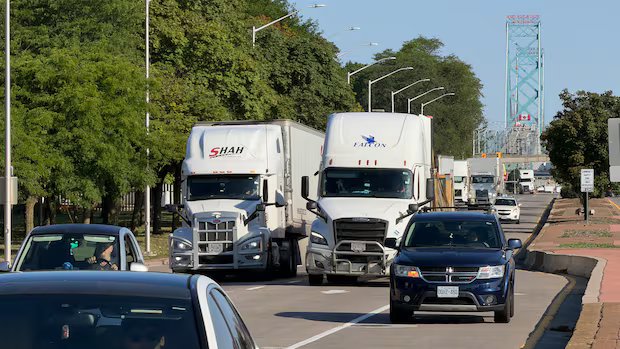
The Gordie Howe International Bridge officially opened to traffic on Monday, but trucks continue to crowd Huron Church Road leading to the competing Ambassador Bridge.
The opening of the bridge was highly anticipated by people in Windsor’s west end since the new six-lane crossing promises to expedite travel flow into Detroit, and especially alleviate the congestion on Huron Church.
CBC News talked with a dozen people in the corridor Thursday. None reported noticing a dramatic change in truck traffic volume.
“It will become much lighter once paperwork for trucks gets done and they start using the Gordie more,” Dave Simpson said. “It’s starting to dwindle.”

Simpson has worked at two stores on Huron Church Road for the past two years and said he is used to seeing long traffic jams. He said Wednesday was very busy with truck traffic, but Thursday was “slightly better.”
“I think it’s good for the citizens of Windsor because we won’t have to pay as much to fix roads here.”
Michael Fitzpatrick said the traffic congestion has been changing day to day since Monday, with heavy traffic on opening day, but some “thinning out” happening since.
“The traffic is a little lighter,” he said.
“I think it’s a lot better than it was. There were times when it was difficult to get across here.”
Ginger Dong, who regularly shops in the area, said there’s not much change yet, but it has slightly improved.
“It’s better than before, less trucks now.”
Roughly 7,500 vehicles crossed the Gordie Howe bridge in the first 12 hours it was open, according to the Windsor-Detroit Bridge Authority.
Traffic shifts will emerge over time
People in the industry say it will take time to get more trucks using the new bridge, in spite of its lower tolls.
Lak Shoan, director of policy for the Canadian Trucking Alliance, said the lingering uncertainty around the opening of the bridge meant many trucking companies were hesitant to immediately switch their routes from the 97-year-old Ambassador Bridge.
“I don’t think anyone expected the traffic to shift overnight by any means,” he told CBC Thursday.
“Now that the bridge is officially open, companies are beginning to set up their business accounts with the bridge. They’re updating their customs information, their dispatch systems, and making sure that their drivers are more familiar with the new crossing.”

Shoan explained that companies will still base their pick of which bridge to use on the best combination of reliability, travel time, cost and service for their customers.
As more fleets complete the onboarding process with the new bridge, Shoan said commercial traffic will take weeks and even months to transition.
“We are hearing some very positive accounts that members are getting ramped up to use the bridge, and that’s something that’s going to continue over the next few weeks and likely months to come.”
‘Not every truck is going to disappear from Huron Church Road’
Frazier Fathers, the city councillor for the area, said some trucks will continue to be seen there.
“Over the coming weeks, I’d expect truck traffic to start shifting again.… We’ll see a gradual transition through the summer and into the fall,” Fathers told CBC News Thursday.
“The Ambassador Bridge and Canadian Transit Company also own their own trucking companies as well, and there is some competition around tolls and things like that. So not every truck is going to disappear from Huron Church Road forever.”

Fathers said the city council might undertake formal studies to get a truck count to better understand the shifting patterns.
“There’ll be a fluid situation particularly for the next several months, as I know that operations are still scaling up on Gordie Howe too. I suspect we will see more traffic moving over there, but there’s always going to be some trucks here on Huron Church Road.”
“It’s going to take time. There’s going to be growing pains, as with any new infrastructure or any new process in the community.”