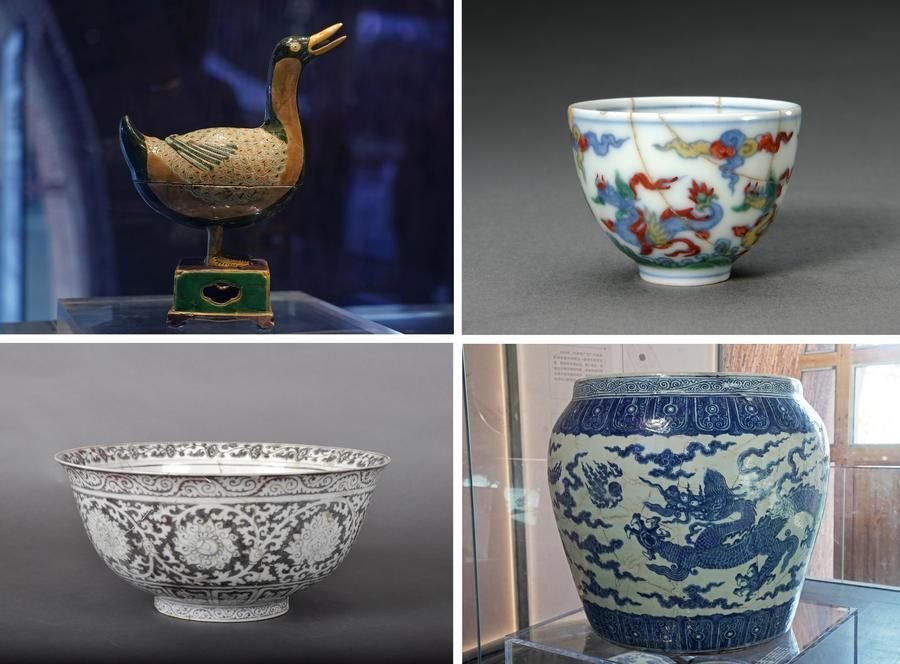
BEIJING: China’s ancient porcelain-making tradition has earned fresh international recognition after the Jingdezhen Handicraft Porcelain Industry Sites were inscribed on the Unesco World Heritage List, highlighting a craft that has shaped global cultural exchanges for more than 2,000 years.
The inscription, announced on Saturday, recognises Jingdezhen’s living porcelain-making tradition as one of the treasures of Chinese civilisation and reflects years of efforts to preserve and revitalise the centuries-old craft, an initiative consistently championed by Chinese President Xi Jinping.
Porcelain is widely regarded as one of the defining symbols of Chinese civilisation, and Xi has repeatedly stressed the importance of safeguarding the country’s cultural heritage while promoting the enduring value of its traditional culture.
During a visit to Jingdezhen in October 2023, Xi toured the Taoyangli Historical and Cultural Block, including the Nanlu Ruins, the Ceramic Museum and a kiln complex dating to the Ming and Qing dynasties.
He also met fourth-generation porcelain craftsman Sun Lixin and asked about his painting techniques.
When Sun replied that his work came “from the heart”, Xi praised the family’s dedication to the craft.
“Devoting one’s entire life to a single craft, with generations of a family committed to the same pursuit, is no simple undertaking,” Xi said.
“The fine traditional culture passed down by our ancestors is something we must continue to hold in our hands, adapt to the times, and carry forward,” he added.
Xi’s commitment to preserving China’s porcelain heritage dates back to his tenure in Zhejiang province in the early 2000s, when he promoted the protection and development of the country’s ceramic traditions.
During several visits to Longquan, renowned for its centuries-old celadon, Xi described Longquan celadon as a national cultural treasure and called for the establishment of a museum to preserve and showcase the heritage.
The museum opened in 2009, the same year Longquan celadon’s traditional firing techniques were added to Unesco’s Representative List of the Intangible Cultural Heritage of Humanity.
The preservation of Longquan became part of Xi’s broader emphasis on safeguarding China’s cultural heritage.
Over the years, heritage conservation has remained a recurring theme during Xi’s domestic inspection tours, with visits to landmarks including the Forbidden City, the Grand Canal, Jiayuguan Pass and the Yin Ruins.
His administration has also overseen the inclusion of more Chinese cultural sites on Unesco’s World Heritage List.
“Protecting, preserving and making good use of these invaluable treasures is our shared responsibility,” Xi has said.
“It is also essential to ensuring the continuity of human civilisation and advancing sustainable development around the world.”
Beyond its artistic significance, Chinese porcelain has long served as a bridge between civilisations.
Through the ancient Silk Road, porcelain vases, jars and bowls reached royal courts across Europe, where they became prized possessions among collectors.
Xi has frequently used porcelain as a cultural ambassador, presenting ceramic works as state gifts and showcasing historic masterpieces during major international events to highlight China’s artistic and cultural heritage.
Ahead of the Conference on Dialogue of Asian Civilisations in Beijing in May 2019, Xi introduced foreign leaders to a rare blue-and-white porcelain vase from the Yuan Dynasty, describing the artefact as “the panda of ceramics” because of its rarity.
Xi has also cited porcelain as an example of how exchanges between civilisations inspire innovation.
In a signed article published before his 2018 state visit to Portugal, he wrote that Chinese blue-and-white porcelain, first shipped there centuries ago, inspired a fusion of Chinese and Portuguese techniques that gave rise to the distinctive Azulejo art form.
Jad Tabet, a Franco-Lebanese architect and former representative to the Unesco World Heritage Committee, said Chinese ceramics had profoundly influenced artistic development in Europe and other parts of the world.
The enduring vitality of China’s ceramic traditions and the continued growth of its porcelain industry demonstrate how cultural exchange can promote shared development and mutual understanding.
As Xi said during a speech at Unesco headquarters, civilisations become richer and more vibrant through exchanges and mutual learning.
“Such exchanges and mutual learning form an important drive for human progress and global peace and development,” he said. — Xinhua