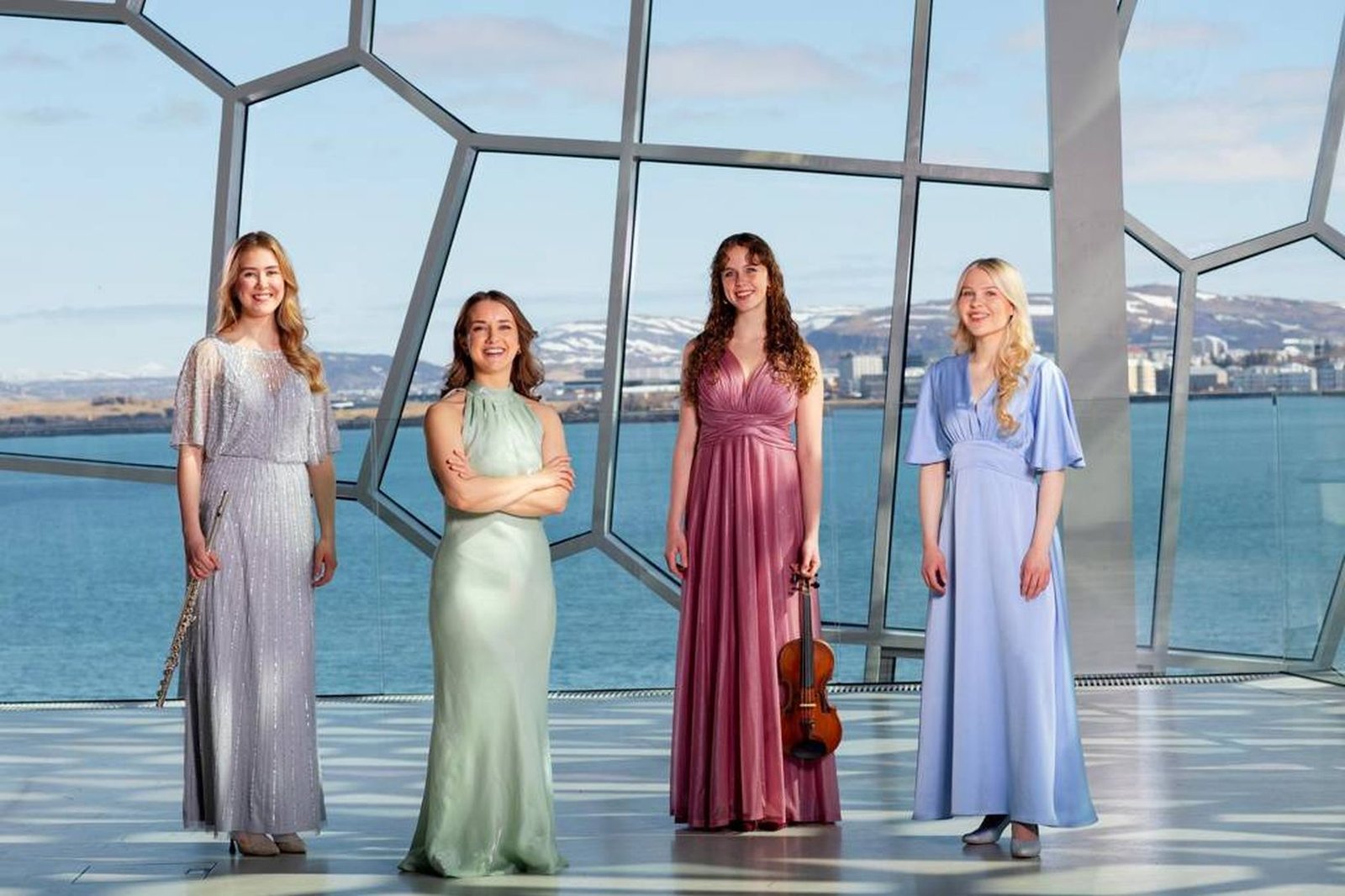
The concert features singer Halldóra Ósk Helgadóttir, who performs four arias; Lilja Hákonardóttir, flutist, performing the Flute Concerto by Jacques Ibert; violinist Matthildur Traustadóttir, who plays the Violin Concerto in A minor, Op. 82, by Alexander Glazunov, and pianist Mariann Rähni, playing George Gershwin’s Piano Concerto in F major.
The conductor is the Swiss Baldur Brönnimann. According to information from the ensemble, he is the principal conductor of the Royal Philharmonic Orchestra in Galicia and is known for his passionate interest in education and work with young artists.
“This is a big step. I’m studying in Leipzig, Germany, and I’ve been able to perform there with various orchestras and in opera houses, but there’s nothing like performing at home. As a child, you’ve looked up to the orchestra, and it’s good to be able to sing with your people in the hall,” says Halldóra Ósk Helgadóttir.
Waltz atmosphere and romance
Halldóra Ósk will perform the arias “Vorrei spiegarvi, oh dio” by Mozart, “Quando m’en vo” by Puccini, “Einer wird kommen” by Lehár and “Glitter and be Gay” by Bernstein.
“The arias by Mozart and Bernstein are actually performance pieces for soprano that are good to have in your suitcase. Then I chose the other two – they are incredibly beautiful arias, with a little waltz atmosphere in them and a little romantic. This is perhaps the best thing you have,” she answers when asked why she chose these works.
“Mozart is a big favourite. An incredibly beautiful lyrical aria and a challenging, but magical melody. So it’s really fun to play out ‘Glitter and be Gay’, there are so many playing opportunities in it mixed with coloratura.”
Halldóra Ósk says it’s a little different for a singer to choose a piece for a concert like this than for an instrumentalist.
“An instrumentalist can take a complete piece because they are composed that way. For singers, a package of arias is offered. Of course, you sing according to your own style – now I’m a lyrical coloratura soprano, and there are certain arias that I can offer and perform well. I had been wondering if you should have some common thread (in the aria package), but that’s just easier said than done,” says Halldóra Ósk, laughing.
“It’s a gathering of the best to show what’s in a man.”
It’s enough to stay with the soprano these days, but she plays the role of Birta in the opera Honorable scholar which is shown in Tjarnarbíó. After the shows, he continues his master’s studies at the University of Music and Theater in Leipzig.
“Then we just see what happens, just keep singing and trying.”
A legendary flute concerto
Lilja Hákonardóttir says it has been a long-awaited dream to perform Jacques Ibert’s Flute Concerto, but the concerto is dedicated to flutist Marcel Moyse, who many believe was the most influential flutist of the last century.
“The concerto is one of the greatest in the flute literature and has always been a favorite of mine and possibly most flutists. The concerto is so colorful and a great masterpiece, so I thought it would be a good idea to use this competition to learn it. This concerto is very colorful and makes great demands on the flutist in terms of technique and nuance. It paints a very French atmosphere that is very characteristic of French flute music in the first half of the twenties century,” says Lilja, adding that French flute music is very popular.
This is not the first time that Lilja has played with SÍ, but it hasn’t lessened the tension at all.
“I got to play with them for the first time when I was 15, at their Christmas concert. I liked it so much that I knew I wanted to do it again. So this competition and this concert are so fun and it’s nice that young people have the opportunity to perform with Sinfó.”
The young flutist lives in London and is in the third year out of four of his bachelor’s degree at the Royal Academy of Music.
“As soon as I get back to London, I will be leading the flute section of the Royal College of Music Philharmonic Orchestra, where we will be playing Hindemith’s Symphonic Metamorphosis. In that piece, I will be playing one of the greatest flute solos in flute literature. Then I will be giving my third solo concert at the beginning of June and I am really looking forward to it. Otherwise, I am just excited that the future is uncertain. I may continue with more studies, master’s studies, so we’ll just see what happens because,” says Lilja.
Everything is being done to welcome these young musicians, according to Hjördís Ástráðsdóttir, SÍ’s director of education, who adds that everyone thinks it is extremely fun to take part in the making of these concerts. However, this is a challenging task for everyone, because the practice time available with an orchestra is limited and every minute counts.
“It’s so fun to follow these young people the last meters before the concert becomes a reality,” says Hjördís.