Nuclear testing took place on a massive scale during the Cold War (1947–1991). This was the result of tensions between the United States (the Western Bloc) and the Soviet Union (the Eastern Bloc), which were competing to develop nuclear weapons as part of their deterrence strategies. As part of the competition in weapons technology development, nuclear tests were conducted by countries such as the United States, the Soviet Union, the United Kingdom, and France in the regions of Asia, Africa, Latin America, and the Pacific.
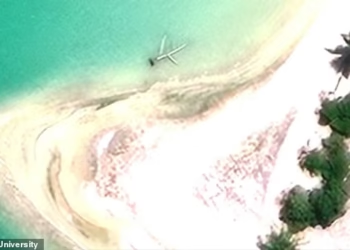
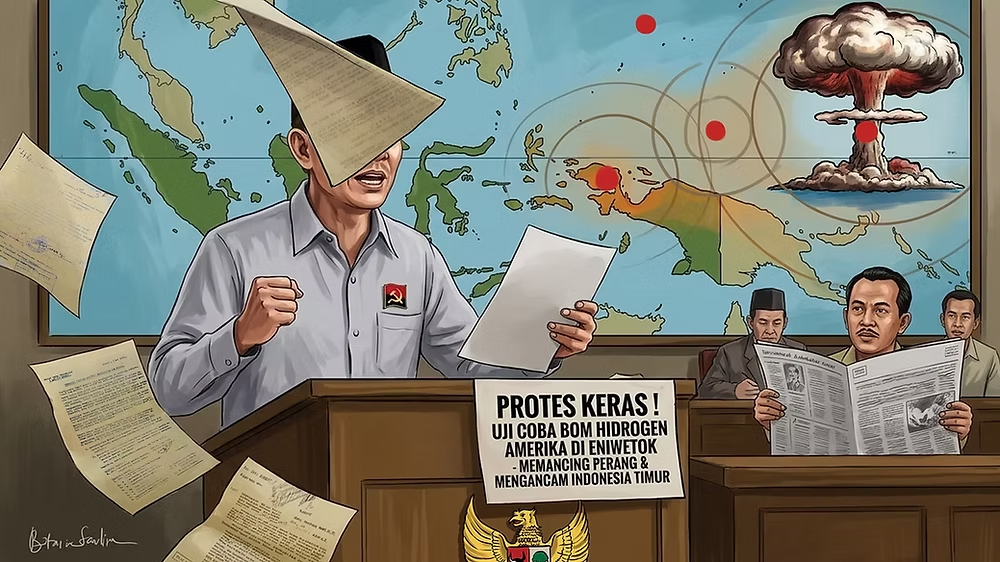
From the late 1940s through the 1950s, these two superpowers—followed by the United Kingdom and France—chose the Pacific region as a testing site because it was considered “remote.” The United States, for example, used the Marshall Islands, specifically Bikini Atoll and Eniwetok Atoll, as testing sites. As a result, between 1946 and 1958, Eniwetok Atoll alone experienced 43 nuclear explosions. Meanwhile, the United Kingdom tested its nuclear weapons in Australia and the Pacific. France, on the other hand, conducted tests in the Sahara and the South Pacific.
These regions were turned into “nuclear laboratories” without regard for the safety of local residents. In fact, the impact of the explosions wasn’t limited to the test sites alone. Radioactive exposure and the accumulation of hazardous waste posed a threat to much wider areas. The tests at Eniwetok, for example, could affect the environment of Halmahera Island, located approximately 3,800 km to its southwest.