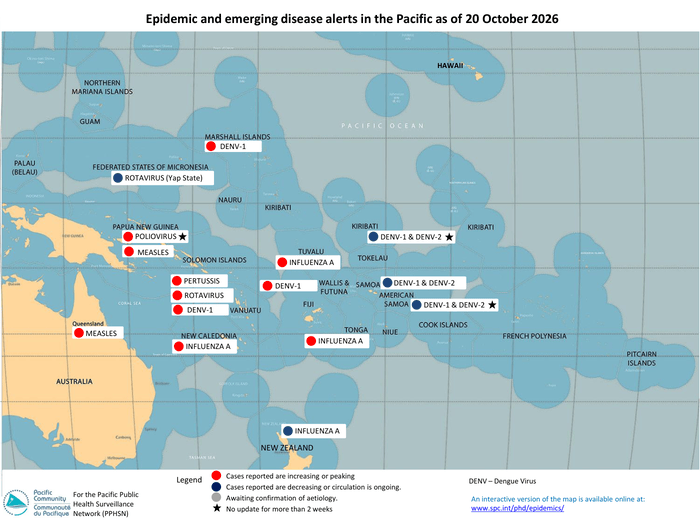
Highlights/updates since the last map was sent on PacNet on 13 October 2026:
Dengue
• Marshall Islands: The 15th Outbreak Situation Reports on dengue in Majuro and Ebeye covering 15 August to 15 October, record 501 specimens tested (Majuro 411, Ebeye 90) and 156 positive cases, confirmed and probable (Majuro 124, Ebeye 32). This is an increase of 21 cases from the 137 cases reported on 05 October (12th Outbreak Situation Reports). The positivity has fallen to 30% in Majuro and 36% in Ebeye. No deaths have been reported. Cumulative hospitalisations rose to thirteen. The attack rate is 5.4 per 1,000 in Majuro and 3.3 per 1,000 in Ebeye. Only DENV-1 has been detected. Vector control has been completed at the households of positive cases, 26 schools and 60 churches have been sprayed, and surveillance is being strengthened on the neighbouring islands. On 08 October 2026, the Cabinet declared a state of disaster for El Niño and the dengue outbreak. The red alert for dengue (DENV-1) remains in effect. – Source: Republic of the Marshall Islands Ministry of Health and Human Services, Outbreak of Dengue Fever Cases in Majuro & Ebeye, 13th, 14th and 15th Outbreak Situation Reports shared with the PPHSN Coordinating Body Focal point on 19 October 2026.
• Samoa: Dengue Fever Outbreak Situation Report Issue No. 77, covering EpiWeek 40 (28 September to 04 October 2026), reports 64 new cases, up 73% on the previous week, with one laboratory-confirmed case and three new admissions. No new intensive care admission and no death were reported. Since 01 January 2025, 20,374 clinically diagnosed cases, 5,547 laboratory-confirmed cases and nine dengue-related deaths have been recorded. DENV-1 accounts for 52% and DENV-2 for 48% of serotyped cases, and children under 15 years for 73% of cases. The blue alert for dengue (DENV-1 & DENV-2) remains in effect. – Source: Ministry of Health Samoa, Dengue Fever Outbreak Situation Report Issue No. 77 shared with the PPHSN Coordinating Body Focal point on 16 October 2026.
• Vanuatu: On 15 October 2026, the Ministry of Health declared a dengue outbreak on Malekula Island, Malampa Province, after four dengue cases were reported between 02 and 12 October in the Central North East and North Malekula Area Councils, with evidence of local transmission. Malekula is the fourth island with a declared outbreak, after Efate, Santo and Tanna. The same day, Malampa Provincial Health reported 22 dengue cases on Malekula, including six laboratory-confirmed, in North East and Central Malekula, with no deaths and no hospitalisations. Surveillance, case investigation, mosquito control and community awareness are being strengthened, and free dengue testing is offered at Norsup Hospital. The red alert for dengue (DENV-1) remains in effect for Vanuatu. – Sources: Vanuatu Ministry of Health, Dengue outbreak declared on Malekula Island, accessed on 20 October 2026 and Malampa Provincial Health, Dengue fever i stap long Malampa, accessed on 20 October 2026.
Measles
• Papua New Guinea: The National Department of Health weekly bulletin for EpiWeek 41 (05 to 11 October 2026) has changed the measles case count: cases are now counted as confirmed by the Expert Review Group instead of laboratory IgM-positive results. On this basis, three confirmed measles cases have been reported in 2026 (East Sepik 2, New Ireland 1), against 17 laboratory-confirmed cases reported up to EpiWeek 40. The last onset date remains 15 September 2026. The measles-rubella vaccination campaign continues to target all children under seven in every district with a detected measles or rubella case. The red alert for measles remains in effect for Papua New Guinea. – Source: Papua New Guinea National Department of Health, Public Health Events Weekly Bulletin, EpiWeek 41, shared with the PPHSN Coordinating Body Focal point on 15 October 2026.
Respiratory diseases
• New Caledonia: The Department of Health and Social Affairs (DASS) influenza bulletin 2026-#10 of 16 October 2026 reports that the epidemic continues, with circulation still intense but levelling off: 130 laboratory-confirmed cases in EpiWeek 41 (05 to 11 October), against 151 in week 40. It is the first decrease since the start of the epidemic, and test positivity fell from 65% to 55%. A(H1N1)pdm09 remains largely predominant (98 of 130, the other 32 influenza A not subtyped). Hospital impact remains significant, with 67 patients hospitalised in EpiWeek 41 (median age 68 years), and intensive care bed occupancy has exceeded 80% on 8 of the last 14 days. Emergency department activity has stabilised at a high level (1,832 presentations in EpiWeek 41, against an average of 1,300), and acute respiratory infections accounted for 13% of presentations, mainly influenza. The red alert for influenza A remains in effect for New Caledonia. – Source: Direction des Affaires Sanitaires et Sociales de Nouvelle-Calédonie, Vigilance DASS bulletin 2026-#10, influenza epidemic shared with the PPHSN Coordinating Body Focal point on 16 October 2026.
• New Zealand: For the week ending 11 October 2026, the all-cause SARI hospitalisation rate in the Auckland region decreased again and remains in the low activity band. Influenza remained the most commonly detected virus among SARI patients, and SARI influenza test positivity rose from 18.6 to 25.9%, while positivity among sentinel GP influenza-like illness cases fell slightly from 17.6 to 15.8%. Pacific peoples have had the highest cumulative rates of influenza-, RSV- and SARS-CoV-2-positive SARI hospitalisation in 2026. The blue alert for influenza A remains in effect for New Zealand. – Source: PHF Science, New Zealand Acute Respiratory Illness dashboard, accessed on 20 October 2026.
• Tonga: The weekly syndromic surveillance report for EpiWeek 41 (05 to 11 October 2026) records 137 influenza-like illness cases, against 99 in week 40, the seventh consecutive weekly increase and the highest weekly count of 2026, and severe acute respiratory infections rose from 14 to 20, above the alert threshold. Between 03 August and 11 October, 156 of 336 tested ILI cases (46.4%) were positive for influenza A, against 89 a week earlier, and 67 SARI patients were hospitalised. The number of deaths among SARI cases is unchanged at three, two of them laboratory-confirmed influenza A. A red alert for influenza A is issued for Tonga. – Source: Tonga Ministry of Health, Weekly Communicable Diseases Syndromic Surveillance, EpiWeek 41 shared with the PPHSN Coordinating Body Focal point on 20 October 2026.
Rotavirus
• Federated States of Micronesia: The Yap weekly bulletin for EpiWeek 41 (05 to 11 October 2026) shows diarrhoea on alert for an eighth consecutive week, although cases decreased to 9 from 16 in EpiWeek 40, still above the alert threshold of 7. Of four patients tested with a gastrointestinal multiplex PCR panel, three were positive: one adenovirus and EPEC co-infection, one EAEC and one rotavirus A. Among 100 diarrhoea cases in children aged 0 to 5 years this season, 34 had completed rotavirus vaccination. A public health advisory on diarrhoeal illness remains in place. The blue alert for rotavirus remains in effect for the Federated States of Micronesia (Yap State). – Source: Yap State Department of Health Services, Communicable Disease Weekly Bulletin, EpiWeek 41 shared with the PPHSN Coordinating Body Focal point on 14 October 2026.
Other Information:
Chikungunya
• New Zealand: In surveillance week 41 (10 to 16 October 2026), one confirmed chikungunya case was notified in New Zealand in a person who had been to the Cook Islands during the incubation period. Year to date, four confirmed chikungunya cases (Cook Islands 1, Indonesia 2, Sri Lanka 1) and two probable cases have been notified, all with overseas exposure. – Source: PHF Science, NZ Arbovirus Notifications by Country, week 41 shared with the PPHSN Coordinating Body Focal point on 19 October 2026.
Dengue
• Hawai’i: On 13 October 2026, the Hawaiʻi Department of Health reported a new travel-related dengue case on Oʻahu, in a person exposed while travelling in a region where dengue is common. It is the ninth dengue case reported in Hawaiʻi in 2026. No link to previous cases has been found, mosquito inspection and control were carried out around the affected area, and the risk of local transmission is considered low. – Source: Hawaiʻi Department of Health, DOH reports another travel-related dengue virus case, accessed on 20 October 2026.
One Health – High pathogenicity avian influenza
• Australia: The national H5 bird flu dashboard recorded 713 confirmed events in wildlife as of 16 October 2026, against 700 on 09 October: South Australia 331, Victoria 245, New South Wales 71, Tasmania 53, Western Australia 10, Queensland 2 and Jervis Bay Territory 1. H5 has not been reported from any Pacific Island country or territory to date. – Sources: Australian Government Department of Agriculture, Fisheries and Forestry, H5 bird flu latest data accessed on 20 October 2026.
Respiratory diseases
• French Polynesia: The health surveillance bulletin no. 37, covering data to EpiWeek 41 (05 to 11 October 2026), reports 10 influenza A cases in EpiWeek 41, against four in EpiWeek 40, three subtyped A(H1N1)pdm09 and three A(H3N2). Five patients were hospitalised, one of them in intensive care. Influenza waves in French Polynesia usually follow the Northern Hemisphere, between October and April. The 2025-2026 wave caused 200 hospitalisations, 23 intensive care admissions and 13 deaths. The influenza vaccination campaign will start on 26 October 2026. – Source: Agence de régulation de l’action sanitaire et sociale (ARASS), Bulletin de Surveillance Sanitaire de Polynésie française n°37 shared with the PPHSN Coordinating Body Focal point on 20 October 2026.