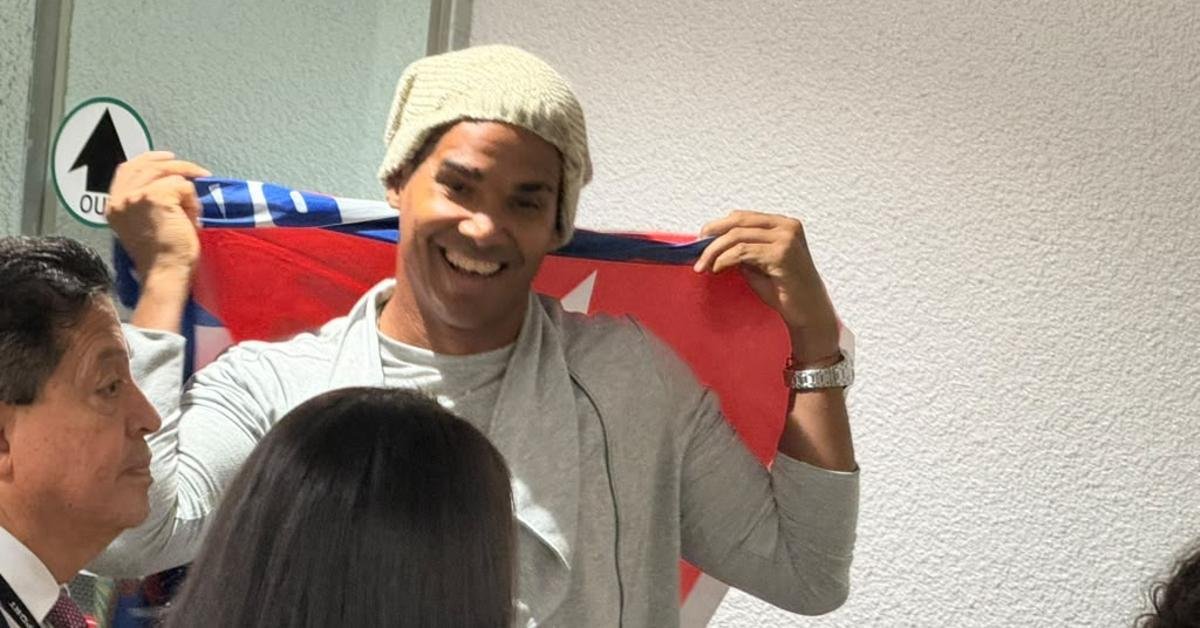
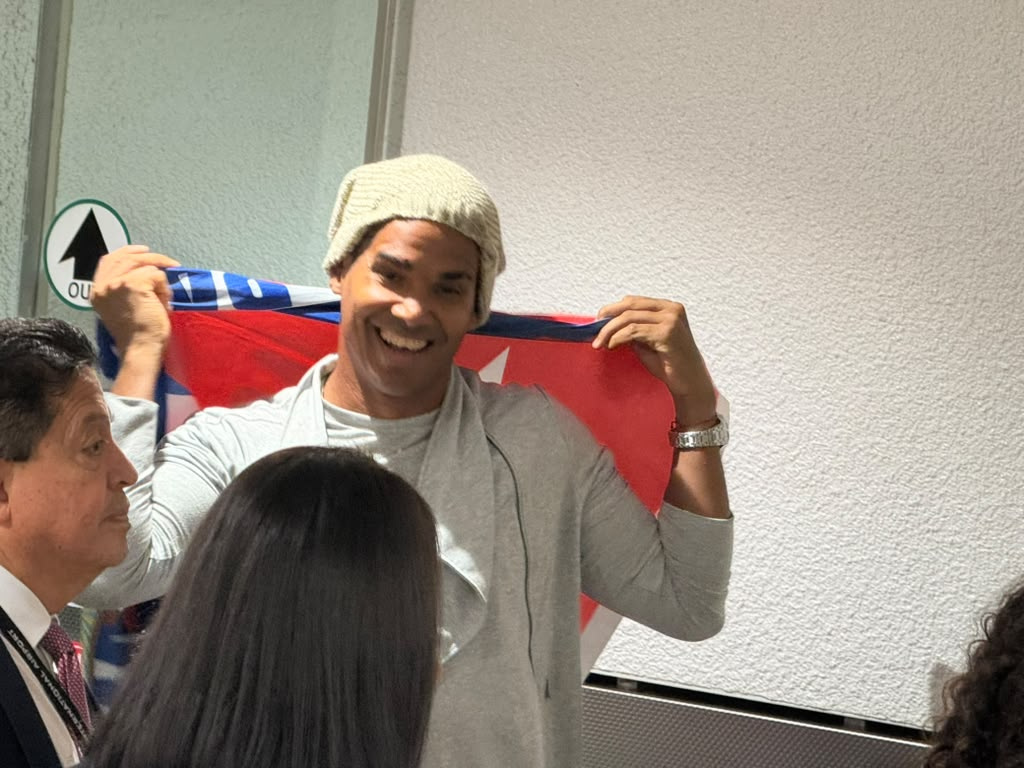
Havana/The artist and leader of the San Isidro Movement (MSI) Luis Manuel Otero Alcántara, whose whereabouts had been unknown to State Security for 11 days, arrived in Miami this Saturday, one day after the United States approve a special permit (parole) on a trip. A crowd of friends and supporters waited for him at the airport and welcomed him by singing the Cuban national anthem.
In his first statements to the press, the artist recalled that “right now Maykel Osorbo is in prison” and asked the exile in Miami, the Cubans who are elsewhere, “Donald Trump”, “to all those who can help us, please contribute to making Cuba free”, concluding: “that one minute of work is one less minute of dictatorship.”
After learning that the political prisoner had boarded a flight from Havana, the artist’s relatives recalled through networks in your name that during this time in the Guanajay maximum security prison “he survived in an environment that deprived him of his freedom for political reasons, prevented him from fully developing his work and distanced him from the people he loves.” The regime’s repression did not dampen Otero Alcántara’s desire to fight: “Today he arrives with the deep desire to live again, resume his creative projects and continue working for the freedom of Cuba.”
They also announced that, upon his arrival in Miami, the artist will visit the Hermitage of Charity “to leave an offering of thanksgiving.” Otero Alcántara, they specified, “brings with him from Cuba a broken Virgin. As are many of us. As is Cuba. It is a gesture that invites us to reunite the fragments, to recompose what has been broken and to believe that it is still possible to heal and recover a kidnapped country.”
The official Cuban press It didn’t take long to release the news of the artist’s departure and in a text, in which he defines him as “the mercenary that Washington comes to look for”, he assures that Otero Alcántara has “a criminal record, not a history of conscience”, in addition to clarifying that “he is not a political opponent nor a defender of human rights. He is a common criminal, convicted by the Cuban justice system after committing crimes classified in our laws: contempt, public disorders and outrage to the symbols of the Homeland.”
Otero Alcántara was taken by the political police to the José Martí International Airport in Havana in an escort similar to the one they provided to the opponents. Jose Daniel Ferrer oa Luis Robles“the young man with the banner”, both also released in exchange for accepting exile. In the case of the MSI leader, arrested on July 11, 2021 – before he could participate in the massive demonstrations that day – and sentenced to five years for the crimes of insult to national symbols, contempt and public disorder, he served his sentence on July 9. However, by then, his loved ones did not know where he was.
Two days before, they reported that the artist had been taken from the Guanajay maximum security prisonin the province of Artemisa, with no known destination. On July 9 herself, she contacted her friend Anamely Ramosart historian in exile and also a member of the MSI. According to what the activist herself published on her networks, Otero Alcántara called her “from a State Security cell phone, unknown number, and the call was on speakerphone.”
When asked how he was doing, the artist responded “good,” said Ramos, “with that tone that we use to indicate that we are as good as possible, given the circumstances.” He could not answer the second question that was asked: “where are you.”
The activist then explained that the parole requested for Alcántara to travel to the United States “was still in process” and that the artist would be “in that unknown place until it is resolved.” According to a US official who spoke with 14ymedio under anonymity, with the confinement of Otero Alcántara after serving his sentence, the Havana regime intended to “put the ball in Washington’s court and make it believe that the artist was still detained due to the delay of the Trump Administration.”
His case, along with that of rapper Maykel Castillo Osorbobecame one of the emblems of the repression after 9/11.
Years ago, both expressed their willingness to accept “prison for exile,” but at no time were they part of the releases carried out by the regime.
Specifically, Castillo, three days after the release of Otero Alcántara, was transferred to the Guanajay prison from Kilo 8, in Pinar del Ríowhere he was serving his sentence, in his case nine years.
Despite being detained at different times, and not on April 4, 2021, the date of the events for which the regime accused them – Osorbo, on May 18 of that same year – both Cuban artists share the same tax file, which is another example of the arbitrariness of revolutionary Justice.
Declared prisoners of conscience by various international organizations, in these years in prison both have been recipients of various recognitions for their fight for human rights in Cuba. The most recent, the 2026 Democracy Award awarded by the National Endowment for Democracy (NED), last june.
Likewise, they have carried out various hunger strikes, at different periods, and have denounced the prison conditions in which they found themselves. It’s been years now, both expressed their will to accept the “prison for exile” exchange, but at no time were they part of the releases carried out by the Cuban regime thanks to agreements with the Vatican, a in January 2025days before Joe Biden’s presidency ended, and another last March.