Depending on one’s level of degradation — of moral vacuousness, of hypocrisy, or all of the above — “culture” can be bent to suit one’s needs.
In some cultures, if you tief a piece of nookie on the side, a body can be awarded death by stoning. That is how it is done in certain countries. Perhaps so — but it’s a little stiff for our taste. We need something more user-friendly. In SVG, tiefing nookie is a recreational sport; and it gets you bragging rights, too. It becomes a badge. Friends high-five you and offer, “Respek Bro.” Respect? Crikey.
The brethren even give the fornicatrix cute little endearing names like “smallie.” (‘Bro, watch over there, that there is my smallie.’) It is a chauvinist courtesy, and if I were so inclined, I could nearly convince myself of that argument. The cute names, though, are endearing only to the sexist blowhard and his like-minded claque, ever ready with their obsequious support.
I recently read an article in The New Yorker, by Elizabeth Kolbert, “What Happens When a Whale Is Born” (March 26, 2026). It is, at once, a quiet, beautiful article — and deeply depressing. (I am quoting from it.)
Quiet and Beautiful. The story begins in 2023 when a team of researchers took off from Dominica in search of sperm whales. On that particular morning, they were looking to tag a whale to record its movements and clicks — the way they communicate.

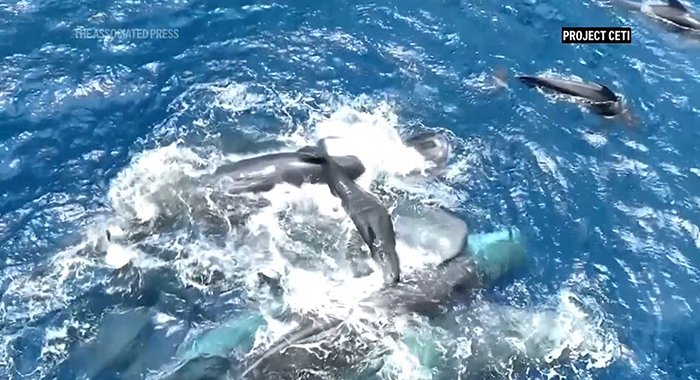
After a few hours, they came upon 11 sperm whales, bunched together at the surface, behaving oddly. They decided to investigate and launched camera-equipped drones. After a short while, a twelfth head appeared. The researchers had witnessed a sperm-whale birth — and managed to record the entire event. They were rapturous.
The team spent two years analysing the drone footage and have just released two papers on it. They noted that “sperm whales are highly mobile and the ones that frequent the waters off Dominica return often enough that scientists have been able to determine which whales hang out together.
“From the drone footage, which captured the moment the baby whale’s fluke first emerged, the researchers were able to determine that a whale named Rounder was the mother. Rounder is a member of a social group called Unit A, which consists of two families that are not closely related. Rounder’s family includes her mother and her half-sister. The other includes an older whale named Fruit Salad, along with Fruit Salad’s daughter and granddaughter.
“When sperm whale calves are born, they are pretty helpless. They can’t immediately swim, and left to their own devices, they will sink. What the footage showed is that, for the first three hours of the newborn’s life, the members of Unit A took turns keeping it afloat. At times, they nestled so close to the baby that they formed a sort of raft beneath it.
“All the members of Unit A participated in the effort to prevent the baby from drowning, but a few — including the calf’s mother and her half-sister, Aurora — took leading roles. More surprisingly, the core group also included a member of the second family, Fruit Salad’s granddaughter, Ariel.
“Another finding that surprised (and touched) the researchers was that Rounder’s 15-year-old half-brother, Allan, showed up for the birth.”
Deeply depressing. Let me return to my telling of our divergent cultural attitudes to nookie-tiefing. Had that dignified incident occurred not in Dominica but in St. Vincent and the Grenadines, our philistines would still be eating whale meat from Rounder and her baby.
Let me tell you how it works here in Blessed St. Vincent and the Grenadines. But first, I know we primarily target humpback whales, but we are not that fussy as to turn down a sperm and her calf. Rounder and her baby, especially the baby, would have been easy pickings for the killer of whales.
Crews, no, butchers, go out in small boats and pitch a godforsaken iron spear in the poor whale’s backside. The spear is attached to floats and after a lengthy period of excruciating pain the mammal becomes too exhausted to carry on. At that point, the lances are trotted out and used to gouge deep into the vital organs. They aim for the heart and lungs, accent on aim. The researchers did not so much choose which country to work in – Dominica — but which not to.
It must be a blood-curdling sight. It would make me vomit and give me nightmares for the rest of my life, the little that’s left of it. The whale eventually, accent on eventually, dies from stress, pain, blood loss, and catastrophic organ damage. The kill is then towed ashore to a party-like atmosphere. It is national news.
We retreat into glib refuge of “tradition” and “culture” as though these words possess moral insulation. They do not. The reality is this: a whale is found, hunted, harpooned, slowly tortured to a horrible death. Not instantly. Not cleanly. Long and slow — and agonising. It may have been a tradition once upon a time, now it is shameful and uncivilised.
We do not have the right to do something because we have always done it. We have moved on from slavery; we can move on from slaughtering whales, too. Always is never always.
To rise above ourselves, all we need to do is engage our conscience and draw a line.
Good luck with that.
Patrick Ferrari
The opinions presented in this content belong to the author and may not necessarily reflect the perspectives or editorial stance of iWitness News. Opinion pieces can be submitted to [email protected].