
COURTESY PROF. FRANK HADLEY COLLINS, DIR., CNTR. FOR GLOBAL HEALTH AND INFECTIOUS DISEASES, UNIV. OF NOTRE DAME
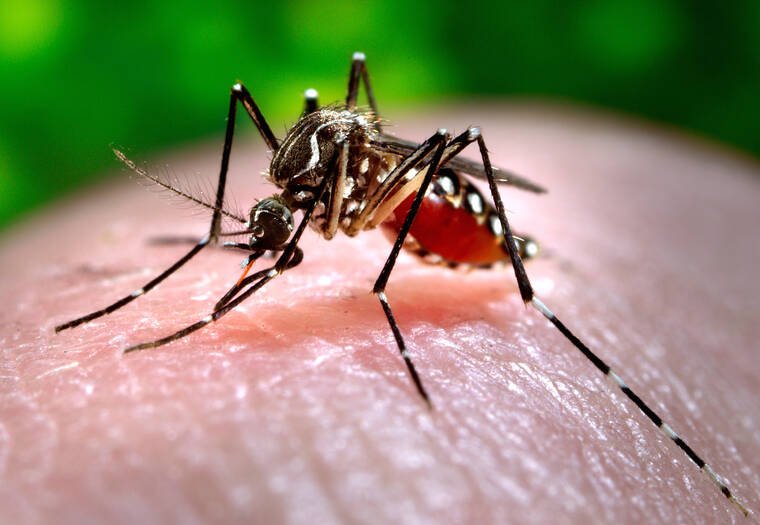
A female Aedes aegypti mosquito acquires a blood meal from her human host at the Centers for Disease Control. The Hawaii Department of Health has confirmed a new travel-related case of dengue on Oahu.
The Hawaii Department of Health has confirmed a new travel-related case of dengue on Oahu.
The latest case comes about three months after the fifth case was reported, bringing the total in the state to six so far this year. A dengue case was confirmed in a visitor last month, but was not included in the state’s official count.
To date, there have been four cases on Oahu, one on Maui, and one on Kauai.
The affected individual was exposed to the virus while traveling in a region where dengue is common, health officials said. As part of routine, teams have implemented mosquito control measures in the affected area, which DOH did not disclose.
“Due to specifics of this case, the expected risk of transmission is low,” said DOH in a news release. “However, this case is a good reminder for the public to reduce standing water as much as possible to help prevent an increase in mosquitoes, to reduce the risk of local transmission of vector-borne diseases.”
Dengue — a viral illness spread through mosquito bites — is a year-round risk in many parts of the world, including the tropical and subtropical areas of Central and South America; Asia; the Middle East; Africa; Puerto Rico; American Samoa, Micronesia, the Marshall Islands and Palau.
Don’t miss out on what’s happening!
Stay in touch with breaking news, as it happens, conveniently in your email inbox. It’s FREE!
While Hawaii is home to Aedes mosquitoes, which can carry dengue, the disease is not endemic in the state.
Mosquitoes, however, only need small amounts of standing water to breed. Some common breeding sites include buckets, planters, water-catching plants such as bromeliads, planters, rain barrels and even cups left outside.
DOH advises people to pour out containers to prevent mosquitoes from laying eggs.
If symptoms of dengue — such as fever, nausea, vomiting, rash and body aches — develop within two weeks of return from dengue-affected areas, residents should seek medical evaluation.
Anyone who suspects a dengue infection should call the Disease Reporting Line at 808-586-4586.