The 250th anniversary of the United States’ Declaration of Independence was celebrated on Saturday (July 4, 2026). It seems a good occasion to reflect on how that country influenced a distant Madras. The list of interactions is long and therefore, I chose to focus on just two significant episodes, both of which had to do with war and had unwittingly set off waves of prosperity in our city.
Back in 1861, the U.S. was at war, just like it is now. Only it was then at war with itself. The American Civil War, waged between the Unionists of the northern states and the Confederates of the south, had just begun, and had an immediate outcome – the cessation of cotton exports from America to Britain. With the mills in Lancashire soon likely to run out of the one commodity that they needed to keep running, attention turned to the colonies. India, it was suddenly discovered, could begin supplying cotton. Bombay was the immediate beneficiary, with exports from that port surging and creating many fortunes overnight.
Madras was a distant second. To be fair, studies had begun even in the 1840s on improving the quality and quantity of cotton being cultivated in four districts – Kadapa, Bellary, Tirunelveli, and Coimbatore. In fact, such was the fear that Bombay brokers, owing to proximity, would lure cultivators in the first two districts to sell to them, that the Godavari-Krishna canal network was sped up in the 1850s so that exports of cotton could take place from Madras. That the man who implemented the scheme was Sir Arthur Cotton is an amusing coincidence.
Burst of prosperity
Sadly, for Madras, however, it was universally agreed that American-quality cotton could not be cultivated here. Nevertheless, the Presidency benefited from the war. Prices of cotton soared from three annas a pound to 12 and shipments rose from 220,000 cwts to 692,000 in 1861. Thoothukudi (then Tuticorin), being close to Tirunelveli, grew and even now has a Great Cotton Road there that commemorates that burst of prosperity. In Madras, firms such as Binny and Parry made large profits, the latter to such an extent that an entire floor was added to its then headquarters which was at the same location as present-day Dare House.

There is, however, something about the air of Madras. It promotes conservatism. Unlike the cotton traders of Bombay, there was always a feeling here that the Civil War could not last. The leader of this group was William Hamilton Crake, Chairman of Parry, who was also Chairman of the Madras Chamber of Commerce. He was to repeat the sentiment in 1862 and 1863 and then two years later, had the satisfaction of saying, “I told you so.”
When the Civil War ended in 1865, Bombay went into depression. Of the 47 exchange banks that had been established there, only seven survived. Madras, on the other hand, chugged along. There was, however, the question of what could be done with the surplus cotton being produced. Mills had already come up in Bombay and Bengal. Even tiny Pondicherry had one. And so, it was decided that Madras, too, would have mills.

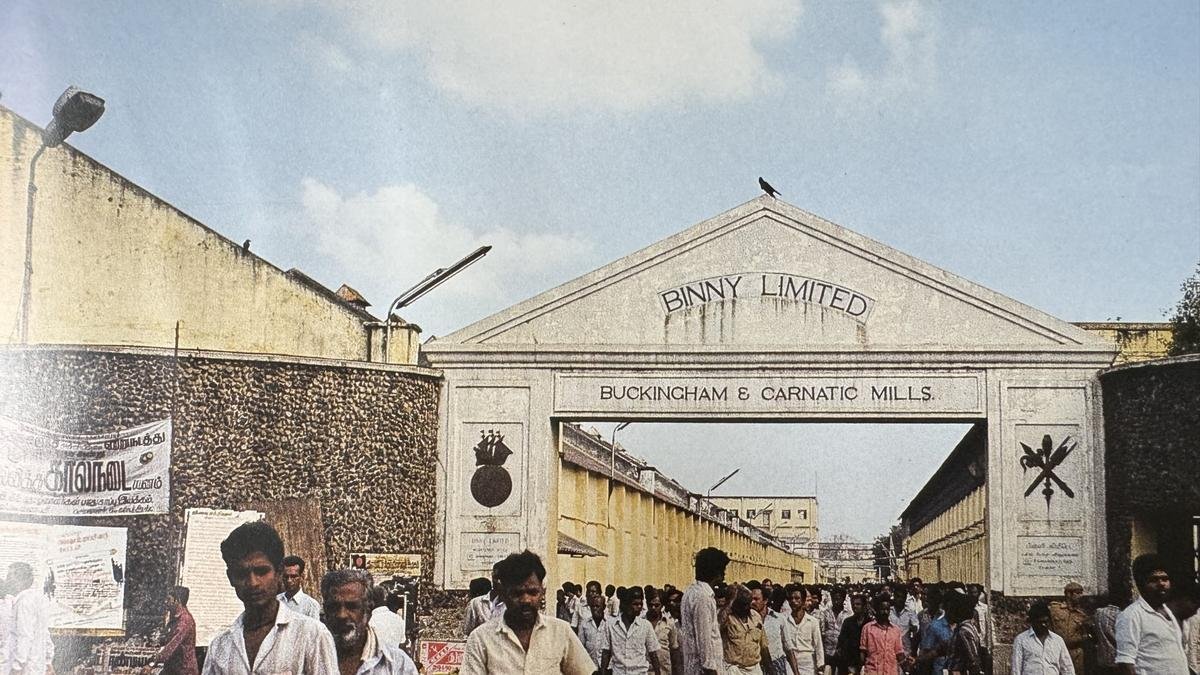
This initiative received a boost when Lord Napier and Ettrick became Governor of Madras in 1866. “India is not the preserve of Manchester,” he wrote, “and the government and people of England would repudiate a calculated neglect of the industrial capacities of the country.” A French expert was called in as consultant, and he identified Ambasamudram near Tirunelveli as a suitable location. While discussions were ongoing there, the A&F Harvey Mill there becoming reality only in the 1880s, Binny stole a march in Madras city itself. Putting aside its trading hat, it invested in a mill just outside the city. The Buckingham Mill Company Ltd. was formed in 1876, taking its name from the then Governor, the Duke of Buckingham and Chandos. A few years later came the Carnatic Mills, on the other side of Otteri Nullah and between them, the two went on to define the industrial landscape of Madras. In the 1920s, when the population of the city was 4.5 lakh or so, Binny employed 10,000 people. That should give us an idea of its influence on Madras.
The next wave of American impact was during WW II. With practically every port on the eastern front either bombed or invaded, Madras was the sole survivor. The American troops made it their base. The city got its first taste of cabarets (organised by Mary Clubwallah Jadhav for the soldiers), a thriving air base at Tambaram, and of several Hollywood films that were screened for the troops’ entertainment. The harbour went through a boom and given the prosperity that a distant war brought, the population doubled. It is safe to say we never looked back after that.
(Sriram V. is a writer and historian.)
Published – July 08, 2026 06:30 am IST