Prime minister Anthony Albanese has labelled a ballistic missile test carried out by China destabilising and provocative, while the prime minister of the Solomon Islands has said it was “not the act of a friend”.
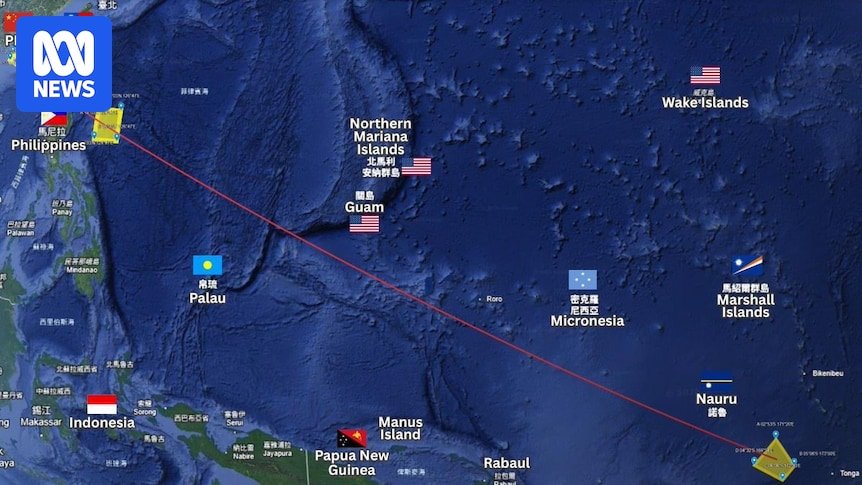
The nuclear-capable missile that China test-fired from a submarine yesterday flew over multiple Pacific nations and appears to have hit waters close to Tuvalu’s Exclusive Economic Zone (EEZ).
China had called the launch “routine”, but both Australia and New Zealand sharply criticised the missile test.
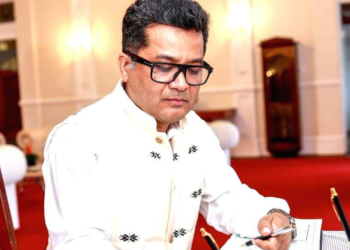
Speaking in Honiara alongside the prime minister of the Solomon Islands, Matthew Wale, Mr Albanese said Australia has raised the test with China directly.
“We have made clear our concerns to China in both Beijing and Canberra, and I am making clear our concerns here as well in Honiara,” he said.
“We don’t want to see any action that is destabilising, or which undermines the peace, security and stability of the Pacific and the region.
“And there is no doubt that this is a provocative act which does destabilise the region.”
The Australian prime minister also noted that ordinarily a test like this would come with 48 hours’ notice, which he said was not provided by China.
Matthew Wale directly criticised the missile test, becoming the first Pacific leader to do so and acting as the current chair of the Pacific Islands Forum.
“China is a good friend of the Solomon Islands, but this is not something a friend does. This is not good in our region,” he said.
“And as chair of the Pacific Islands Forum I have registered my strong protest yesterday with the ambassador. Solomon Islands also lodged a protest note.
“We don’t want to see any more countries — China, America, anybody — testing [intercontinental ballistic missiles][ in the Pacific Islands region, that’s the bottom line.
“Be our friend, but don’t threaten us.”
Missile shows ‘significant’ range capability of China
Overnight, the head of Taiwan’s national security council, Joseph Wu, posted an image on social media showing the missile arcing across Micronesia and Melanesia, before plunging into the ocean roughly 1,000 kilometres north-east of Solomon Islands.
Mr Wu, who has long been a vocal critic of China, called the test “a provocation that destabilises the Indo-Pacific”.
“China just proved itself again to be a bully on the block,”
he said.
The ABC has been told the missile, which was armed with a dummy warhead, flew over the EEZs of at least three Pacific island states, including the Federated States of Micronesia, Nauru and Kiribati.
It landed closest to the EEZs of the Pacific nations of Tuvalu and Kiribati, about 1,000km north-east of Solomon Islands, and seems to have hit the water near the border of Tuvalu’s EEZ, or potentially even just inside it.
The trajectory of a test-fired Chinese ballistic missile in the Pacific, according to the Taiwanese government. Taken 7/7/2026. Supplied: Joseph Wu/Government of Taiwan/X (Supplied: Joseph Wu/Government of Taiwan/X)
Defence Minister Richard Marles would not be drawn on the missile’s trajectory, saying it “wasn’t particularly close to Australia” but that he would not “go into the detail”.
“I think it’s less about the precise point as it is about the capability here,”
he said.
“This is a very significant capability in terms of the range that’s been demonstrated and the means by which it’s been launched from a submarine.”
He also called the launch “very concerning and deeply destabilising”.
“This is a long-range missile which China itself has said would be nuclear-capable, which has been launched from a submarine, which also implies something in terms of extending China’s range to deploy nuclear weapons,” he said.
“What we are about is trying to establish a peaceful Pacific, and what this is about is undermining that.”
Opposition Leader Angus Taylor rubbished the missile launch as “not the actions of a friend” and labelled it “unacceptable”.
“The truth of the matter is, the best pathway to peace is strength, and that is why we need to increase defence spending,” he said.
“Weakness is provocative.”
He said the matter should be raised at the “highest levels”.
Minister for Pacific Island Affairs Pat Conroy confirmed Australia had only been notified of the missile test hours before it was launched.
“We don’t think it’s best practise, which is to follow the Hague Convention,” he said.
“We’ve been very clear about seeing the biggest military build-up in our region since World War II, and it’s not being accompanied by sufficient transparency.“
Shadow Defence Minister James Paterson said while it was unlikely the test was in direct response to the signing of a new alliance between Australia and Fiji, it was indicative of China’s attitude more broadly.
“It is consistent with the People’s Republic of China’s approach to the region, which is not only destabilising and unwelcome, but also threatening and coercive,” he said.
“They want to intimidate the region, and we should be very clear that we are not intimidated by it.”