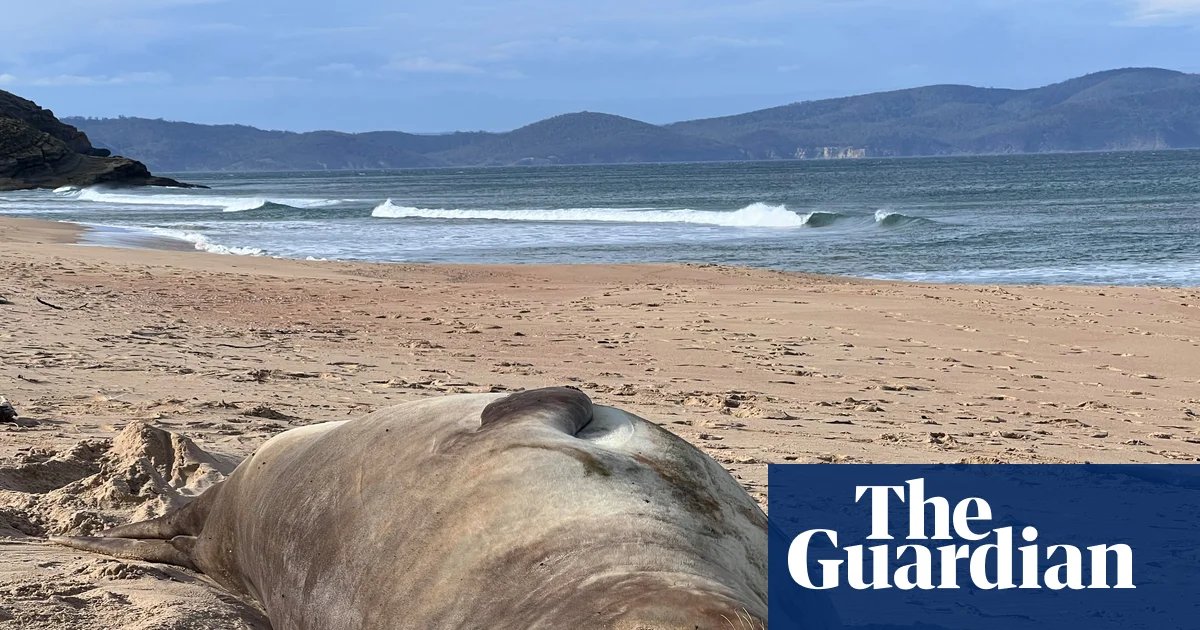
Wildlife officials have warned people to give Neil the seal space during his visit to Tasmania, saying some have gone so far as to bring their human babies close to the 1,000kg giant for a photo.
Neil, a southern elephant seal, was born in Tasmania in October 2020, but his existence is an anomaly: most of his kind live thousands of kilometres south on the subantarctic Macquarie and Heard islands. Elephant seals return multiple times a year to the area where they were born to moult, breed – or in Neil’s case, rest and learn how to play fight.
“Neil was born in Tasmania, near Hobart, and he thinks that’s where home is because he doesn’t know where Macquarie Island is,” Dr Clive McMahon, an elephant seal expert, told the Guardian this week. “And he doesn’t have a map.”
Dr Kris Carlyon, the section head for wildlife health at Tasmania’s department of natural resources, said while he understood the widespread interest in the mammal, there was a real risk of the public “essentially loving Neil to death”.
“We have seen examples around the world where large, potentially dangerous animals have had to be euthanised if there is risky behaviour by the public, resulting in an unmanageable safety concern,” Carlyon said on Thursday morning.
“He can look cute, cuddly [and] placid, but he’s a large marine predator – and we certainly wouldn’t be approaching things like polar bears [and] bison in other parts of the world.”
Neil has returned to southern Tasmania 12 times so far. But his size this year, and his propensity to sleep in the middle of the road and attack bollards with his bulk has caused a stir. He could ultimately grow to be 3,500kg and about 4.5 metres long.
Carlyon urged the public to let Neil rest while he’s on land for about six weeks after a busy feeding period in the Southern Ocean. Some people have tried to leave meals for Neil, but he does not need food and won’t feed even if they try.
“Neil’s fame is a bit of a double-edged sword,” Carlyon said. “Right now the attention Neil gets helps with awareness of our threatened species, helps with his protection in some ways. But it also encourages perhaps risky human behaviour, people trying to get selfies with Neil, people trying get that little bit closer for that good photo.”
He said there have already been instances of people “carrying their small babies up close to him and simply trying to get that shot for Instagram”.
The warning elicits reminders of Freya the walrus, who was euthanised in Norway in 2022 after she presented a “persistent threat to human security”. Officials said at the time their warnings for the public to keep their distance from the animal were not heeded.
after newsletter promotion
Carlyon said wildlife officials have the option of relocating Neil if the situation grew dire, but it was a risky option of last resort.
Dr Jane Younger, a seal expert at the University of Tasmania, said Neil is already big enough to harm a person.
“He’s already at a size now where he’s dangerous,” she said. “Even if he’s not in an aggressive mood, he could easily kill a person. They have a big mouth, big teeth, you could get very seriously injured.”
Carlyon stressed that if people respect Neil, he won’t mind them either. He urged residents to stay at least 20 metres away from him – 50 metres for dogs – and to not get between the seal and the water.
“Neil’s not inherently aggressive in the sense that some other animals might be,” he said.
“He’ll certainly defend his space, and if he feels threatened he may lash out. So really it’s about that proximity and staying away.”