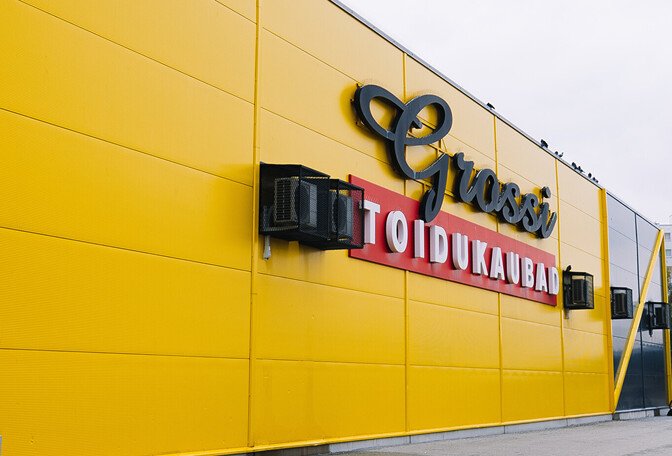
Estonia’s largest grocery retailer by revenue is Coop, followed by Selver, Maxima, Rimi and Grossi. While some chains saw revenue decline in 2024, revenue increased at all of the country’s major grocery retailers last year, albeit only modestly.
Coop
Operating as a cooperative, Coop held a market share of nearly 23 percent last year. As of the end of the year, it operated 315 locations, including Maksimarket and Konsum supermarkets, Coop neighborhood stores and home improvement centers.
In its annual report, the company noted that food sales volumes in Estonia’s food and essential goods sector declined for the second consecutive year and that private consumption has remained at 2023 levels over the past two years. Nevertheless, the consolidated revenue of Coop Eesti increased 0.2 percent last year to €855.3 million. Operating profit, however, fell by one-quarter compared with 2024, totaling €10.2 million.
Coop’s figures are difficult to compare directly with those of the other retail chains, as the group consists of regional consumer cooperatives and the central organization that serves them, Coop Eesti Keskühistu. Legally, it is not a traditional corporate group but rather a cooperative network.

Retained earnings from previous years totaled €59.22 million. Coop does not pay dividends, however, as its policy is to reinvest all profits into developing its retail network.
Coop’s market share is set to grow further after Finnish retail group SOK announced this spring that it would sell Prisma Peremarket’s Estonian stores to Coop.
Prisma
Prisma has posted losses for several consecutive years and 2025 was no exception. The retailer reported a net loss of €3.79 million, 7 percent larger than in 2024, while revenue increased by nearly 1 percent to €207.7 million.
Prisma’s labor costs totaled €15.37 million and it employed an average of 622 people last year.

“Prisma Peremarket’s short-term operations were primarily affected by weak consumer confidence, relatively high energy prices and the overall instability of the economic environment. To mitigate potential negative impacts, special attention was paid to cost efficiency and energy efficiency,” the retailer said in its annual report.
Grossi
OG Elektra, which operates the Grossi grocery chain, posted much stronger revenue growth than its competitors. Revenue rose from nearly €253 million in 2024 to €288.23 million last year, an increase of 14 percent. Profit also increased, rising 11 percent to €12.98 million.
In its annual report, OG Elektra emphasized that it has absorbed two rounds of VAT increases at the expense of its own profitability. Last year, the company also entered the spa sector by beginning construction of a spa hotel in Viljandi.
“The company is looking to the future with ambition. If the planning processes proceed as expected, the 2027 expansion plans could add several new destinations to the map,” OG Elektra said in its report.

The retailer’s labor costs, including payroll taxes, totaled €30.05 million and it employed an average of 1,347 people.
At the end of the year, the chain operated 85 food and essential goods stores and two general merchandise stores.
OG Elektra reported retained earnings of €152.55 million.
Rimi
Rimi Eesti estimated its market share in Estonia at 13.2 percent. The company’s revenue increased by just under 0.5 percent last year to €484.98 million. It posted a profit of €2.45 million, down 69 percent from the more than €8 million earned in 2024.
“For the company, 2025 was characterized by sales growth driven by inflation, while sales volumes continued the downward trend seen in previous years,” Rimi Eesti said in its annual report. It added that customers became even more price-conscious and price-aware amid the broader economic situation, particularly following the VAT increase.

As of the end of the year, Rimi operated 83 stores, including hypermarkets, supermarkets, mini stores and express stores. The retailer employed an average of 2,491 people, with labor costs totaling €44.29 million.
Rimi Eesti paid €8.2 million in dividends last year.
Maxima
Maxima, which operates 86 stores, also cited weak private consumption and the second consecutive year of VAT increases in its annual report.
“Due to intensified competition for market share in food retailing, the company’s share of promotional sales increased,” Maxima said in its annual report, adding that it nevertheless succeeded in increasing sales.
Maxima’s revenue increased to €601 million, approximately 0.4 percent higher than the previous year. Net profit reached €15.8 million, up 116 percent from 2024. At the end of the year, retained earnings from previous years stood at €16.22 million.

The chain employed an average of 2,852 people and labor costs totaled €54.2 million, down 4 percent year over year. The average number of employees also declined from 2,937 in 2024.
Selver
The Selver chain, which at the end of the year included 72 Selver stores, two Delice stores, a café, a mobile store and e-Selver, likewise described last year as a difficult one for the retail sector. Price growth accelerated while consumers’ purchasing power remained weak.
“Consumer behavior is characterized by postponing purchases of less essential products and a much stronger preference for promotional items and retailers with a lower-price image,” the company said in its annual report.
Selver’s revenue increased 0.2 percent last year to €622 million and the retailer acknowledged that its revenue growth was below the average for its market segment.
Profit declined by one-fifth to €10.34 million. According to Selver, lower sales volumes and a decline in gross profit from merchandise sales affected earnings, driven by pricing strategy measures and the high share of promotional products in customers’ shopping baskets.

Selver employed 2,906 people and annual labor costs, including payroll taxes, totaled €43.97 million.
At the end of the year, Selver reported retained earnings of €47 million.
RR Lektus, which operates the Meie grocery chain, had not submitted its annual report by Tuesday afternoon.
—