The mass jubilation in New York City on Saturday night as the Knicks clinched a first NBA Championship in 53 years was novel: it felt like the first time in years that a large number of Americans in one place felt genuine joy.
July 4th is the 250th anniversary of the signing of the Declaration of Independence, that visionary document of freedom written and signed mostly by men who owned slaves. The three branches of government remain in the control of the Republican Party, which has just executed a wildly unpopular and likely illegal war on Iran to little effect, save the killing of thousands. The Trump administration is facing potentially enormous losses in the upcoming elections and is resorting to all means, fair or foul, to try to limit the damage.
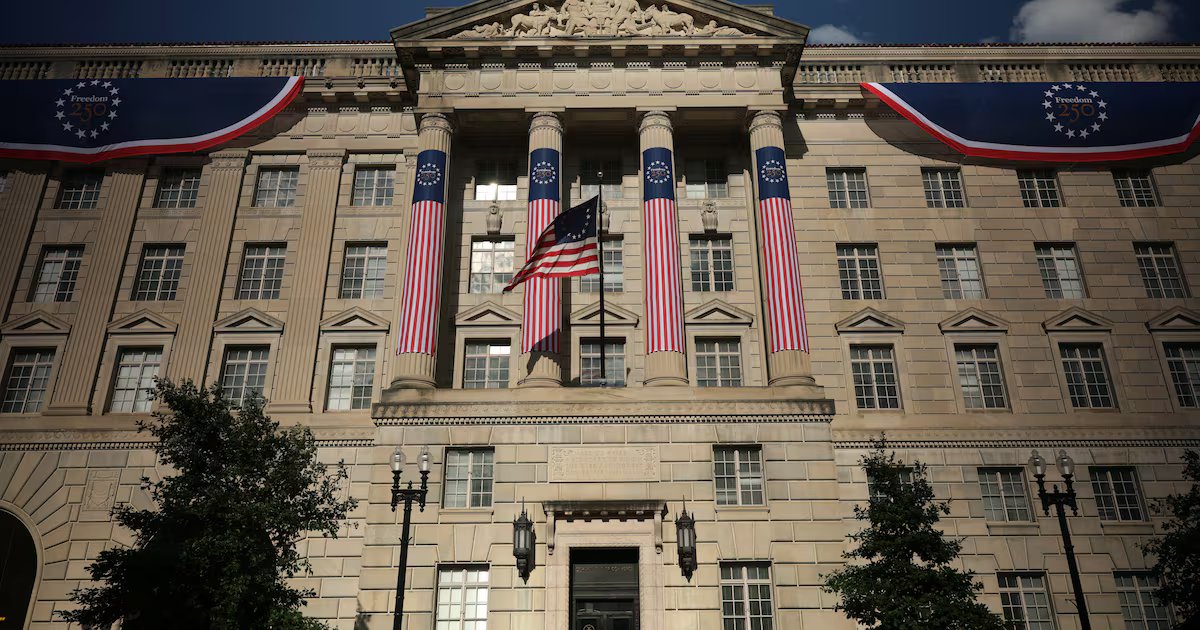
Anniversaries require celebrations. Donald Trump has seized control of the symbolic remembrance of the semiquincentennial by redirecting its funding into a series of pet projects. He is currently remodelling Washington in signature Mar-a-Lago style. Bronze statues are being coated in gilt, triumphal arches are being mooted and even the Lincoln Memorial might be getting a remodel. Enormous banners of historical figures, some of which appear to be AI-generated, hang from prominent buildings advertising events such as the “Great American State Fair”. Sadly, despite the best efforts of a number of companies, the reflecting pool is still a luminous, algal green.
The most startlingly outré expression of this Trump late style was the “UFC Freedom 250”, an MMA event held on the White House lawn, sponsored by cryptocurrency companies and firms partly owned by Trump family members. The event was streamed exclusively on Paramount+, whose parent company was controversially approved for a merger with Skydance Pictures by an increasingly friendly Trump administration. The integrity of the event was somewhat marred by accusations of attempted match-fixing against Eric Trump. The vast network of corruption that extends from the Trump family is so large and complex as to be almost impossible to comprehend all at once.
The administration’s efforts go beyond the cosmetic and into the realm of historical rewriting. The purpose of the commemoration is now to present a vision of the founding of the US in line with Maga core principles. “Mobile museums” are touring the country broadcasting material created by right-wing agitprop organisation PragerU and conservative Christian university Hillsdale College. A “Founders Museum” in DC created by the same groups features mostly AI-generated videos of the founders repeating suspiciously current-sounding conservative catchphrases.
Trump’s ignominious interventions are the latest in a history war almost as long-running as the US itself. As soon as the British surrendered at Yorktown, Americans began arguing about just what the revolution meant
This year’s anniversary stands in contrast to the warmly remembered bicentennial celebrations of 1976. The president, Gerald Ford, inheriting a chaotic planning organisation staffed with Nixon’s cronies, took the wisest course and put someone in charge who simply disbursed money to state and local organisations, which in turn created a multiplicity of events guided by no single authority. This gentle, nostalgic patriotism appealed to a population weary after years of war and scandal.
Trump’s ignominious interventions are the latest in a history war almost as long-running as the US itself. As soon as the British surrendered at Yorktown, Americans began arguing about just what the revolution meant. In Gore Vidal’s magisterial 1973 novel Burr, an ageing president Thomas Jefferson mocks his political rival, saying “it is too late to change what is now the accepted version of our revolution”. That has not stopped every subsequent generation trying.
Before the Civil War, both Northern abolitionists and Southern slave-owning fire-eaters appealed to the principles of freedom espoused in the revolution. The mid-20th century saw a reconsideration of the founding in American academia, taking a more expansive, systematic, and critical view that encompassed the perspectives of non-white and Indigenous people, women and others outside the confines of the revolutionary elite of Boston, Philadelphia and Virginia. A frequent bugbear of conservatives in the 1980s and ’90s was the idea that the memory of the founding generation was being soiled by left-wing academics, a complaint they have not stopped offering since.
In 2019 a group of writers launched the “1619 Project” in collaboration with The New York Times. This was an attempt to recentre the founding around questions of enslavement, with 1619 being the year that enslaved Africans were first brought to British Colonial North America. The project sparked immediate backlash from the right, which responded with its own, Trump administration-approved “1776 Commission”. It is from that commission that many of these dubious commemorations come.
The fact that the US still operates under the original 1789 constitution makes these arguments more than academic. A simplistic memorialisation of the eternal wisdom of the US constitution requires us to uncritically celebrate a supreme court that has assumed enormous power in order to run roughshod over the rights of Americans, a gerrymandered and critically unpopular US congress that has relinquished its power to an out-of-control presidency, and that latter office itself. But the United States at 250 is an edgy, doom-stalked place, where few are happy with the direction of the country, and 59 per cent say its best days are behind it. Expecting good-natured, patriotic remembrance at a time like this is a ludicrous fantasy.