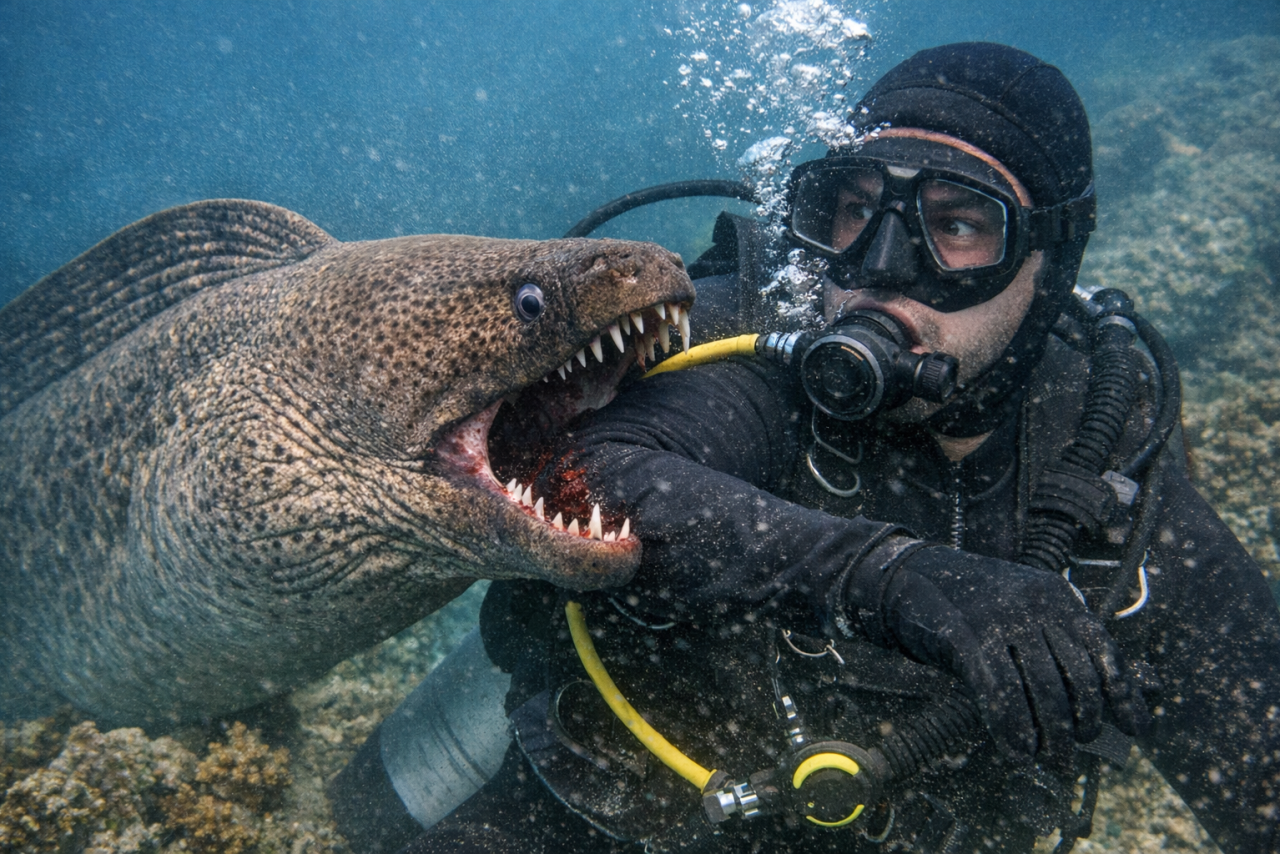
Diving, which should have been a routine and well-known experience, turned into an unpleasant incident that ended up in the hospital with five stitches. Namely, the experienced diver filmed the Javan moray, an individual that he claims he has known for years. During numerous previous dives, he regularly stayed near the same animal, whose behavior was always predictable and unobtrusive.
However, this time the situation developed completely differently.
Earlier during the dive, he followed a stingray that was moving in that area. When he returned to filming moray eel, he immediately noticed that something was not usual. Instead of staying close to its shelter, the moray began to swim straight towards the camera.
The diver backed off and continued filming from a few meters away, expecting the animal to lose interest soon.
That didn’t happen.
Murina continued her approach, followed him to the surface, and then bit his leg. Thanks to the 3-millimeter diving suit, the injuries were mitigated, but medical care and stitches were still required. Her teeth even pierced her diving suit, requiring five stitches. Imagine if she bit him “barely”, he wouldn’t have had a good time.
The exact reason for the attack remains unknown. It is assumed that the moray eel may have reacted to the presence of the stingray, mistaking the diver for prey or simply displaying behavior that had not been recorded before.
This incident once again reminds us of the unpredictability of the marine world. Regardless of the experience and knowledge of individual animals, the sea remains a wild environment in which man is always a guest.
The Javanese moray lives in the tropical waters of the Indo-Pacific, around Indonesia and the wider region of Southeast Asia. This includes areas around the island of Java and nearby coral reefs, and it is not found in the Mediterranean or the Adriatic, where other moray eel species live.
MURINE IN THE ADRIATIC
Moray eels are one of the most enigmatic, but also the most underestimated predators of the Adriatic – they look like a snake, but they are actually fish with extremely strong jaws and sharp teeth, which can inflict a very painful bite. wikipedia+2
What does moray eel look like and where does it live?
Moray eels have a long, eel-like body without scales, with a head dominated by strong jaws full of thin, sharp teeth, and the palate is also equipped with part of the teeth. They spend the day hidden in rock crevices, holes and crevices, mostly with their heads sticking out, while they are more active at night when they go out in search of prey. euronews+2
Several species of moray eel live in the Adriatic – the most famous is the yellow moray eel (Muraena helena), and the black eel (Gymnothorax unicolor) and the sharp-toothed eel (Enchelycore anatina) have also been recorded, especially in the southern and central part of the sea. They are most often found on rocky and steep shores, around reefs, wrecks and underwater rocks, at depths of only a few to tens of meters. scubalife+5
How dangerous is moray eel for humans
As a rule, moray eels do not hunt people and do not “stalker” swimmers or divers, but they can be very dangerous if they feel threatened or provoked. Experts emphasize that they do not attack a human unless someone disturbs them – for example, tries to pull them out of cover, puts their hand near their hole or blocks their escape route. natural Croatian+2
The problem is that their bite is extremely strong and penetrating: the sharp teeth easily tear the skin, and the wounds are often deep and irregular. An additional risk is represented by bacteria and toxins in the mouth and mildly toxic mucus, due to which the wound can quickly become infected, and in more severe cases lead to more serious complications such as blood poisoning. adriaticnature+3
Moray eels in the Adriatic: nocturnal predators
The yellow moray eel is the most widespread Adriatic moray eel – it can grow over a meter in length and weigh more than 10-15 kilograms. It is a nocturnal and highly territorial species that searches for food in the immediate vicinity of its shelter, hunting smaller fish, crustaceans, cephalopods, and carrion. velimirvrzic+4
In addition to it, the black moray is also present in the Adriatic, darker in color and somewhat rarer, and the sharp-toothed moray, which is sporadically recorded in the wider Mediterranean area. All three are considered “dangerous beauties” of the Adriatic – they are attractive to watch, but require distance and respect, especially when spearfishing and snorkeling. wikipedia+3
Recorded attacks and what divers are doing
Although moray eels are not among the most common causes of injuries at sea, attacks do occasionally occur, especially when close contact occurs. There have been recorded cases in the Adriatic in which a moray eel bit a diver or a fisherman – for example, near Žirje, it inflicted a wound on a diver that required him to be hospitalized in Sibenik, although the injury was fortunately not life-threatening. index+3
The most common “victims” are spearfishers who hook a moray eel or try to pull it out of a hole, as well as careless divers who stick their hand into a crack without checking what’s inside. In such situations, the moray eel defends its shelter and reacts suddenly and lightning fast, and protective suits and gloves may not be enough to prevent a serious bite. journalist +4
Can moray eel be eaten?
Although moray eel is caught for food in some places, experts and fishing portals warn that it is not the most suitable for human consumption. Its meat can be risky due to toxins and possible poisoning, so it is generally not recommended for consumption in the Adriatic, especially if you do not know exactly how to prepare and clean it. scubalife+1
This is why it mostly has a bad reputation among fishermen – not only can it bite when pulled out of the sea, but then it creates an additional dilemma of what to do with it. It often ends up returned to the sea or is simply abandoned as soon as it is removed from the tackle. adriaticnature+2
How to behave if you meet her
The profession is clear on this matter: it is best to observe the moray eel from a distance and not try to touch it, feed it or “pull it out” for the sake of photography. Divers are advised not to stick their hands into unknown holes and crevices, and if they notice a moray eel emerging, keep a distance of several meters and avoid sudden movements. natural Croatian+2
In the event of a bite, the wound should be washed, disinfected and medical attention should be sought as soon as possible due to the risk of infection and the effects of toxins. Although most such injuries do not end tragically, they can be very painful and leave unpleasant scars – another reminder that the sea is a wild system where man is always a guest, not a host.