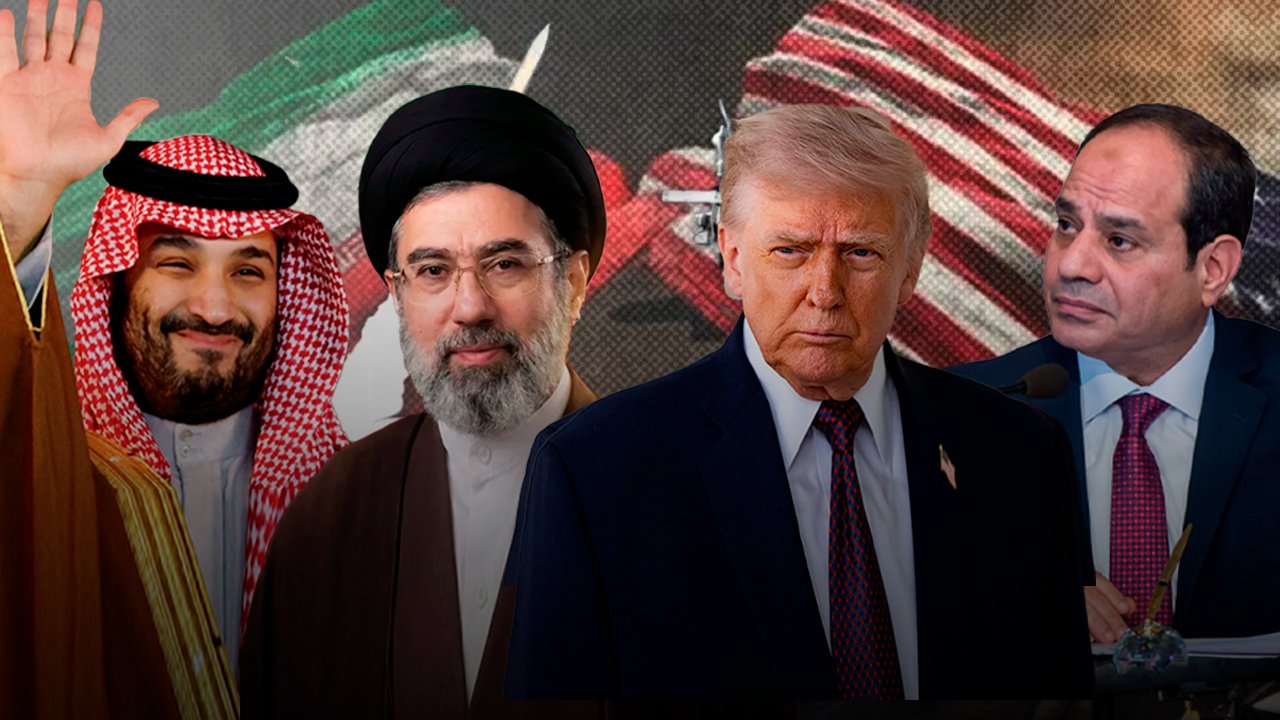
A few weeks ago, it was leaked that Saudi Arabia and the UAE were asking the US to end the operation against Iran. But later the situation changed and caution prevailed in their position. At the same time, Saudi Arabia and the UAE are not happy about Egypt, which has a special position in the Arab world.
The picture of interests in the Middle East against the background of the Iran war – in the “Geosiyosat” program of Kun.uz.
— Why is Saudi Arabia asking the US to stop the blockade of Hormuz?
Jahangir Akramov: The attitude of Saudi Arabia and the United Arab Emirates towards Iran remains serious, they see Iran as a rival in the Gulf region. This conflict should be understood not only in a sectarian (Shia-Sunni) framework, but in a broader geopolitical context.
For example, there were concerns that the rise of Shiites to power in Iraq or Syria would lead to increased Iranian influence. For this reason, there has been some concerted effort to prevent the rise of Iranian influence in areas that are ethnically Arab but sectarianly Shiite.
It should not be forgotten that the excessive escalation of Iran is against the interests of Saudi Arabia.
However, since the beginning of the war, Riyadh wants the issue to be resolved in a controlled manner rather than by military means. Donald Trump’s policy is not working as they expected. On the contrary, Washington’s actions may further complicate the situation in the region, causing concern in Saudi Arabia. Therefore, the view that “let’s first stabilize the problem of the Strait of Hormuz, then we will reach an agreement with Iran through mediators – Turkey, Pakistan or Egypt” is growing.
The leadership of Saudi Arabia, especially the think tanks around Mohammed bin Salman, try to carefully calculate the possible risks. They are well aware that Iran’s geopolitical potential is high. One of these opportunities is related to the Bab al-Mandab Strait. This strait is the entrance to the Suez Canal, which connects the Red Sea with the Indian Ocean.
If this corridor is closed, the economic interests of not only Egypt, but also Saudi Arabia will be seriously affected. This risk becomes even more significant given that a significant portion of Saudi oil exports are carried through Red Sea ports, using overland pipelines. If the Yemeni Houthis go full-scale in the war and try to close the strait, Saudi Arabia’s economic potential could suffer significantly.
However, the Houthis have not yet joined the full-scale war. This shows Iran’s cautious strategy: it is keeping this option as a “back-up card” considering the long-term confrontation. In the words of Donald Trump, Iran is saving another “cushion” for the next strikes.
Therefore, the strategy of “controlled chaos” prevails in the region, that is, there is tension, but it should not get completely out of control. Because it is not in the interests of Saudi Arabia to derail the situation.
As for the UAE, its position is different from that of Saudi Arabia. While Saudi Arabia is in favor of a relatively moderate and diplomatic solution, the Emirates has taken a more firm position. This is especially related to territorial disputes around the islands of Abu Musa, Little Tonb and Big Tonb. The Emirates are inclined to pursue a stricter policy, considering that such a historic opportunity will not repeat itself.
Nevertheless, one of the factors determining the final balance is Egypt’s position. Egypt’s relatively subdued and anti-war approach is keeping Saudi Arabia and the Emirates from direct confrontation. Because the military potential of these two countries is not the same as that of Egypt. Egypt has historically experienced war with Israel, Great Britain and France. Saudi Arabia and the Emirates have mostly limited experience with military operations in Yemen.
The situation in the region is based on a complex balance, each side is trying to avoid a full-scale war while protecting its interests.
Sanjarbek Rashidov: The Strait of Bab al-Mandab will become increasingly strategic and may even become a second global “hot spot” similar to the Strait of Hormuz. There are several reasons for this. First of all, this strait, which is only 26.5 kilometers wide, is a very weak area militarily, which means that the missile systems of the Yemeni Houthis can easily reach almost any part of it.
Today, Saudi Arabia has achieved a significant recovery of pre-war oil exports. One wonders how this was done, especially given the risks associated with the Strait of Hormuz. In fact, this result was achieved thanks to the use of the Bab al-Mandab route.
Saudi Arabia forcibly diversified its export routes: oil reserves were diverted through desert areas to Red Sea ports, thereby restoring export volume to 70–80 percent. It is known that Saudi Arabia is one of the largest oil exporting countries in the world. If both the main routes – the Strait of Hormuz and the Strait of Bab al-Mandab – are blocked at the same time, it will be an unprecedented blow not only to Saudi Arabia, but also to the entire world economy.
Such a situation would also seriously affect the domestic political stability of Saudi Arabia, as the economy is still heavily dependent on oil revenues. At the same time, the people of the Gulf monarchies are used to a high standard of living. They are not ready for large-scale wars and do not want such a scenario.
Iran, on the other hand, has been living under sanctions for many years, has felt constant external pressure, and because of this, has been formed as a country with a high level of military and political mobilization.
Interestingly, the name “Bab al-Mandab” means “gate of mourning” or “gate of tears” in Arabic. If the Yemeni Houthis, fully supported by Iran, begin to block trade routes through the Red Sea or attack tankers and merchant ships, this could lead to a serious economic and political crisis on a global scale – literally a period of mourning.
***
In the conversation, Egypt’s relations with the Gulf Arab states and Israel, as well as its position on the Iran war, were discussed. You can watch the full conversation on YouTube channel “Geosiyosat | Kun.uz”.