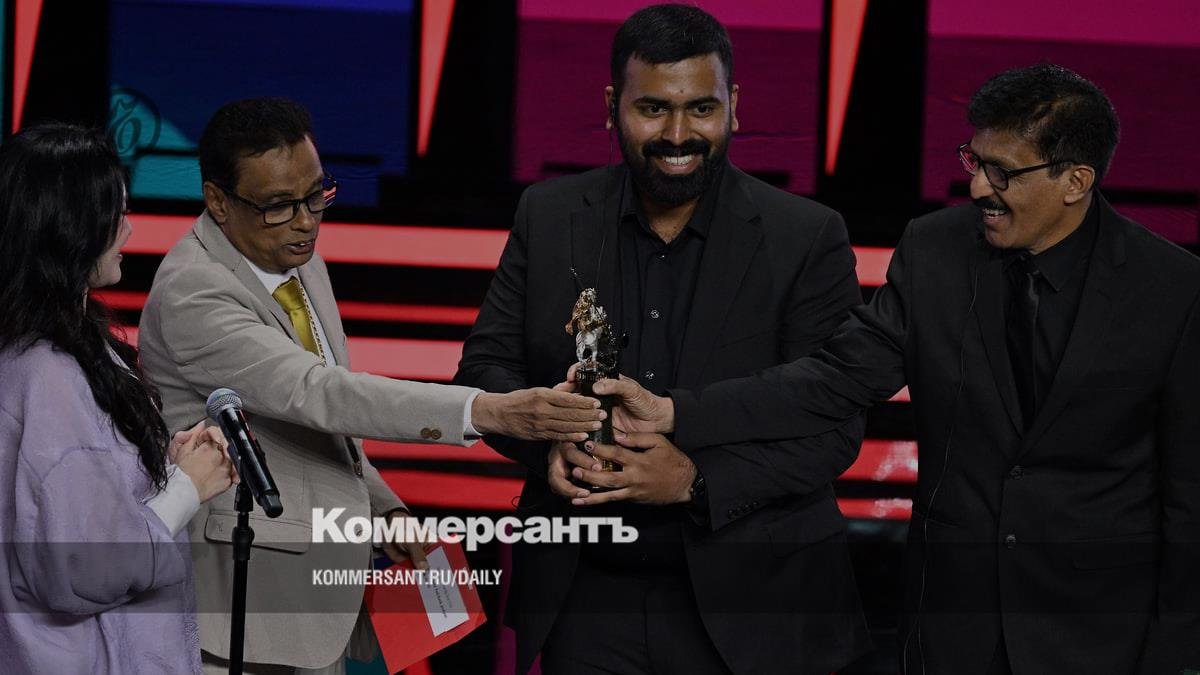
The 48th Moscow International Film Festival (MIFF) has completed its work. The main prize, the Golden Saint George, was awarded to Fazil Razak’s The Passion (India) by the jury chaired by Sri Lankan director Prasanna Vitanage. The best documentary was “The Long Way Home” by Xusong Zheng (China), and the best short was “Nowhere and Yet Somewhere” by An Huilin (Republic of Korea). Viktor Shamirov’s film “Temperature of the Universe” won the “Russian Premieres” competition. Comments Julia Shagelman.
Indian filmmakers have won the MIFF for the second year in a row. At the last festival it was director Pradeep Kurba, a native of Meghalaya, with his film Elysium, shot in the local Khasi language. In this – Fazil Razak from Kerala, filming in Malayalam. “Passion” is his second full-length work, following his debut “The Verdict”, released in 2023, which continues the theme of women’s fate in a patriarchal society.
The film’s protagonist Amala (Amrutha Krishnakumar, who also co-wrote the screenplay and won Best Actress) was abused by her husband (as was her mother, and perhaps previous generations of women in her family), resulting in mental problems. A meeting with Shanu (Ishaq Musafir), who plans to kill the girl who left him, but is not averse to taking out his anger on Amala, who accidentally turned up to him, returns her to situations similar to those she experienced in the past. Riding around on a stolen motorcycle, Amala and Shanu become something of an Indian Bonnie and Clyde, but their personal stories are only part of a larger picture of how gender-based violence, perceived as almost normal, destroys the lives of both women and men.
The MIFF prizes for best director and best actor went to one of two Russian films in the main competition: “Vygotsky” by Anton Bilzho. The role of the patriarch of Russian psychology and pedagogy, who died very young and did not have time to implement even half of his grandiose plans, is truly one of the best to date in the career of a sought-after artist Sergei Gilev.
Having no external resemblance to the prototype and not striving, together with the director and screenwriters, for biographical accuracy, he created a very charming image of a man who perfectly understood the child’s psyche because he himself was not afraid to remain a child, even when he grew up into a respectable Soviet scientist.
And the director, who freely juggles facts and fiction, managed to include the audience in the game, which, according to Vygotsky, is the basis for full-fledged mental development.
The film was awarded a special jury prize “Retribution” by Spanish director Daniel Guzmanat first quite successfully pretending to be a social drama, but the further it goes, the more it moves into the territory of a sentimental crime romance. It touches on topics that are currently topical for Spanish society as well – urban gentrification, bureaucracy, the difficult situation of pensioners, even the lack of funding for medical institutions.
However, in the end, it all comes down to forcing the audience to feel sorry for the main character Lucas, who has embarked on a slippery criminal path in order to save his beloved named grandmother from eviction from her apartment (the wonderful non-professional actress Rosario Garcia, the same age as her heroine, unfortunately died before the film’s premiere). In general, it’s not even difficult to sympathize with him – Lucas is played with sincere emotional impact by Guzman himself, supported by excellent supporting actors. But the illogicality and sometimes outright stupidity of the script decisions, playing tricks with the hero in order to lead him to a heartbreaking ending, as intended by the authors, interferes.
The national competition “Russian Premieres” this year turned out to be quite eclectic: there were uncompromisingly “festival” works like “Songs of the Genies” by Roman Mikhailov or “Shurale” Alina Nasibullina, and potential folk hits like “The Red Ghost. 1812″ by Andrey Bogatyrev.
“Temperature of the Universe” by Viktor Shamirov, which received the well-deserved main prize, is a rare example of a harmonious combination of author and spectator cinema, which ten years ago was called “mainstream art”.
This quiet film about relationships in an intelligent circle of scientists – astronomers and historians – is reminiscent of Soviet films of the late 70s in intonation and mood (for example, “Autumn Marathon”). At the same time, Shamirov, unlike many of his colleagues, does not immerse the characters in some kind of emasculated, airless space: the world of his film is alive, recognizable, distinctly modern – which is worth just the rehearsal of a school concert for the upcoming Victory Day. And the characters here are alive, a little ridiculous, not very happy – the same as the audience looking at them from the audience. And the fact that they manage to find a little warmth for each other in the endless cosmic cold that surrounds us is comforting and encouraging – a rare quality for films collected at one festival dedicated to analyzing traumas, exposing ulcers and glorifying the exploits of past and current wars.