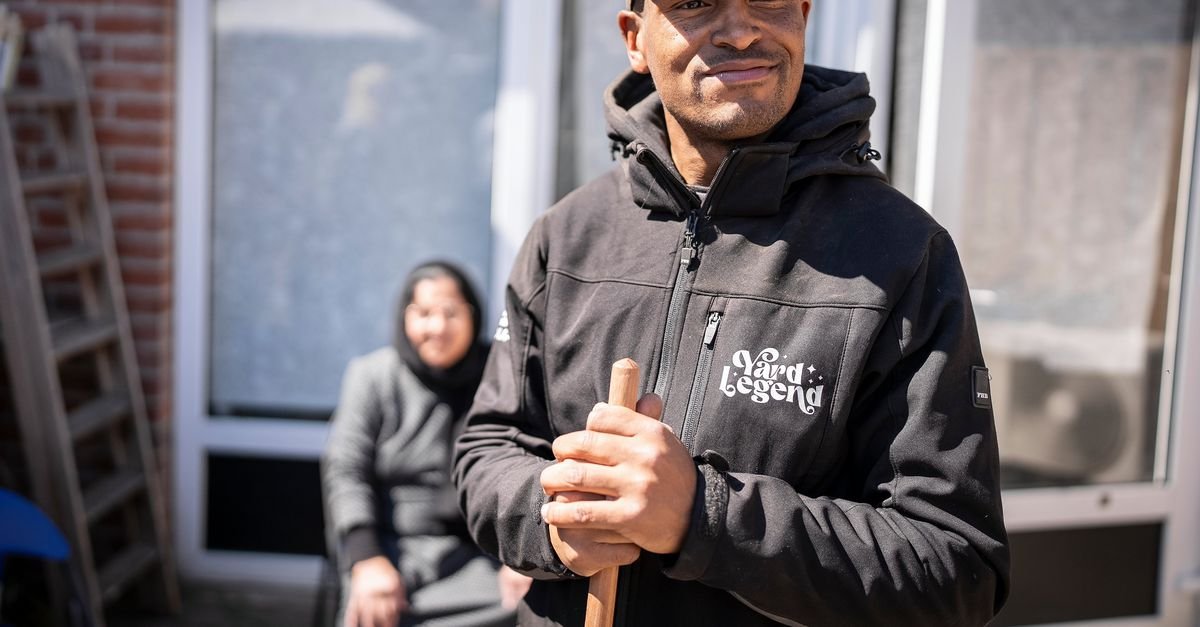
“I came today to help you with your garden for free,” Son Cicilia says to a small, elderly woman standing in blue slippers in the tall grass of her garden. “Is that okay?” The woman nods enthusiastically, she does not speak Dutch but she has been told what Cicilia is coming to do. “Then I will immediately get my things and start.”
Gardener Son Cicilia (42) often does it: making neglected gardens accessible to people who cannot do so themselves. On this sunny April morning he is working in a garden overgrown with nursery grass in Etten-Leur. His brush cutter can be heard far into the quiet neighborhood. From the wilderness of nettles and Japanese knotweed emerge a rotten fence, broken laundry racks, and a few rusty folding chairs.
It is the garden of Sideke, a woman in her late sixties with rheumatism who fled from Afghanistan. She does not want to use her last name NRC. Her Afghan friend Azita – her last name is bij NRC known – gardener Cicilia had texted: “Hello, my girlfriend lives in Etten-Leur. Can you come, she really needs someone’s help to clean the garden. She is old and sick and has no one.” An acquaintance of Azita comes to interpret for Sideke. When asked why no one can help her with her garden, he answers that he himself has a hernia, “and the neighbors all have their own problems here.”
Cicilia is known on social media as Yard Legend. In a year and a half, often with the help of his sons Dymond (20) and Jayden (17), he has renovated around 450 gardens for people who are ill or too old and cannot arrange other help. Anyone needing help can submit a request via its website. He receives hundreds of requests. Cicilia films every garden he cleans, he has about 250,000 followers.
“I come to people who have been renting a house for fifty years and who have always maintained their garden themselves,” he says, “but then the years start to count, physical discomfort arises, they have a walker or a mobility scooter, and then it stops. They have already paid off the house twice with their rent, so to speak, but no one can help them with their garden.”
He recently helped a woman in a wheelchair who said to him: “My garden is my holiday. I have nowhere to go, this is my place to relax.”
Do something meaningful
On August 17, 2022, while waiting at a traffic light in Breda, Cicilia was rear-ended at eighty kilometers per hour by a driver who was under the influence of drugs. Car totaled, Cicilia in the creases. “There is still a personal injury lawsuit underway.” Cicilia had a landscaping company in the Breda area. This was no longer possible due to the head, neck and back problems that resulted from the accident. He put the company in the name of his eldest son, and limited his own working days to two a week.
But he was not really positive about life, says son Dymond. He says he has seen his father change in recent years. “Easily angry over little things.” “I lacked meaning,” says Cicilia herself. He found it again when he saw a video of the American TikTok gardener Spencer, known as SB Mowing, who visits people who cannot take care of their garden. “I only have to work a few hours a day, and it gives me the opportunity to do something meaningful,” he says. The rental of his house on Curaçao and several large garages provide sufficient income for the time being. He plans to start next year with ‘purpose days’ at companies, “for example to renovate the gardens of healthcare institutions and hospices with teams.”
“People have already paid off the house twice with their rent, so to speak, but no one can help them with their garden”
“It’s not actually about the gardens in the first place,” says Cicilia as he rakes up Sideke’s green waste; he wants to show on his social media who lives behind the closed curtains; make it visible who needs help and why. And how easily you can help each other. That’s why he films everything, that’s his condition: that you give permission for your story to be posted on social media.
Such as that of Quincy from Houten, with whom he recently worked, “abandoned by his mother at the age of four”, raised by a father who died of MS in 2024. Quincy now lives alone in the house where he lived with his father. “Right now I just can’t keep up,” he says in the TikTok vlog, “but if I get a push in the right direction it will be a bit easier.”
“Quincy is only twenty years old,” Cicilia says in the video, “but he has already been through more than most people in a lifetime. From an early age he took care of his father. Always ready. Always strong. Until he suddenly found himself completely alone at the age of nineteen.”
The video shows at an accelerated pace how Cicilia tames the wilderness. After an hour and a half, the backyard is accessible again. Quincy comes out visibly upset. No, he never thought it was possible that someone would just do this for him.
Cicilia also helped Bobby from Hilversum, who lost his 38-year-old wife in an accident last year and had already had a heart attack. He was left with four young children. “What’s going through your mind?” Cicilia always asks when a resident steps into the tidy garden. “The children can play in the garden again,” says Bobby gratefully.
:format(webp)/s3/static.nrc.nl/wp-content/uploads/2026/04/28123205/WEE_2033181561_1.jpg)
:format(webp)/s3/static.nrc.nl/wp-content/uploads/2026/05/12152859/220526WEE_2033181561_8.jpg)
Sideke comes to look at her renovated backyard.
Photo John van Hamond
Don’t dare ask for visitors
Cicilia believes that people should help each other much more, he wants to spread “the empathy virus”. “We judge so easily,” he says, “but we don’t know what people behind that front door have to bear.”
After an hour and a half, Sideke’s garden is tidy again. The tiles are visible, the border has been pruned, the waste is piled up in a corner of the terrace. “There is really no honor to be gained from these types of gardens,” says Son Cicilia, pointing to the tiles that have collapsed due to overgrowth. “They would have to be completely dug out, completely rebuilt.” He often receives reactions on social media such as: “Hey, you prune everything away without looking!” And: “This isn’t gardening, is it?!” “But what should I do?” he says. “Pruning shapes here with my scissors? This is wild growth, this is rigorous, rough work. My goal is to make the garden accessible so that people have light and air again.”
He receives emails from people who are afraid that they will be evicted by the housing association because of the neglected garden, who cannot sleep because of it. “There is shame, people no longer dare to ask for visitors, neighbors will complain, especially if vermin come.”
In the house with closed, torn blinds on the windows, the back door opens, and in the doorway Sideke presses her hands to her heart, beaming. Thank you, she says ten times to Cicilia and his son, thank you.
Cicilia does not understand “that as a society we let it get to this point.” Let the housing associations employ gardeners to maintain the gardens two to three times a year, he suggests. Or let him train young people who can come and do this, young people who just don’t know what to do anymore, just like he did in his landscaping company, boys who just can’t get somewhere on time, for example, and therefore always lose their work. Not with Cicilia. “We all have something,” he says. “And we don’t know the stories behind someone’s behavior.”
:format(webp)/s3/static.nrc.nl/wp-content/uploads/2026/04/28123115/WEE_2033181561_.jpg)
:format(webp)/s3/static.nrc.nl/wp-content/uploads/2026/04/28123529/WEE_2033181561_4.jpg)
Photo John van Hamond