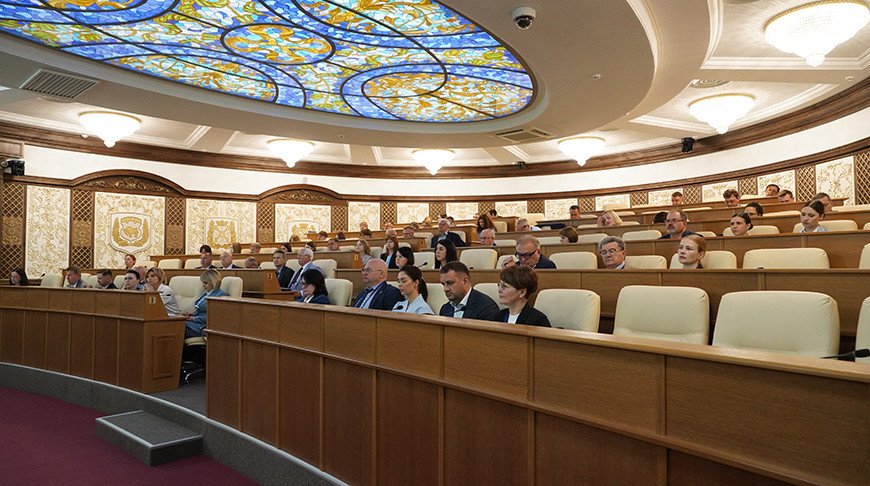
MINSK, 25 June (BelTA) – Mutually beneficial integration within the Union State of Belarus and Russia will make it possible to combine resources and competencies to achieve food security, said Dmitry Gorodetsky, First Deputy Chairman of the Brest Oblast Executive Committee, during the session Legal Support for Food Security of the Union State held as part of the 13th Forum of Regions of Belarus and Russia, BelTA has learned.
Dmitry Gorodetsky emphasized that in today’s realities, food security is becoming a key element of state sovereignty and national security. “Our model is based on our own competitive agricultural production, focused on independence in key food products,” he said. Brest Oblast is one of Belarus’ leading agro-industrial regions. It produces a quarter of the country’s gross agricultural output and has maintained strong positions for many years in milk production volume and quality, livestock productivity, and food exports.
“We are consistently working to improve food quality. We are actively modernizing production facilities. Therefore, we feel confident and are able to contribute to ensuring the food security of the Union State. The level of self-sufficiency in key food groups exceeds 100%, including more than sixfold in milk, fourfold in vegetables and potatoes, and more than double in eggs and meat,” Dmitry Gorodetsky noted.
Brest Oblast accounts for one third of Belarus’ total food exports. Its key foreign trade partner is Russia, and trade continues to grow. “Our trade geography covers 75 regions of Russia (from Kaliningrad to Sakhalin) for exports and 68 regions for imports. Every year we expand the range of goods supplied. Import cooperation is also important for ensuring stable operations of our industrial enterprises and maintaining balance in the consumer market,” the first deputy chairman stressed.
Brest Oblast also cooperates with Russian regions in pedigree livestock breeding, seed production, and automation of production processes to renew agricultural machinery fleets. “It is further mutually beneficial integration within the Union State that will allow us to combine resources and competencies to achieve food security, exchange advanced agricultural technologies, and reduce costs,” Dmitry Gorodetsky said.
According to him, there is strong potential for developing joint breeding and genetics to reduce dependence on imported seeds and breeding material. Joint opportunities also exist in developing and producing veterinary medicines, vaccines, feed additives, and plant protection products. Cooperation in agricultural machinery manufacturing and processing equipment will help reduce dependence on imported machinery and components. Industrial production of berries and fruits could also become highly promising.
“The development of a single market and a coordinated export policy will allow the Union State to become one of the most powerful and resilient agro-industrial complexes capable not only of fully supplying its own population but also of making a significant contribution to global food security,” Dmitry Gorodetsky concluded.