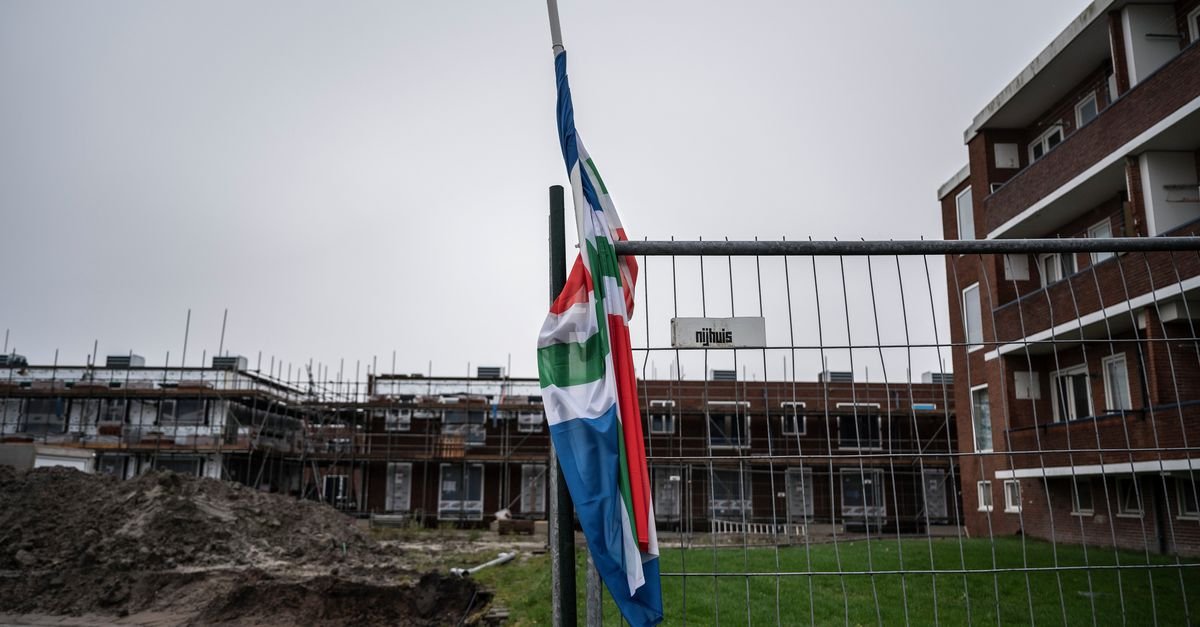
In the province of Groningen, a gigantic reinforcement operation is underway for homes that have been dangerously damaged by earthquakes caused by gas extraction. The safety of almost 28,000 homes was determined in reports based on calculations. About half require major improvements. The Groningen Safety Advisory Board (ACVG) recently published a shocking report: such eight thousand reinforcement reports contains errors. Despite these errors, the final conclusion for the residents will, in most cases, not change. This concerns problems such as not taking serious damage into account or not checking assumptions in calculations. Moreover, the input of residents in the reinforcement is structurally ignored.
This is a problem with national consequences. The scale of the reinforcement is already enormous. Due to the errors found, reinforcement will take longer and the social and economic costs threaten to escalate further. In addition to the high price paid, this is a further attack on trust. According to the Parliamentary Commission of Inquiry into Natural Gas Extraction in Groningen, the fact that residents are not heard was the central problem three years ago. The House of Representatives and the government put on their sins and promised improvement. This report affects the credibility of everyone involved.
In itself it can be defended that calculation results are the basis for policy. But the fact that 30 percent of reports contain errors is not an incident. Since the start of the reinforcement, around 2015, insiders knew that the reports contained many errors. The general public only became aware of this recently, through a broadcast of research program Pointer by 2025.
To repair the mistakes, ACVG emphasizes in its recent report the importance of communication and dialogue with residents to restore trust. The advisory board makes recommendations to remove “doubts about the correctness of the safety assessment”. Following the Pointerbroadcasts, ACVG and the supervisory authority State Supervision of Mines urged for better quality assurance. These authorities therefore believe that safety can be calculated accurately and reliably. We doubt that.
We believe that the safety calculations for homes in Groningen can never be solid, for various reasons. The calculations are complex, depending on uncertain assumptions about earthquake activity that is constantly changing, ground movement and the structural condition of buildings. It was also sobering that the “facts” are not always correct: as recently as 2019, it turned out that the magnitude of the ground movement was on average twice as large as estimated. Due to social distrust, the figures will be questioned again and again. This distrust does not only come from residents: it runs deep between agencies, governments and the NAM, the Dutch Petroleum Company. We have seen this as a core problem for twelve years. It is an illusion that we can make good policy based on figures.
Scandalous
The fact that it is still not possible to listen to residents is scandalous. At the same time, it is a logical consequence of the current approach. Calculation results are decisive in this regard. Input from residents is not only unnecessary, it is undesirable. It works like this: in 2014, NAM and the state decided that damaged homes needed to be reinforced. Which homes and how: engineers would calculate that.
The calculations are ostensibly intended for the safety and well-being of residents. But in the meantime, NAM, state and region are mainly concerned with money. The NAM thought that only hundreds of homes were unsafe. The region was thinking of many tens of thousands. The calculations were intended to resolve the deep mutual distrust. Because the parties could not reach mutual agreement, the figures started to determine policy. This distrust is also the reason that residents have no say. After all, they have a (financial) interest. The calculations must be objective and must not concern residents’ interests.
Due to social distrust between institutions, the figures will be questioned again and again. We have seen this as a core problem for twelve years
It is time for the logical conclusion that a major mistake was made at the very beginning of this long history. We cannot rely on calculations to determine how we will strengthen Groningen homes. Two things are needed. The first is the restoration of trust between agencies and governments. The second is the courage, this time together with residents, to determine the best solution to get out of this swamp.
Neighborhood to neighborhood
For many years we have been advocating for the restoration of trust as a basis for a better approach to the earthquake problem. Solutions such as discussions between ‘a dialogue table’, the National Coordinator Groningen or the Ministry of Economic Affairs have not worked, because higher-level parties do not want to share their power.
We see more in agencies that sit down with residents neighborhood by neighborhood to determine what is needed locally. On that scale, residents’ voices finally count. This will hopefully leave some room for the egos of the authorities to have a good conversation: what happened here? How do we make things right again? The Agenda for Recovery aims to do this, with an integrated approach aimed at damage, reinforcement and sustainability per location. Unfortunately, authorities rarely choose to do this. Such a good conversation with the population is more relevant to the price than the buttery-smooth calculations ever were. We hope that the ACVG report will be an eye-opener: safety calculations do not solve this problem for us, we have to make our own choices.
It is essential that we take a different path so that the reinforcement operation does not expand indefinitely. The fact that there are no deaths in Groningen seems to be a humane objective, but this policy was also, and above all, a business interest for the state and NAM. Achieving that safety became a “reinforcement operation” that has been proven to cause damage to the well-being and health of residents. It’s time to stop this perversity.