A former silver mining area in northern Ontario has been tapped to be the home of North America’s first battery-grade cobalt refinery. The nearby town — aptly named Cobalt — may finally be living up to its name.
When completed, the facility will process mined cobalt rock — refining it into cobalt sulfate, an essential ingredient in lithium-ion batteries used in everything from electric vehicles and smartphones to fighter jets.
Electra Battery Materials, the company behind the project, says the plant will be fully operational by the end of 2027 and could produce 6,500 tonnes of battery-grade cobalt — enough to supply about one million electric vehicle batteries per year.
“Increasingly we need these critical minerals for our batteries and for our high-tech in order to function in modern society,” said the company’s founder and CEO Trent Mell. “So it’s not just the cars, it’s not just powering our grid with storage, it is also national security.”

A $100-million facility, now under construction near Cobalt, Ont., will be North America’s first battery-grade cobalt refinery. For The National, CBC’s Lisa Xing takes a closer look at the Electra Battery Materials project and its potential to bring Canada into an industry dominated by China.
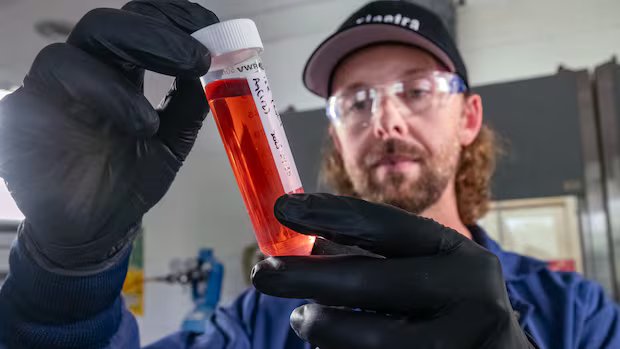
In the refinery’s lab, Graham Kinsman, Electra’s metallurgical lead, is busy tweaking chemical and physical processes to remove impurities like iron and copper from the cobalt.
“There’s a lot of specificity involved, so at each stage of the process we’re adjusting pHs, we’re addressing temperatures to make sure that we are efficiently removing the material that we need to remove,” he said.
The final product is a very pure form of cobalt that stabilizes the batteries so they don’t overheat and helps them hold a charge for a longer period of time.

A long mining history
Despite the town of Cobalt’s name hinting at an abundance of it in the area, the plant won’t be sourcing mined rock locally — or even domestically. Instead, it will be imported from overseas.
The community got its name after cobalt was found during construction of the Temiskaming and Northern Ontario Railway in 1903. But more important at the time was the discovery of silver.
The area immediately became the site of a major silver rush that lasted through the 1920s. At its height, it supplied 44 per cent of the world’s silver production, according to the Cobalt Mining Museum.

In the last decade, mining companies have been prospecting for cobalt in the old silver mines, hoping to spot the tell-tale pink “cobalt bloom” that occurs when cobalt comes into contact with oxygen. But none so far have found a vein that could sustain a mine.
Mell’s former company, First Cobalt Corp., was among those that were prospecting and coming up short. But in 2021, the company rebranded as Electra and began the work to re-tool a former metals refinery in the area.
Overseas cobalt has a ‘bad brand’
The supply will come from the Democratic Republic of Congo (DRC), where about three quarters of the world’s cobalt is mined, according to Natural Resources Canada.
From there it will be sent to the Port of Durban in South Africa, then shipped more than 20,000 km by sea to the Port of Montreal and finally trucked about 700 km northwest to Cobalt.

Human rights groups and academics have long reported concerns about mining practices in the DRC, including the use of child labour, exploitative working conditions and poor environmental practices.
Mell says the company is taking steps to address these concerns. “We’ve been to the Congo. We’ve been to the mining site,” he said.
“There are annual audits that take place, either ourselves or third-party experts that will do it. And the battery makers do the same thing as well.”
Even with the checks and balances, “cobalt coming out of the DRC has a bad brand,” said Marilyn Spink, executive director at Canadian Critical Minerals & Materials Alliance.
As a result, she says, manufacturers are actively looking for alternatives for their batteries. So, “if battery chemistries are changing, you’re going to be making something that the market no longer needs.”
But that hasn’t happened yet. And Mell isn’t concerned.

“The demand curve for cobalt as a commodity is still going up,” he said. “The [Canadian] military demands alone are going to go up ten times by 2030. And so that’s a big market.”
Despite the potential for changing battery ingredients, Spink says building refineries — known as the “midstream” in the critical minerals supply chain — is good for Canada and could encourage domestic mining as well.
“Eventually, if there’s cobalt in Canada, we could stop importing the cobalt as you scale up.”
Chinese dominance
Currently, China has a monopoly on the battery-grade cobalt supply chain, refining more than three quarters of the world’s supply.
There’s only one refinery outside of China located in Finland, and it mainly supplies European customers.
According to Mell, that’s a problem, because when China cuts off access to its critical minerals due to trade disputes, he says “it sends a pretty sobering message back to the defence industry.”
Just this week, China imposed export controls on two U.S. critical minerals companies, prohibiting Chinese businesses from selling them certain products.

When it comes to the cobalt supply chain, Mell has no qualms mimicking China’s business model.
“This is a case of a Western company copying what’s happening in China. We don’t need to reinvent the wheel.”
Electra’s goal is to supply about four per cent of the world’s cobalt sulfate by the end of next year, and the company has entered a supply agreement with South Korean company LG Energy Solution for 60 per cent of its product.
The project has received $37.5 million Cdn in grants and loans from the federal and provincial governments. The U.S. Department of War has also shown interest, awarding about $28 million Cdn to the project.
The U.S. contribution has no strings attached and there are no formal agreements to send cobalt south of the border, Mell says, but he notes that Washington does want to secure part of the supply chain on this continent — just in case.
“The geopolitics is really driving a lot of the narrative on both sides of the border today.”