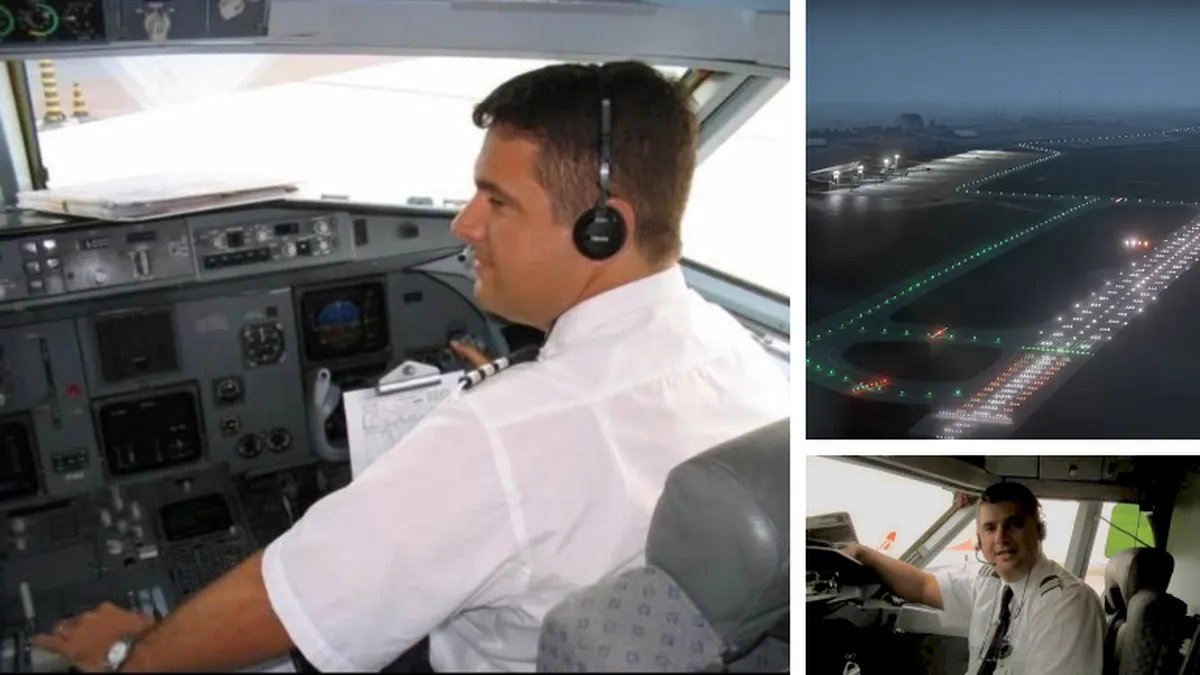
López de Haro knows this situation perfectly. Throughout his career he had to make missed approaches on more than one occasion. He especially remembers some early mornings in Montevideo where visibility was practically zero. and the only reference came from the cockpit instruments.
The new ILS Category III B changes that scenario because it allows certain aircraft to perform automatic landings guided with extreme precision by signals emitted from the ground. The procedure, known as autolandallows the plane to complete the maneuver even when the pilots have practically no visual references.
To explain it, use a simple comparison. “The ILS is like an imaginary cross that guides the plane to the runway. As long as that cross remains centered, you know you are coming exactly where you need to come”he points out.

The difference is that the new category takes that assistance to a much higher level. As he explains, the technology allows the plane to automatically follow the trajectory, touch the runway, maintain the central axis and complete braking practically on its own. “It doesn’t matter how fog there is. It doesn’t matter that you don’t see anything”he summarizes.
How does the system work?
Although it can be summarized as a “landing autopilot”, the ILS Category III B is actually a combination of technology installed both on the ground and in the aircraft.
The system emits radio signals from antennas located next to the runway that tell the aircraft, with extreme precision, whether it is aligned correctly and whether it is maintaining the proper angle of descent. These references are captured by the aircraft’s instruments and processed by its flight computers.
When the aircraft and crew are certified to operate under this category, the system can execute a automatic landing (or autoland). In this case, the aircraft follows the trajectory indicated by the signals from the ground, touches the runway at the planned point and maintains the central axis during the first seconds of the landing roll.

For this to be possible, it is not enough to simply equip the planes. It is also required specific infrastructure at the airportas high intensity beacon systems, precision radio aids, weather sensors and operating procedures specially designed for very low visibility conditions.
In Carrasco, the implementation of ILS Category III B involved the installation of hundreds of LED lights, dozens of kilometers of wiring, the modernization of the radio aid system and the incorporation of meteorological technology capable of accurately measuring runway conditions in real time.
The result is that pilots can operate with visibility margins much smaller than the current ones. While with the previous system fog could force flights to be canceled or diverted, the new technology allows operations to be maintained in situations that until now represented a barrier for the airport.
Fewer delays, fewer cancellations and fewer detours
The public discussion about the system was marked in recent months by differences between the National Directorate of Civil Aviation and Aeronautical Infrastructure (Dynacia) and the air traffic controllers regarding the number of personnel necessary to operate the new technology.
The relevance of the new system was also reflected in a proposal made by the International Air Transport Association (IATA)an organization that brings together more than 360 airlines all over the world.
At the beginning of June, the entity sent a letter to the Uruguayan authorities requesting that ILS Category III be implemented “as soon as possible”. The document was sent to the Dynasty and sent a copy to the ministries of Defense, Transport and Tourismin addition to the authorities of the Carrasco Airport.

According to IATA, the implementation of the system is especially important with the arrival of winter, when fog and other adverse meteorological phenomena increase the need for operate under low visibility conditions.
In this sense, from the perspective of passengers, López de Haro believes that the benefits are much easier to understand. Each winter leaves a long list of flights delayed, canceled or diverted due to fog banks that prevent normal operations in Carrasco.. For him, new technology aims precisely to reduce that problem.
“Forget it, there are no more cancellations or detours”states to The Observer. Although it clarifies that the implementation will be gradual and that it is still there are operational restrictionsmaintains that the final objective is for fog to stop being a determining factor for airport operations.
It is already operational, but with restrictions
The low visibility landing system ILS Category III B began operating at the Carrasco International Airport since last Friday, after the Dinacia and the Ministry of Defense will agree with air traffic controllers on a series of measures to strengthen operations.
As reported by the Association of Air Traffic Controllers of Uruguay (ACTAU) to The Observerthe authorities recognized part of the technical observations raised by the union, among them the need to have at least three drivers per shift to operate the system safely.
The implementation will initially be partial and with restrictions: The ILS will be used for landings only and will allow the arrival of approximately one aircraft every 20 minutes in low visibility conditions. To cover the required shifts, overtime will be used mainly while medium-term solutions are analyzed, such as the incorporation of personnel from other airports.
But The improvement not only impacts travelers but it also has important economic consequences for airlines.
Each missed approach means additional fuel, extra flight time and operating costs that end up accumulating during the most difficult winter months. When a plane must divert to another airport, the bill grows even more. “A single missed approach can cost an airline between one thousand and two thousand dollars. If the plane has to divert, the figure multiplies”explains López.
For this reason, he considers that the incorporation of the ILS Category III B is a necessary condition for Carrasco to advance in an aspiration that has been on the table for years: to become a regional connection center. “No company wants to operate regularly at an airport where there is the possibility of having to divert every time fog appears. This improves the reliability of the entire system”he maintains.
The pilot who learned to explain
In the last few days, while the fog caused delays, cancellations and detours in Carrasco, One of López de Haro’s videos explaining the operation of the new landing system began to circulate massively on social networks and went viral.
With simple graphs and everyday examples, he explained why an airport can be practically paralyzed when visibility drops to a minimum and how the arrival of ILS Category III B can change that scenario. The content was shared thousands of times and made it, once again, one of the most consulted voices to translate complex aeronautical concepts into the language of passengers.
However, the authority with which he speaks on the subject comes from a life dedicated to aviation. The first time López de Haro flew he was just seven years old. Her mother had separated and had started a relationship with a pilot. One day they invited him to board a plane in Paysandú. From above he saw the world transform into a map and felt something that he still remembers clearly.
“At seven years old, flying is magical“, he says. That fascination ended up becoming a profession. Over the years he worked for different airline companies, He transported funds for Banco República, operated executive flights and international freighters and accumulated thousands of hours of cabin experience.

However, popularity came through an unexpected path. For years he discovered that every time someone found out he was a pilot the same confession came up: the fear of flying.
Over time he understood that a good part of that fear was born from ignorance. “The most dangerous question for people who are afraid of flying is ‘what if?'”he explains.
What if an engine fails? What if something happens? What if the plane crashes? To combat these doubts, he began recording videos explaining aeronautical concepts in accessible language. What started as an experiment ended up becoming a community that today brings together more than 100,000 followers on TikTok and tens of thousands more on Instagram.
But the numbers are not what you value most. He remembers passengers who wrote to him from a departure lounge to tell him that they had gotten back on a plane after years, people who were able to reunite with family in other countries, workers who regained job opportunities that they had previously rejected for fear of traveling. “That made me cry“he admits.
“Fly calmly”
After talking about automatic landings, instrument systems and approaches in low visibility conditions, López de Haro ends up returning to the same theme that made him famous: fear.
Therefore, when asked What would you say to a passenger who looks out the window and sees nothing but a white mass of fog?avoids technical explanations, preferring to remember something much simpler.

The pilots in front know perfectly well the limits of the aircraft, work under extremely rigorous procedures and have exactly the same objective as those traveling behind. “The pilot in front is a father, son, grandfather…“, says.
And then he sums up a lifetime of experience in a phrase that, perhaps, explains why thousands of people listen to him when he talks about aviation: “No one is going to do something that is not safe, fly calmly”.