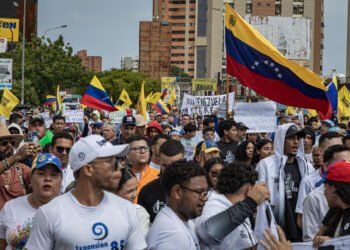
Abelardo de la Espriella is the new president of Colombia.
According to the pre-count, with 12,959,542 votes he gained a narrow lead of 245,000 votes over his rival, Iván Cepeda. And in his victory speech he used a radically different tone than his campaign speech. He promised to govern for all Colombians, including those who did not vote for him, to not persecute opponents for thinking differently, to respect the balance of powers and not to deceive Colombians with miraculous solutions.
That is to say, From the outset he assumed the tone of a ruler and not of a candidate who will prolong his campaign already elected. It was a surprising speech given the very polarizing one he used in the campaign and with which he became an electoral phenomenon. His victory breaks the rules of politics of the last two decades.
Although throughout his life as a lawyer he has been an insider in areas of power, many of them murky, he arrives at the Casa de Nariño as an outsider, without commitments to traditional parties or economic conglomerates. The way he won evokes Álvaro Uribe’s victory in 2002, when the former governor achieved a surprise victory in the first round, although even in his case many political parties joined him in the last stage. Abelardo kept the majority away.
Two things are different, he has much less experience in the State than Uribe had and – after a victory in the pre-count with a difference of less than 250,000 votes – he receives a much narrower mandate.
Even so, he will be the first president truly without ties to the political or economic class—instead of politicians, between the first and second rounds he received endorsements from celebrities—which gives him immense freedom to govern although little predictability for his government.
Abelardo De la Espriella won because he managed to embody three things at the same time: the punishment of Petro, the promise of order and the hope of a country that longs for a president who bets on private initiative, merit and the return to traditional values. He did so with a modern, disciplined campaign, which was nourished by the symbols and methods of an international wave of the populist right led by Trump.
The question now is whether a president elected as an outsider can govern within the rules he promised in his speech to respect.
Because although he campaigned on the promise of extreme change against the Petro government, his narrow lead takes away room for his most radical proposals and he will govern with a strong opposition in Congress and in the streets, active courts, an increasingly deepening fiscal crisis and a press that is scared but willing to carry out its mission.
The Abelard phenomenon
Fye a completely emotional campaign centered around politics as a digital show and a political marketing product. De La Espriella managed to personify the rejection of the establishment, of politicians, become the de facto candidate of the Democratic Center against the will of Álvaro Uribe (whom he did not mention in his speech) and defeat the candidate of a popular president like Petro, who worked hard to ensure that Iván Cepeda won.
It was a creative campaign built around the figure of a tiger turned into a man, a patriotic liturgy, a military aesthetic, influencers who used AI to stigmatize opponents and journalists, social networks, a luxury display, bulletproof vests on top of clothes, an armored box, and many slogans.
More than a detailed program – he delegated public policy explanations to his vice presidential formula – Abelardo’s campaign used the language of existential threat; he, the savior of the country against communism; he, the defender of freedom and order in the face of chaos and narcoterrorism; he, the representative of good citizens against internal enemies; him, the antidote versus the poison.
Abelardo portrayed a conservative, religious country that appreciates personal effort and that rejected the Petro government’s indolence regarding health and safety.
That emotional language permeated a country that President Petro has been dividing for four years between rich and poor, slavers and slaves, those from Chapinero and those from the periphery. But Abelardo benefited above all from the weakness of the traditional parties, feeding the existing contempt for politicians.
Even against Álvaro Uribe, whom he had always said he admired. In his fight against Paloma Valencia, his campaign influencers attacked the former president in AI videos, painting him as subordinate to his nemesis Juan Manuel Santos. While Uribe supported Paloma Valencia as a “woman with clean hands” who was going to take care of everyone, even the Petristas, Abelardo distanced himself by painting himself as the avenger. And so, in that way, he captured the right-wing vote early without having to be organically Uribista.
One of the questions starting today is whether with Abelardo’s victory a new, populist and libertarian right like that of Trump and Milei is born, or if the new president will govern more with the traditional flags of the right. Since De la Espriella is a pragmatic and non-ideological man, it could be either of the two.
The vehicle of anti-Peterism
Because although Abelardo won without having to seduce the center, Abelardo won more as a vehicle of anti-Petrism than as the absolute owner of a new ideological majority. The president-elect’s speech seems to have understood him this way and that could make the difference in the effectiveness of his mandate.
As happened four years ago when Gustavo Petro was elected with votes that were not necessarily all from the left or from Colombians who longed for the same revolution as the leftist president, the votes of the new president are not all from furious “abelardists.”
A part, yes, voted for him because they wanted to punish Petro and the left. Another voted not so much out of anger as out of fear of what four more years of continuity of the Pact would mean, especially for the health and economic crises.
Another part of his voters want order and security, not the ideological battle he poses. Another, however, did so because she identified with a candidate who advocated traditional family values, who has four children, who claims extreme masculinity and who rejects Wokism. And another did it for an economic calculation. Businessmen who felt mistreated by Petro, middle classes tired of uncertainty, sectors that long for favorable rules for investment. Quite a few did so with the hope that a government would arrive that would put an end to the rampant corruption of the Petro government.
In other words, many people voted with the hope of preventing another four years of Petro, and not necessarily to see him extradited, to see the elimination of the left or to impose religious education in schools. Just as four years ago people voted to punish Iván Duque and Uribismo and not necessarily to end the health system that existed or to stop there being more oil exploration.
Petro interpreted it as total adherence to his program and he was wrong. The proof is that today he ended up handing over power to the person who promised to punish and extradite him.
Judging by his more institutional speech and typical of a person whose central mission is to represent the unity of the country, De la Espriella seemed to understand that he will arrive on August 7 to govern a country that is divided in half.
*Article originally published in The Empty Chair.