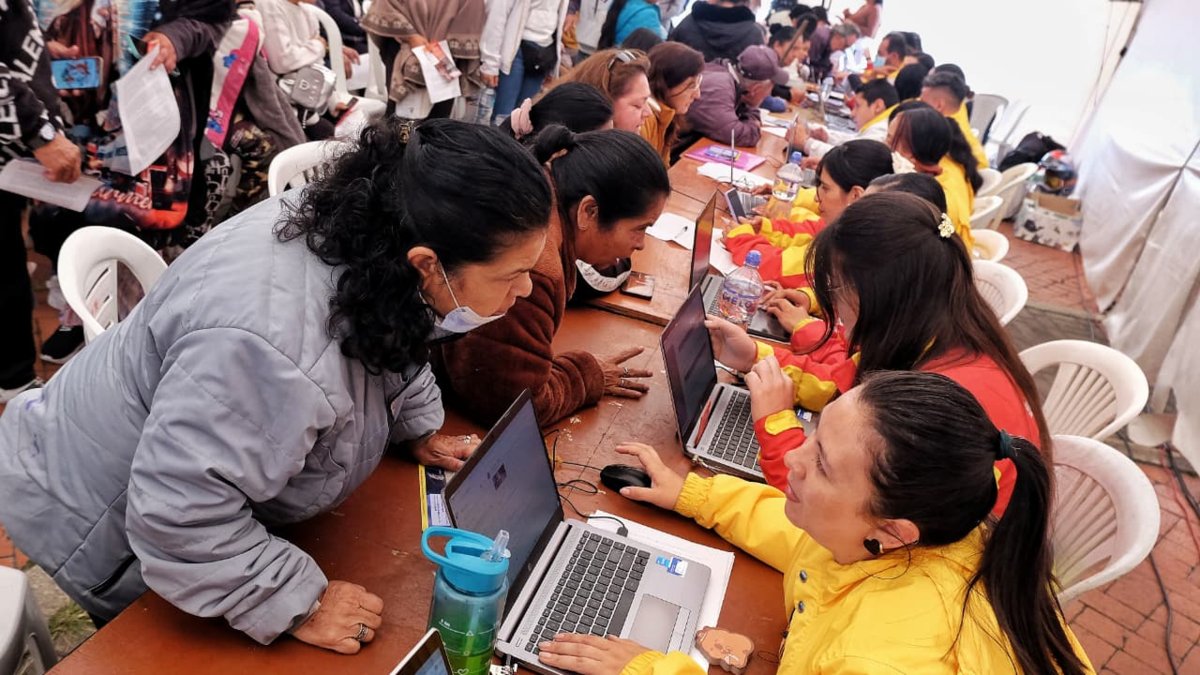
For a few days now, news has been circulating that Sisbén is over, which is the system that the Government has to classify the population according to their living conditions and income, which allows subsidies to be focused on those who need them most.
READ ALSO

Photo of Sisbén. Photo:Mayor’s Office of Bogotá
Today, the Sisbén database has around 30 million people and is certified by the National Planning Department (DNP), the entity that prepares the surveys carried out by each municipality with its inhabitants.
On these bases the population is organized by groups. For example, in A there are all people who belong to extreme poverty, That is, it is the one that has the highest priority to access government aid.
In Group B are those in moderate poverty, in Group C are the vulnerable, that is, those who are at risk of falling into poverty, and in Group D are those who are neither poor nor vulnerable.
Does it end after July 1?
Although news has circulated that this system could end as of July 1, National Planning told this medium that it isn’t true; What will happen is that this model will evolve as a new system called the Universal Income Registry (RUI) will begin to be implemented. which is a new tool implemented by the Government that centralizes and cross-references databases to estimate the real income of each household.
READ ALSO

“The categorical answer is no; Sisbén does not disappear, it evolves,” said the entity led by Natalia Irene Molina.
The transition to this The new model will begin to be implemented in Bogotá this July 1, the date on which the first official version of the RUI will be known. However, the entity indicated that it will be developed throughout the country and that its final adoption is expected in the second half of 2026.
Sisbén survey update Photo:District Planning Secretariat
“It is a project of national scope, not exclusive to Bogotá, whose definitive adoption as The only instrument for targeting social spending will be from the second half of 2026“, they stated.
During a recent session in the Council of Bogotá, the district secretary of Planning of the capital, Úrsula Ablanque Mejía, explained that The RUI will be fed by databases from 47 entities, including Dian, the National Registry and the Ministry of Educationamong others, and that its implementation will have a transition period of two years. According to him, the system seeks to overcome the limitations of instruments based exclusively on self-declared information and improve the targeting of social programs.
Will anything change for people who are already in Sisbén?
The Bogotá Planning Secretariat maintains that people who are already registered in Sisbén should not do anything beyond keeping their information updated.
“The RUI will function as an instrument that compiles different sources of information, including Sisbén, so it is possible that the articulation of these databases generates changes in the current classification; it will depend on the socioeconomic information of each of the households,” they confirmed.
READ ALSO

This means that Sisbén will no longer be the instrument that provides the final classification with which subsidies are decided through the current groups. With the entry into full force of the RUI, this It will become just one more source that will be added to the information provided by other public and private entities.
According to citizen complaints, some people had offered to downgrade for votes. Photo:Cali Mayor’s Office
“The RUI will use all that combined information to determine the new population classification in a much more precise way. In summary: Sisbén remains as a collection tool and database, but the official classification to access the social offer will depend exclusively on the RUI“, they explained from National Planning.
With all this, the DNP will begin to calculate the observed and/or presumptive income to build a socioeconomic classification closer to the reality of each household.
Could people lose subsidies?
By incorporating these new sources of information, some people could be classified in better socioeconomic conditions than those previously recorded; instead, others could show greater vulnerability.
READ ALSO

However, the Government warns that this does not mean that they automatically lose benefits or access to social programs since Each program must analyze the impacts and define its transition mechanisms before making decisions about their beneficiaries.
Sisben Photo:Sisbén and Canva
“It is important to emphasize that the Sisbén is a classification system, just as the RUI will be when it is implemented, therefore, each social program is headed by the entity that executes it. will define your entry, permanence and retirement criteria“, they point out
Just as Sisbén has been until now, the RUI classification will serve as an input for the targeting of subsidies, but decisions about entry, permanence or withdrawal of beneficiaries will continue to be the responsibility of each social program.