Anyone who believes and hopes that something in this world can change for the better is forced to listen to reproaches from time to time: why are you so naive at your age? All these stories about the “new times”, in which everything will be different, have already been heard more than once. But it doesn’t take long and everything goes back to the same old routine. Everything repeats itself in a circle. It will be exactly the same this time as well.
There are objections to these accusations. We even had a special party in Latvia: “Jaunais laiks”. Forerunner of “Unity”. The same “Unities” that now embody long-standing stagnation and the “old days”.
At that time, “Jauno laikai” was led by an even bigger revolutionary than today’s Andris Kulbergs – Einārs Repše. It was not for nothing that he was called “the Martian”, and he himself did not shy away from this nickname. Where is Repše now, and what is his historical and political legacy in the people’s memory? A “Martian” minister in a striped latex suit.
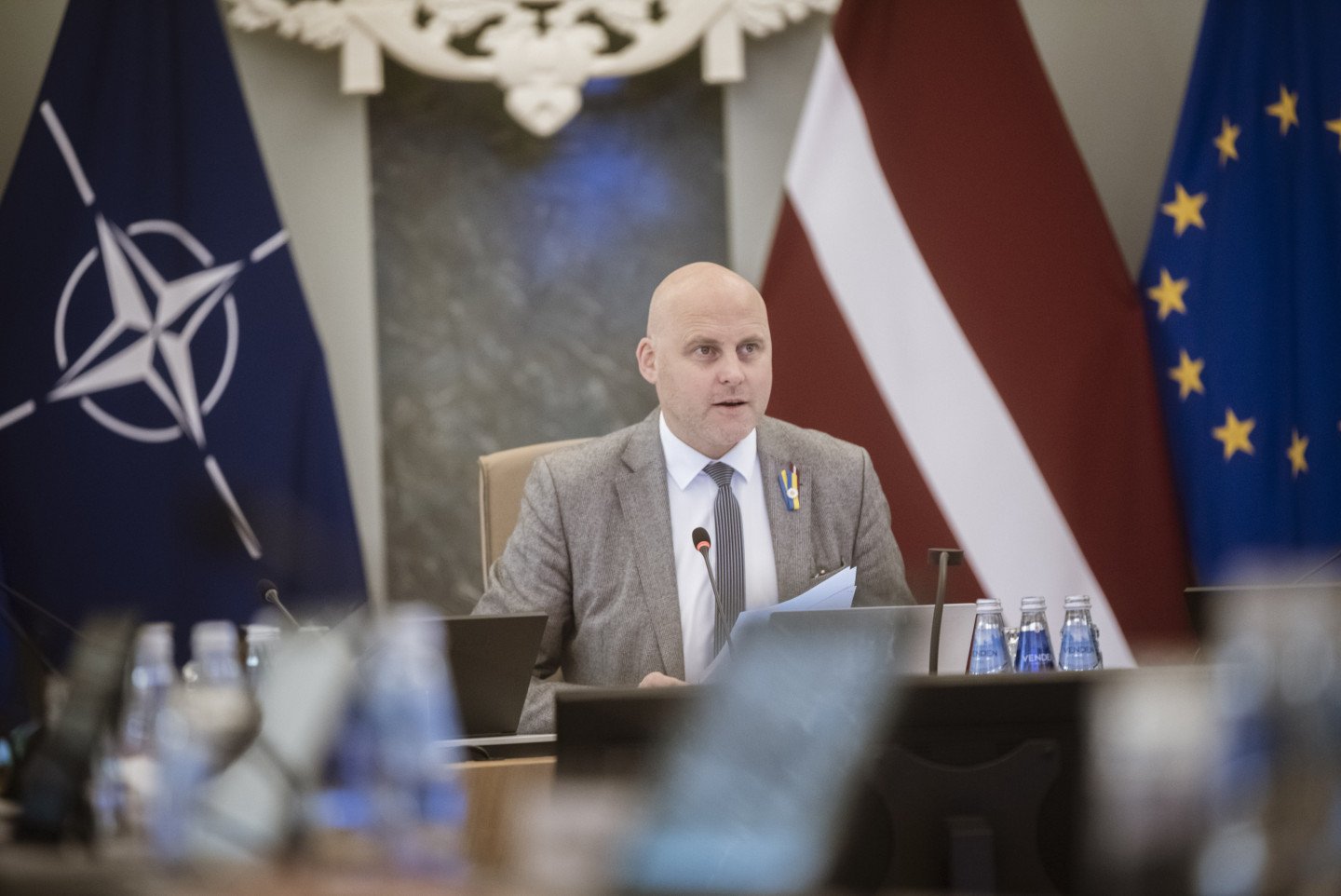
Historical experience says that even the Kulberg system will “mix”, break, “enter and saddle”. But that’s how it should be. Kulberg, like any other leader, has to fit into the overall system, which is bigger than himself. Another thing is that this “new” system will not be exactly the same as it was before him.
First, let’s find out what’s new in this system. First, another level of openness. Even from the days of “perestroika”, I perfectly remember that change begins directly with openness (“glasnostj”). Paraphrasing Imanta Ziedonis: without openness, everything is small and bread is not cut by a sharp knife. All change-makers should remember this.
I will admit, when writing the word – openness – I had to think whether to put this word in quotation marks or not. After all, Kulberg, on the contrary, is trying to make government meetings less open and to end such wide public access. It is, but it is more about the apparent openness than the real one. Just because something happens in public doesn’t mean it’s open. It just means that the real decisions are made elsewhere.
With Kulberg openness, I understand something else. First of all, the daily video recordings of Kulberg himself, in which he informs the public in simple, humane language about what he has done during the day, as well as the regular tweets of Guntars Vitols, advisor to Finance Minister Mārs Kučinskis, which he has not stopped writing since starting work in the system.
In this respect, Vitols’ records are extremely blessed precisely because he unashamedly (without naming specific words), as he says, “from inside the bunker” describes how businessmen who have turned this road into a well-trodden path and now feel unpleasantly surprised that “access to the trough” has closed, come to the “trough” (Ministry of Finance). Another question: for how long? Closed or closed, and to whom?
Unfortunately, historical experience once again shows that this ban on access is usually not very long-lasting, because no one, not even the strictest guardian of public finances, is able to withstand for long the enormous pressure of the “wanting to eat” masses. “Senior” political observers remember how, back in 1992, the then head of government, Ivars Godmanis, issued an order banning the export of non-ferrous metals every other day (due to public pressure) and was forced to cancel this order each time in the following days (due to pressure from non-ferrous metal traders).
There is no doubt that even today Kulberg himself, Kučinskis, Vitols and others sitting at the decision-making table are surrounded by friends, friends of friends and acquaintances, bombarded and persuaded by “friendly” suggestions. There are “missed calls” on their phones, but queues are forming at the doors of their offices with those who say that there was a “terrible misunderstanding”: in this completely correct direction to reduce the “wasting” of budget money, his small business also accidentally got under the wheels of the bus, which is, of course, completely unacceptable. There is no doubt that spending should be reduced, it’s just that others should do it. For them there, not for me.
Vitols writes: “There are the first signs that the rats are getting excited. A good sign! I just found out that one was planning to wipe out almost 4 million in a very questionable procurement of ‘programming hours’, which will now be stuck in moratorium.” It is about the 30-day moratorium on IT purchases announced by the government. An obvious question immediately arises: what will happen after these 30 days? Is it the same as during Godman’s first government? Lifting the moratorium? Reinstating ‘dubious’ procurement practices?
If I had to put my own money on the tote, I’d bet on that. I will explain the reason for my choice. The fact that Vitols does not call these “rats who are worried” by name is an indirect confirmation that he himself does not fully believe that the pressure will be fully endured. But if you don’t believe in victory yourself, then winning is extremely difficult. Then the opponent must be distinctly weak, which is definitely not the case in this case.
It can be argued: Vitols is simply aware of the legal consequences if a procurement is publicly called “dubious” in advance, so it sticks to this vagueness. Again true, but you can completely change the style of the post. No one to call “rats”, no purchase “questionable”. Legally and semantically correct words can be found for these designations, but let’s name these companies that apply for four million financing. In the words of Willow, “wiping”.
There is another important reason to call “dubious sweepers” names. On the one hand, naming one will also leave dozens of others “behind the scenes”, which can be used as an excuse not to name anyone, but again is a counter-argument. By naming one in particular, everyone else will also immediately become more attentive, slowing down their shameless insistence: give money!
It is easy for us who do not have to bear this pressure to speak, but the fact that at least some movement has begun to stop or at least reduce the “wiping out of millions” is in itself another “new thing” that allows us to speak of Kulberg’s “new times”.
There is little doubt that in the “old days” this “wiping down 4 million in a highly dubious procurement of ‘programming hours'” would go down like a stick. With the signatures of all well-paid senior officials of the Ministry of Finance and civil servants, who would receive decent bonuses in the amount of a month’s salary at the end of the year for these signatures. That is, a five-figure sum.
In answer to the question posed in the title: how long will these “new times” of Kuhlberg last, one thing can be said. We will be able to detect the end of these “new times” very easily. This will happen when Vītola’s recordings can no longer be distinguished from the recordings of the State Secretary of the Ministry of Finance, Baiba Bāne, but the Prime Minister himself will have replaced even the apparent humanity in his nightly video recordings with undisguised formalism, and in his communication will have completely switched from Latvian to the state language of the apparatus – the language of bureaucracy. Then we will also be able to say: the experiment is over. Everything has taken its course according to the old course. The curtain descends.