Finding a presidential candidate with enough support to be elected in the Riigikogu this September will not be an easy task, analysts have said, after Alar Karis announced he would not seek a second term earlier this week.
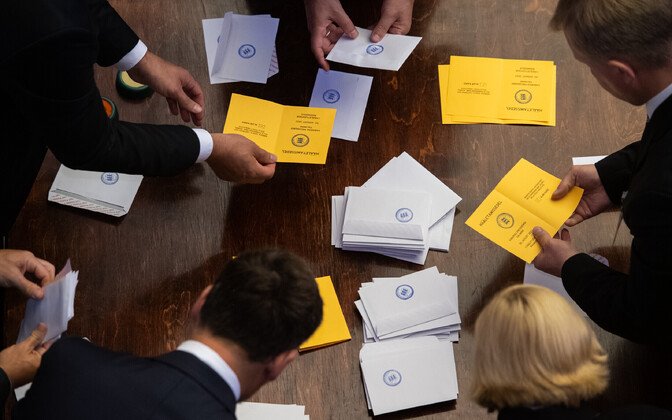
Karis’ successor will be elected by members of the Riigikogu, not directly by the public.
The candidate will need to win 68 votes of a possible 101. Even if the governing coalition and former coalition partner Social Democrats agree on a common candidate, they would still fall short.
Sociologist Juhan Kivirähk said politicians lack consensus on what qualifications the next president should have.
“The question is: what are we looking for? Are we looking for an expert in constitutional law? Then the president could be [justice chancellor] Ülle Madise or [lawyer] Jüri Raidla, who was born on the same day as I was. If we are looking for a leading representative in foreign policy, then we should turn to [diplomats] Jüri Luik or Jonatan Vseviov,” Kivirähk said.

Kivirähk added that psychologist Mati Heidmets could, as president, promote issues concerning society. There is no shortage of strong candidates, but not all of them are likely to be acceptable to everyone.
Tarmo Jüristo, head of the Liberal Citizen Foundation (SALK), said the parliamentary election campaign is also making reaching consensus more difficult.
“The general tug-of-war and attempts by parties to score points against each other in the parliamentary election campaign affect the presidential election process and its course one way or another. It would be nice if they didn’t. Unfortunately, in practical political life, these things are not separate,” he said.
Jüristo said it is difficult to know how the 15 unaffiliated MPs in the Riigikogu will vote.
“That is one very big unknown—exactly which way all those votes currently sitting under the window will go, because it is likely to become important,” he told “Aktuaalne kaamera”.

Analysts said the president is more likely than not to remain unelected in parliament. The outcome in the electoral college is difficult to predict. For example, there was a serious confrontation in 2006, when the candidates were Arnold Rüütel and Toomas Hendrik Ilves.
“That was when the liberal and conservative camps faced off, and before the electoral college convened, no one knew what the outcome would be. In the end, Toomas Hendrik Ilves was elected,” Kivirähk recalled.
Karis said on Tuesday that he would not run. Art Johanson, an analyst at the Institute for the Study of Societal Issues, believes that if parliament fails to elect a president, politicians could ask him to stand again.
“If it goes to the electoral college, then the situation will probably become a bit more heated, and that’s when negotiations may begin. But for now, there are still two months left,” Johanson said.

He said no candidate is likely to build the level of support that Alar Karis has within the next two months.
“If it happens that a very unpopular candidate is elected, then the parties that push that person through will certainly also lose support in the polls. In that sense, this is definitely going to be a major test for the parties,” Johanson said.
The first round of the presidential election will take place on September 2.
—
Follow ERR News on Facebook and Twitter and never miss an update!