HIGH QUALITY:
Dairy farmers in Taiwan are extremely prudent when raising their dairy cows, compared with imported products, an official said
-
By Yang Yuan-ting / Staff reporter
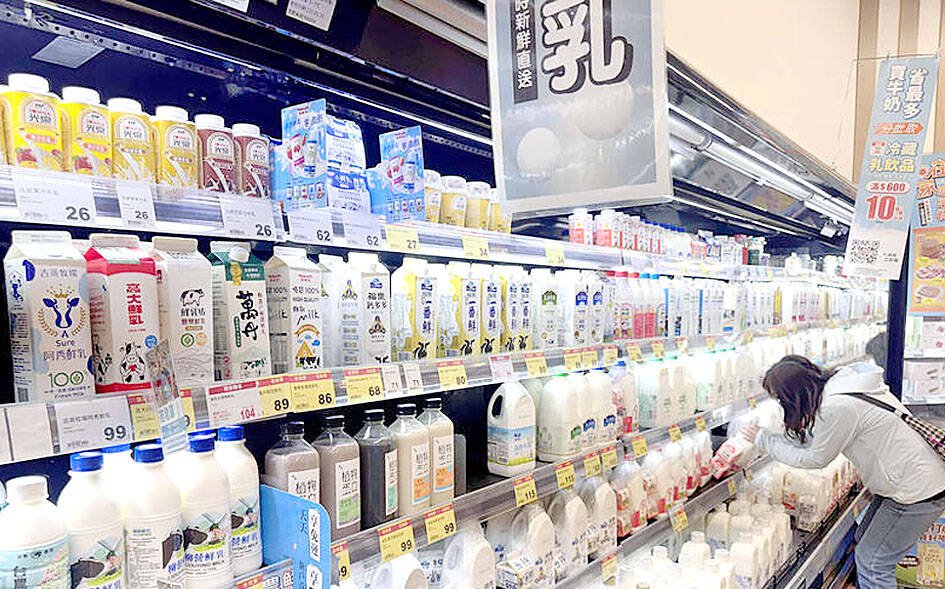
The Dairy Association of Taiwan yesterday said that raw milk used in Taiwan’s fresh milk — including sterilized milk — is Grade A milk, saying that its quality standards are fundamentally different from those of dairy products imported from other countries.
The comments came after a recent global cost-of-living survey ranked Taiwan as having the world’s most expensive milk, with an average price of US$3.09 per liter, sparking widespread discussion.
Raw milk is graded from A to D according to their somatic cell count (SCC), with Grade A milk containing fewer than 300,000 cells per milliliter (cells/mL), Grade B ranging between 300,000 and 500,000 cells/mL, Grade C between 500,000 and 800,000 cells/mL and Grade D from 800,000 to 1 million cells/mL.
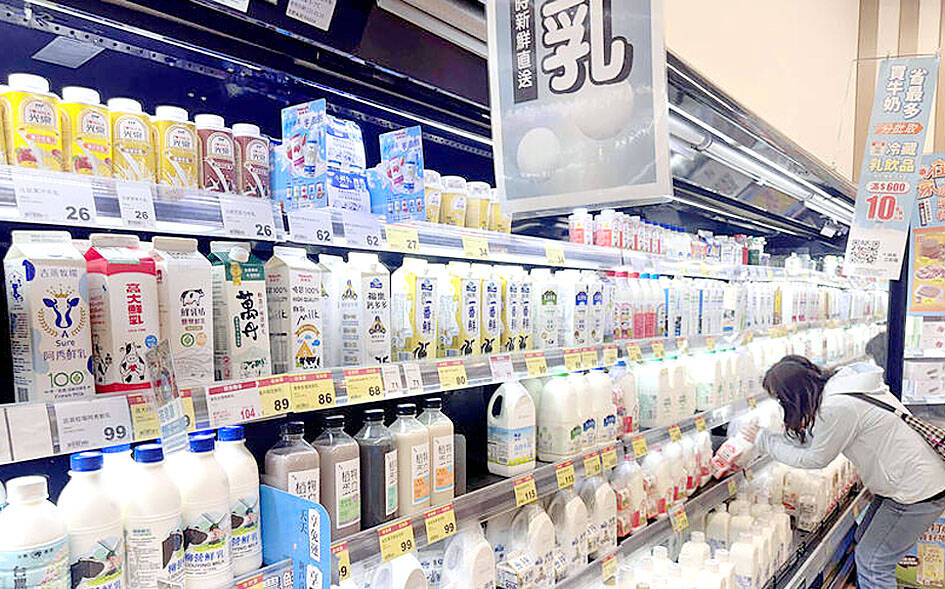
Photo: CNA
Association chairman Hsu Jih-tay (徐濟泰) said somatic cells primarily come from a cow’s mammary gland cells, so if a dairy cow’s udder is healthy, the SSC in its milk would remain low, and a sudden increase in the SSC usually indicates that the cow is experiencing inflammation.
When Taiwanese dairy plants sign contracts with dairy farmers, they only accept Grade A raw milk, and any raw milk with lower grades must be discarded, he said, adding that low-temperature pasteurization is used to preserve nutrients in fresh milk.
Even though regulations in Taiwan permit certain residual limits for veterinary drugs and antibiotics in raw milk, the contracts between dairy plants and farmers strictly require a zero-detection standard for both, enforcing even more stringent rules than legally required, he said.
When dairy plants use large milk tankers to collect raw milk from dairy farmers, a single tanker can collect from two to three contracted dairy farms at a time, Hsu said, adding that a sample is retained from each farm before collection.
Before final unloading from the tanker, the milk is tested using highly sensitive test strips, and the entire batch is destroyed if non-compliance is detected, he said, adding that the retained samples would be used to trace which dairy farm caused the problem, which must compensate the other farms according to the contracts.
As the compensation cost can be massive, Taiwanese dairy farmers are extremely prudent and careful when raising their dairy cows, Hsu added.
In 2008, a massive food safety crisis involving the deliberate adulteration of infant formula and other dairy products with the industrial chemical melamine was discovered in China. Excessive intake of melamine can lead to impaired reproductive capacity, kidney failure and other health issues. Taiwan has since banned the import of Chinese dairy products.
Milk prices in China have recently slumped, falling to historic lows.
Animal diseases are prevalent in China and its epidemic prevention methods are opaque, Hsu said, adding that since milk can easily carry pathogens, it is not advisable to resume the import of Chinese dairy products.