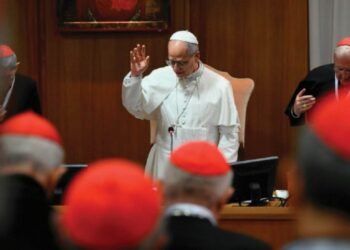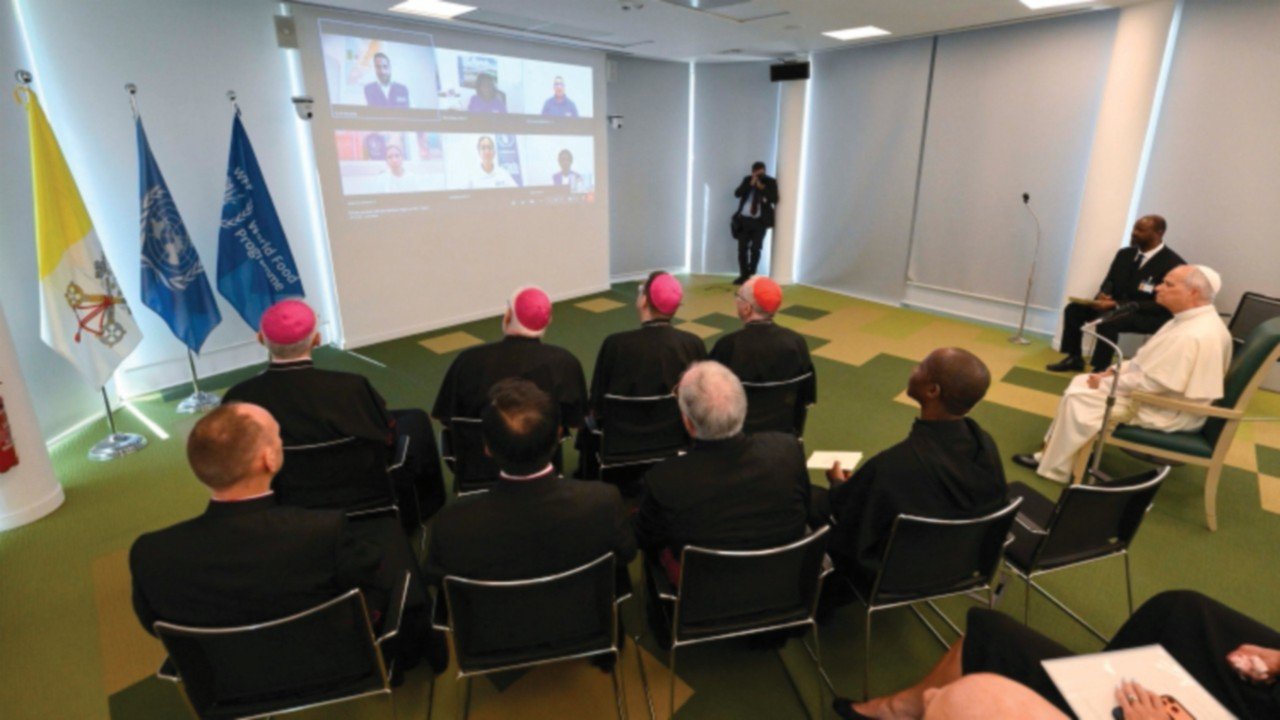
Not limiting ourselves to guaranteeing “immediate help”, food to those in need, but looking at the “root causes of hunger” on the one hand. On the other, the need to provide nourishment “that gives hope to build a world of peace”. These are the reflections offered late yesterday morning, Monday 22 June, by Leo XIV at the end of the visit to the headquarters of the United Nations World Food Program (WFP) in Rome. After delivering his speech to the Executive Council – which we published yesterday – the Pope conversed via video call with representatives of the border areas where WFP operates. Finally, before returning to the Vatican, he stopped to greet the employees in the Garden of Peace, insisting on the mission of a better future, especially for young people. Below, in our translation from English, the words of the Pontiff during the video link.
Good morning, good afternoon,
and probably good evening to all of you, scattered all over the world.
We are pleased to be here today, to share this brief moment with representatives of the different member nations that are part of the World Food Programme, but also with each of you who represent so many people engaged on the ground in the difficult task of fighting hunger. I don’t know if it’s appropriate to ask maybe two or three of you to say a few words about where you are and what the most difficult challenges you face are, because then I too will be able to hear some of the reality of what it means to fight against hunger. I know that many of you literally risk your lives to be in the places where you work, and I would like to assure you all of the prayers and support of the global community and, especially, of the Catholic Church, which is often an interlocutor and collaborator on the programs on which you oversee and work. The task of bringing aid to those most in need, of course, is often a great challenge. But perhaps, hearing some experiences personally could also help each and every one of us, present here in Rome this morning, to understand a little better, up close, the type of challenges you face.
(After the third presentation)
Thank you, Cyril, for the mission you are carrying out in Lebanon.
One of the things that people often don’t understand is the cyclical progression that leads many parts of the world into ever greater difficulty; hunger often causes conflict, and conflicts cause more hunger. And so we continue to go around in circles, as I’m sure some of you, if not all, have seen in the work you do. Often, the crisis that is affecting the entire world, in the field of migration, is also the result of extreme hunger and conflicts that force people to leave their homes, which they do not because they want to. They do it because they are forced to survive. So the work of each of you, of all of you together in the World Food Program — what we are certainly trying to support and promote — is very important, because together we are not just giving the immediate help, which is clearly essential, of bringing food to the hungry; we are also called to identify the root causes of hunger in the different areas in which you operate, to intervene there and to try to find solutions to those problems. The world today could live without hunger. Resources should be available. The capacity to produce food exists, and yet resources are often spent to promote wars and conflicts and, so to speak, other less important end results, so that hunger continues and, in some parts of the world, even increases. You are on the ground, on the front lines, and it is thanks to you that the work of the World Food Program can be carried out. I would therefore like to thank each and every one of you and all the people you represent. And I want to encourage you in your work, because it is very important that there are people who assist the World Food Program in providing this help to the many people in need. So thank you for what you are doing. May God bless you all and may you and your colleagues move forward. Please pass my message on to the people you work with, and may God always bless you in this very, very important work. Thank you.
And this is our translation from English of the improvised greeting from Leo XIV outside, before taking his leave.
My dear friends, good morning, good afternoon to all of you, to all those who are following online.
I am truly honored to be here in your presence, and to have among you so many representatives of the workers of the World Food Programme, who dedicate their lives to a special mission around the world and, as Mrs. McCain just said, even in places on the front lines that some have never heard of, in areas where they literally have to risk their lives every day to ensure that food supplies reach those most in need. This is truly a great mission, because it is a way to recognize human dignity – that same dignity given by God – which every person on the face of this earth deserves. So thank you for your service.
As I walked out through the garden, a number of different values and objectives of the World Food Program were represented. I would just like to highlight two words as I share these brief moments with you.
One of these is the word “community”. It is a word that is personally very dear to me and that I consider increasingly important, since we live in a world that is polarized, divided and marked by many conflicts and wars, where the destruction of human relationships continues for many different reasons, including technology. Instead of helping us create a better world to live in, technology is often used as a method of war, destruction and death. So, the work that you do — and, perhaps even more than the work itself, the spirit that you share as you all collaborate together in building community, in reaching out to communities in need — is truly a special gift. And I would encourage all of you to think about your role in being a family — Mrs. McCain used that word too, the family that you all represent — but to build a community around the world, so that you and your service are truly an avenue to help people come together, to be united, and to work together to solve the problems that cause hunger and to look for ways to create a more just world.
And the other word — the last one I saw on my way out — is the word “hope.” You represent, in a very real way, hope for the world, and this is a mission that I think we all share and that we all look to as part of our mission, both the Catholic Church, those of us who are believers, and those who work together because we believe in the human dignity of all. We say we want to build a world in which there is hope for the future. Very often we read about young people who no longer have hope, young people who, due to difficulties in their lives, do not necessarily live in the poorest parts of the world, but where they have lost a vision and a sense of their own existence. They have lost that ability to look into the future and say: «This is worth doing. This is worth giving my life for. For this reason it is worth meeting and looking for a way to move forward.” You represent hope. And the work you do, especially reaching those most in need, is certainly a sign of hope, a concrete expression of the hope we are all looking for.
So I thank you for this and I want to assure you all of my prayers for your work, for your mission, and for all who work in the World Food Programme. May you all be strengthened and protected as you carry out this mission, because food for the world is something that we all want to offer: food for the world in the sense of something to eat every single day, but also food that gives hope to build a better world, a world of peace, a world where we are all truly united. God bless you all and thank you.