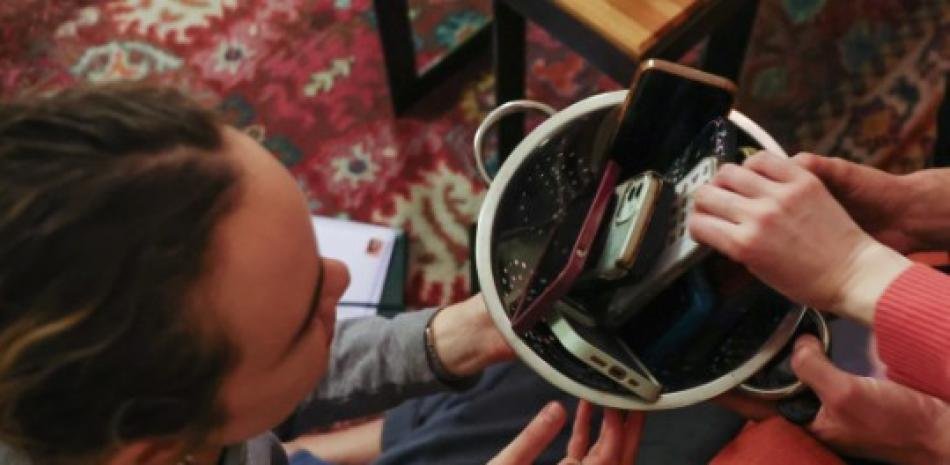
More than a dozen millennials gathered in a brownstone apartment in Brooklyn and they placed their phones in a metal strainer before two hours of reading, drawing, and talking—anything but staring at screens.
A similar scene was unfolding a few kilometers away, in an old cardboard box factory from the early 1900s. 20th century converted into luxury offices. Almost twenty people in their thirties stared at their mobile phones for a few minutes. Then they put them aside and looked at their own palms. Then, those of their neighbors.
The goal of the exercise was to emphasize the importance of paying attention to real life, and not the shiny screens that have taken over our world.
Two decades after Steve Jobs will present the iPhonea small but passionate movement, with branches in several countries, rebels against the omnipresent screen.
“The products have become more insidious, extractive and exploitative,” said Dan Fox, 38, who organized the meeting at the house. Members of the fledgling movement “want to start a revolution,” he said.
But can a “care activism” movement of millennials and members of the Generation Z break free from the largest companies in the world? The figures indicate no. However, cultural changes are beginning gradually, and the rebellion against what many call “human fracture” is growing.
Apple and other big tech companies say they have taken steps to help users reduce the time they spend on their devices, including features that track usage and a less attractive gray mode.
The “dumb phones” They offer a low-tech alternative.
Activists say it’s not enough
“They want to take down big tech,” says Fox, a comedian who works in marketing for Light Phone, a Brooklyn-based company, one of several “dumb phones” with basic features.
Unlike most modern products, the company boasts about the lack of features on its phones, such as “social networking, sensational news, email, internet browser, or any other anxiety-inducing endless stream.
Fox was inspired to join the movement when he attended a Tame Impala concert at the Radio City Music Hall in 2015. It felt like everyone in attendance was recording the concert with their phones instead of immersing themselves in the music.
“I realized that phones literally get in the way of the things I like,” Fox said.
Mobile internet access has become so integrated into modern life that one of the few places in the world where it is not readily available is wartime Iran, where authorities cut off internet access during mass protests in January.
A growing reaction
D. Graham Burnett is a historian of science at Princeton University and one of the authors of “Attention! A Manifesto of the Attention Liberation Movement,” making him a pillar of the growing backlash against the corporate exploitation of human attention.
Along with MS NOW host Chris Hayes’ best-selling book The Sirens’ Call: How Attention Became the World’s Most Endangered Resource, his work is part of a growing set of publications that urge people to step away from screens and pay attention to life.
Burnett says the “attention liberation movement” is about throwing off the yoke of apps that consume our time. People “need to reconnect with their nature. Their attention is the fullness of their relationship with the world.”
The people in Fox’s living room began the evening by introducing themselves, as if they were in a support group.
“I don’t feel good about my relationship with the phone. I feel like an addict,” said Riley Soloner, who teaches theatrical clowning and works as an usher at Carnegie Hall. He arrived with a backpack full of books, paper ones.
Other chapters have emerged around the world
Across the Atlantic Ocean in the Netherlands late last month, several people gathered in a neo-Gothic cathedral for a meeting of the Offline Club.
“We organize our events and meetings with different themes. One of them is connecting with oneself through creative activities, reading, writing or puzzles,” explained co-founder Ilya Kneppelhout. “It’s something that invites you to slow down, reflect and look inward.”
There are several dozen “care activism” groups in United States and Canadaand the movement has also emerged in Spain, Italy, Croatia, France and England. Burnett said he hopes it will spread even further.
In January, members of Oberlin College’s Harkness Housing and Dining Cooperative decided to run their organization without emails or spreadsheets, extending the move to a complete ban on technology in the shared spaces of the 1950s brick building.
“People expressed a sense of relief that they didn’t have to check their emails, or their text messages, or the news. It allowed us to spend a lot of time just talking to each other,” said Ozzie Frazier, a 21-year-old junior.
During the cooperative project, that lasted a month, people began checking out CDs from the library and enjoying craft nights, live music and the board game Bananagrams, Frazier said.
“A lot of people felt very connected to each other. Not having the devices gave them a kind of mental space,” Frazier said.
Wilhelm Tupy read “Attensity” after coming across it in a bookstore in Vienna and visited the School of Radical Attention in the neighborhood Brooklyn DUMBO during a trip last month.
He felt like he had found something that bridged his sporting career as a judo champion—with his need for focus and fluidity—and his post-retirement work as a business consultant.
“Nowadays, discipline is not enough,” he said. “It is increasingly difficult to maintain attention and concentration on goals and everything one wants to achieve and do.”