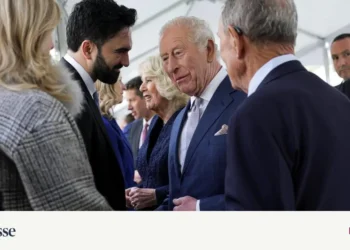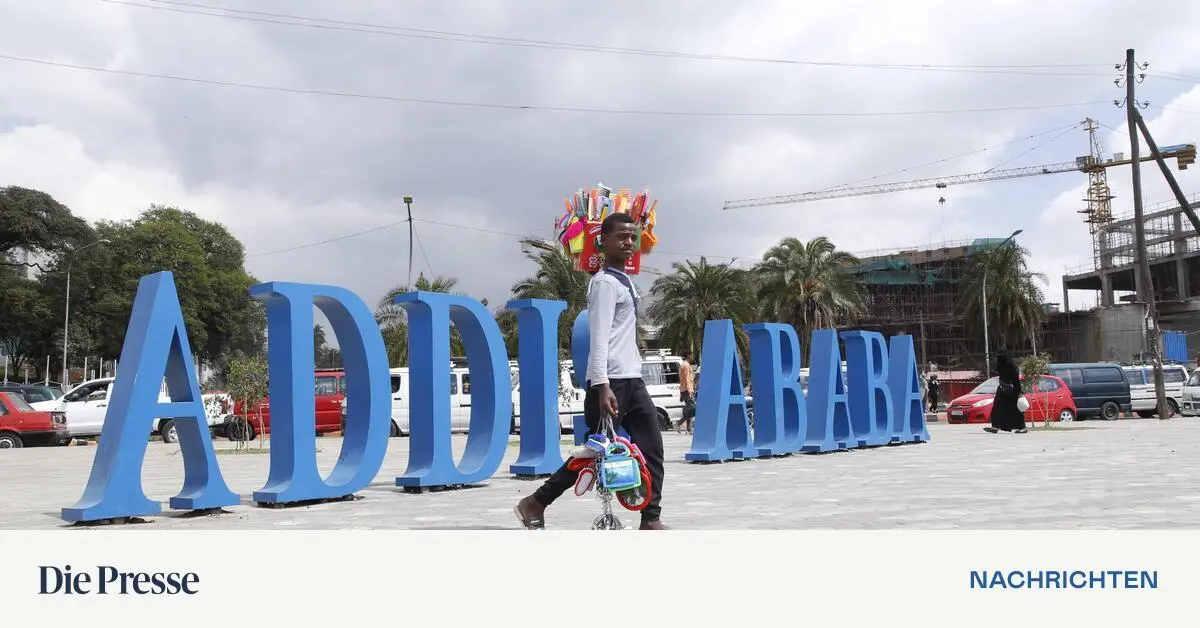
For Foreign Minister Beate Meinl-Reisinger (Neos) these are travel-intensive days. On Saturday she was one of the few EU foreign ministers to take part in the Antalya Diplomacy Forum in Türkiye. From there we should go directly to Addis Ababa. The budget negotiations forced her to return to Vienna at short notice. After these burst, we headed towards Africa again on Monday.
Because Austria expects new business in Africa. To this end, a memorandum between Austria and the African Union (AU) was signed on Monday by Meinl-Reisinger and the Chairman of the African Union, Mahmoud Ali Youssouf. Austria wants to get more involved in the Ethiopian market. The federal government’s new Africa strategy is being developed and is due to be adopted in June. With the aim of deepening economic cooperation and expanding existing projects.
In the course of this, Meinl-Reisinger also offered that the AU could set up a representation at the UN organizations in Vienna. “In this new world disorder, Austria needs strong partners,” says Meinl-Reisinger. In Europe people still have a wrong image of Africa. “The question is not whether Africa is relevant for us, but whether we as Austria or the European Union are relevant,” Meinl-Reisinger told journalists on Monday. In Addis Ababa, Meinl-Reisinger also met EU Commissioner Josef Síkela. Not only Austria’s relationship, but also that of the European Union with Africa should be significantly intensified. This is why there is the EU investment strategy Global Gateway, which was launched in 2021. It is essentially a competition to the Chinese Belt and Road Initiative. Essentially, it’s about investing up to 300 billion euros in various regions of the world – but especially in Africa. These investments will go into areas such as renewable energy, digital networks, transport infrastructure, healthcare systems and education. “Africa has long been more than a recipient of development aid. It’s about economic cooperation, security and migration,” says Meinl-Reisinger.
And it’s increasingly about geopolitical influence. Because Africa is becoming increasingly strategically important for Europe. Not only because of its wealth of resources, but also because of its demographic dynamics: around 70 percent of the population is under 35 years old. This is important for Europe, which is looking for skilled workers. With around 130 million inhabitants, Africa’s second largest country has enormous potential.
If you want to do business in Ethiopia, you can’t ignore Addis Ababa. With the headquarters of the African Union, the capital is the political center and the heart of a rapidly growing market. Around 300 European companies are already represented in Ethiopia, more than in any other African country. Big names like Siemens and Heineken are also there.
The business delegation that Meinl-Reisinger accompanied to Ethiopia shows that Austrian companies are also very interested in the market. Hopes are focused primarily on one project: the construction of a new mega airport in Bishoftu, around 40 kilometers southeast of Addis Ababa. The airport is expected to reach gigantic dimensions. Up to 100 million passengers a year, which is almost twice as many as at Frankfurt Airport. The existing airport in Addis Ababa currently serves around 25 million passengers. The cost of the project is the equivalent of almost eleven billion euros. The state-owned Ethiopian Airlines Group accounts for around 30 percent. There is great interest from international investors, especially from China and Europe. The tenders are ongoing and it should be clear in August who will win the contract. Austrian companies such as Frequentis, Tridonic or Trumer Schutz Buildings are more likely to come in as sub-suppliers, i.e. in the second line. Italy in particular is currently intensifying its discussions on financial support for the project, according to representatives of the Chamber of Commerce. The airport is scheduled to be completed in 2030. The project is one of the major prestige projects for Ethiopia. But it is also an economic necessity. The number of passengers is increasing rapidly. It was only in April 2026 that the domestic terminal of the existing airport was expanded by around 45 million euros.
Direct trade between Ethiopia and Austria has so far been manageable. At around five million dollars a year, exports to Austria only make up a negligible proportion. Austria has so far played little role compared to large buyers such as the USA or Saudi Arabia. The new agreement should change that.
Ethiopia’s export structure is currently changing significantly. For decades, coffee dominated foreign trade. But last year gold became the most important export commodity. The rise in gold prices and higher export volumes have led to a massive sales boom: Gold exports reached $3.5 billion last year. In 2024 it was still $409 million. Coffee exports increased from $1.4 billion in 2024 to around $2.65 billion in 2025.
The reason why the amount of gold exported has increased is that the Ethiopian government has lifted a ban: one of the most important local gold mines, the politically controversial gold mine Midroc Gold Mine Plc, was previously banned from operating due to environmental regulations. In addition, the foreign exchange market was turned upside down, among other things to curb gold smuggling. The Ethiopian birr was de-pegged from the dollar in 2024. Before the liberalization of the foreign exchange market, there was a large discrepancy between black market and official exchange rates. Smuggling was therefore widespread.