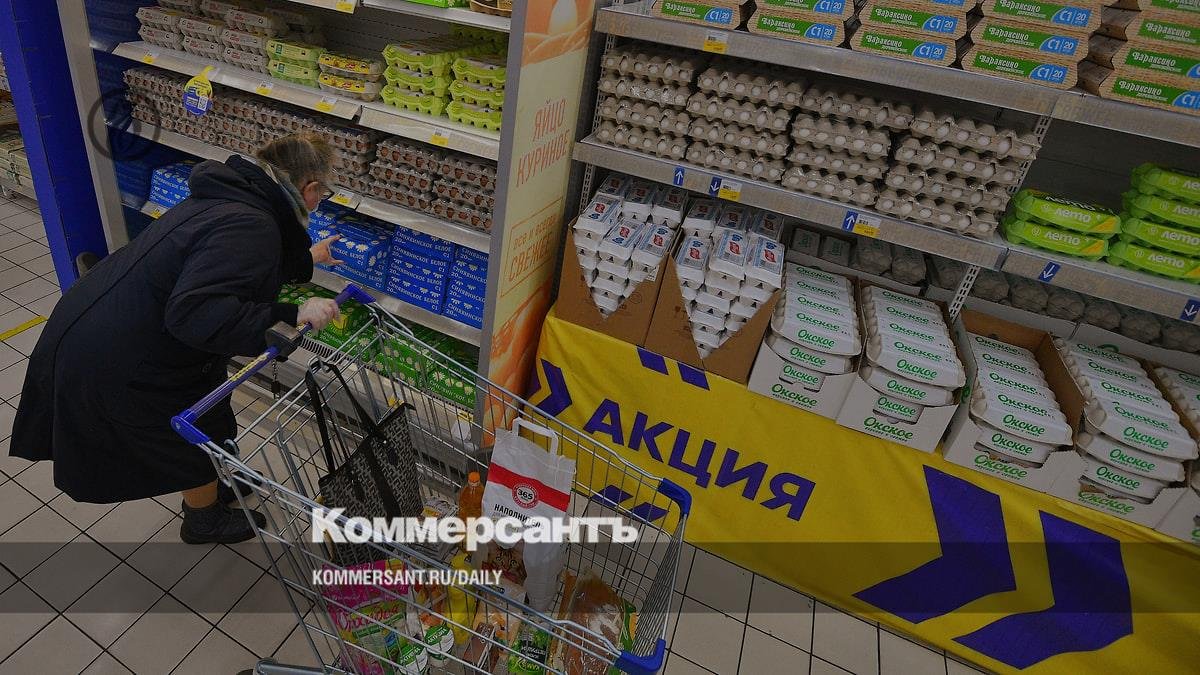
Due to the increase in production in conditions of limited sales and seasonal factors, large retailers are asking poultry farms to reduce purchase prices for eggs by 22–25%. Traditionally, more eggs are put on the market in the summer, while demand drops. But this year, manufacturers may be faced with the need to sell their products at 50% below cost.
Retailers X5 and Lenta approached suppliers with a proposal to reduce egg purchase prices for July under long-term contracts. The networks propose to set the cost for C2 at 35 rubles. for a dozen, C1 – 45 rubles, C0 – 50 rubles, citing the fall in general market prices. This is stated in letters received by the company (Kommersant has it). Representatives of three poultry farms confirmed to Kommersant that they had received the letter. One of them clarified that we are talking about reducing prices by 22–25% from current ones. This correction, according to him, will be the fifth since the beginning of the year.
Lenta explained that the appeal is due to an increase in the supply of eggs and a decrease in demand in the summer. Some suppliers have already reduced prices by 25–45%, the company clarified. X5 “Kommersant” did not respond promptly. Magnit declined to comment. Chairman of the Association of Retail Trade Companies Stanislav Bogdanov explains that requests for adjustments in purchasing prices following market dynamics are standard practice for all food products, including eggs. Contracts for their supply usually contain provisions for revising the cost of products in such conditions.
Kommersant’s interlocutor at the poultry market explains that factories sell 30% of eggs under long-term contracts with retailers. They sell another 50% at auction. These eggs, he said, are presented in retail without a brand or under the chains’ own brands. Manufacturers sell only 15% of the supply under their own names.
Eggs are now one of the cheapest food products in Russia.
According to Eggpack.ru monitoring, the average wholesale price for the most budget C1 products as of June 14 was 28 rubles. for ten. Since the beginning of the year, the value has decreased by 44%, although year-on-year it increased by 21.7%. In retail, according to Rosstat, as of June 15, the average cost of a dozen eggs was 75 rubles, having lost 23.6% year-on-year. Over two years the decline was 33.4%.
In the long term, pressure on the market comes from constant production growth. In January-May of this year, Russian agricultural organizations produced 17 billion eggs.
Year on year the value increased by 3%. For the whole of 2025, output increased by 4.3%, to 48.6 billion units. But the opportunities for selling eggs in Russia are limited: their consumption is practically not growing, and deep processing is not sufficiently developed. Export as a significant sales channel is also not considered (see “Kommersant” dated May 29).
Summer is traditionally a difficult period for egg producers. But this year, according to a Kommersant source on the poultry market, the situation is worse than usual.
Last summer, eggs were sold for 55–58 rubles. and the price did not fall below cost, he recalls. Now chains offer to sell eggs on average 50% cheaper than the release price. The expert says that issue C1 costs an average of 55–57 rubles. for ten. Adds another 7–10 rubles to this. per package and 3–4 rubles. for transportation to the distribution center.
Stanislav Bogdanov notes that chains, for their part, maintain a minimum markup on eggs, selling them from certain periods significantly below purchase prices. This situation on the market in 2026, according to Eggpack.ru, was observed from mid-January to early April. Then manufacturers increased selling prices in light of increased demand due to Maslenitsa and Easter (see “Kommersant” dated February 20). Although it is within the framework of long-term contracts, according to a Kommersant source in the poultry market, poultry farms usually do not increase the cost of products. At the same time, they themselves are often forced to meet the nets halfway due to the limited shelf life of eggs.
To reduce the risks associated with selling eggs below cost, poultry farmers previously began discussing with the authorities the establishment of minimum and maximum prices for their products. It was proposed to implement this mechanism both within the framework of procurement and during retail sales. The initiative has not yet received unequivocal support from regulators (see “Kommersant” dated May 5).