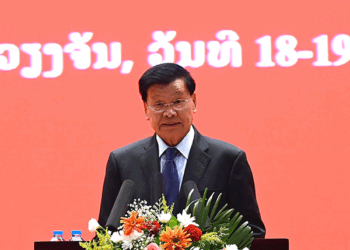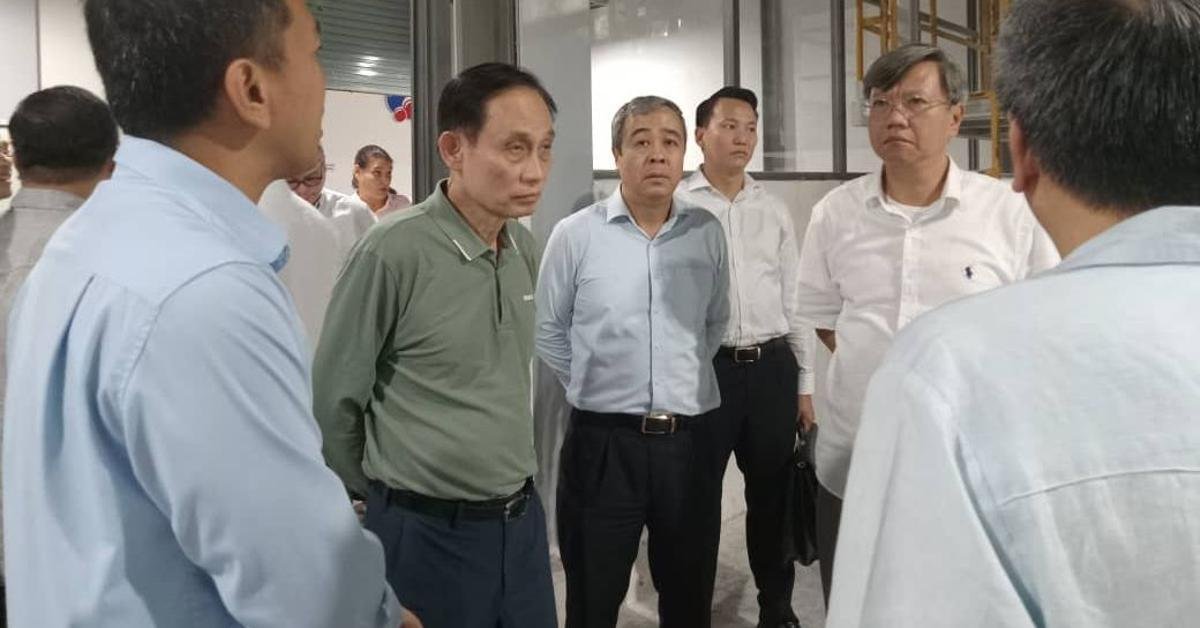
Madrid/Le Hoai Trung, Minister of Foreign Affairs and member of the Political Bureau of the Communist Party of Vietnam, assured that his country is moved by the “brotherhood” with Cuba. Visiting the Island, President To Lam’s special envoy stated that Vietnam will continue investing in investments “where it is most needed,” taking advantage of new business opportunities for entrepreneurs, with the purpose of “helping in this complex scenario.”
Vietnam is among the few partners that maintain a significant business presence on the Island and also seem willing to expand it. According to the official mediaLe Hoai Trung assured that his country will not leave Cuba alone, “despite the siege to which it is subjected by the US Government.”
During a tour of the Mariel Special Development Zone (ZEDM), in Artemisa, the senior official visited the company ViMariel SA, – the first industrial park in Cuba with exclusively foreign capital, authorized in Cuba since 2018– a subsidiary of the Vietnamese corporation Viglacera.
Vietnam will continue to focus on investments “where it is most needed”, taking advantage of new business opportunities for entrepreneurs
Ana Teresa Igarza, general director of the ZEDM, presented the recent reforms approved by the National Assembly as an opportunity to consolidate already established businesses and attract new foreign capital, which indicates that Vietnamese businessmen are very encouraged: “We have to work together,” he indicated. According to the director, Vietnam is currently “the second country with the largest business presence within the Mariel Zone.”
For her part, ViMariel’s business manager, Huong Nguyen, confirmed the intention to expand the project, recalling that the company has a 50-year concession to develop and manage this industrial park.
After visiting the ZEDM, Le Hoai Trung moved to Pinar del Río to supervise rice production. The official media indicates that more than 900 hectares have been planted during the first half of 2026 in the areas linked to the joint Cuba-Vietnam program. The Vietnamese foreign minister praised the soil and noted that on worse land than that, his country had achieved high yields in 2025.
The Vietnamese foreign minister praised the soil and noted that on worse land than that, his country had achieved high yields in 2025
Le Hoai Trung also visited the industrial complex where rice production for national consumption is processed. According to Granmathe Vietnamese foreign minister praised the quality of the grain.
The Cuban Vice Minister of Agriculture, Telce González Morera, took the opportunity to remember that the sector has been greatly affected by the measures of the US Government and that “a solution has been sought for all the difficulties that have appeared.”
For years now, Hanoi has been presented by the Cuban Government as an economic model to follow: a one-party political system that managed to attract massive foreign investment and transform its economy through the reforms known as Doi Moi, begun in 1986. However, Cuba’s results have fallen short.
Precisely, the measures announced last week include the legalization of private banking, the opening of state companies to private shareholders, new facilities for foreign investment, flexibility of the exchange market and gradual reduction of universal subsidies.
However, numerous economists have warned that the reforms come after years of accelerated economic deterioration and amid a profound loss of public confidence. The absence of political and institutional changes raises doubts about the country’s real capacity to attract large investment flows.