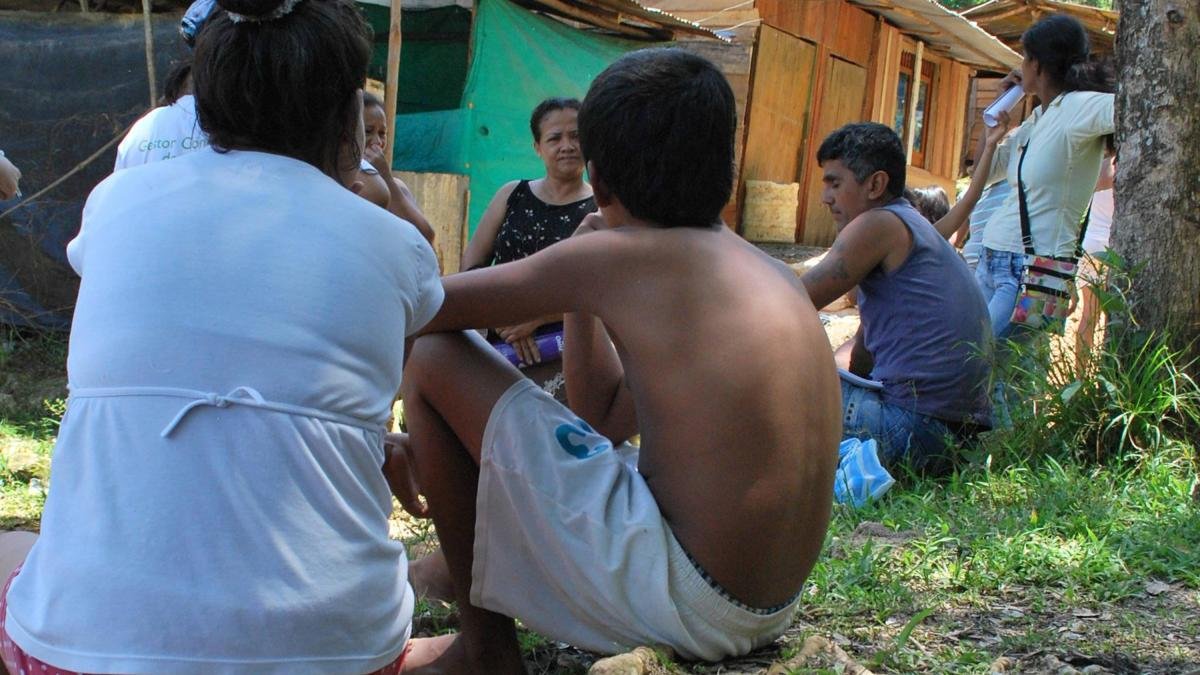
Nearly 1.8 million Colombians will no longer be poor in 2025 and one million will emerge from extreme poverty, according to figures released by Dane. The improvement allowed both indicators to reach their lowest levels in recent years and consolidated the social recovery observed after the sharp deterioration caused by the pandemic.
But the report also leaves an additional signal that is equally relevant and that is that inequality has also been reduced. The Gini coefficient, which measures how concentrated income is in a society, fell from 0.551 to 0.531 last year, one of the biggest recent improvements. This means that The progress was not only reflected in a smaller number of poor people, but also in a less unequal distribution of income among Colombian households.
READ ALSO
Despite this, Colombia closed the year with 14.4 million people in monetary poverty and nearly five million in extreme poverty. while the gaps between cities and rural areas continue to make substantial differences in the opportunities and living conditions of the population.
Monetary poverty went from 31.8 in 2024 to 28 percent a year later, a reduction of 3.8 percentage points.
The improvement was even more marked in extreme poverty, which measures those who do not have sufficient income to purchase even a basic food basket. This indicator decreased from 11.7 to 9.6 percent, while the population in this situation went from 5.97 million to 4.97 million people. In other words, one million Colombians left behind the most severe form of economic deprivation.
In 2025, a person was poor if they had at least $482,041 a month to cover basic needs. Photo:Secretariat of Social Integration.
For Luis Fernando Mejía, president of Lumen Economic Intelligence, the main explanation for the reduction in poverty and extreme poverty was the improvement of the labor market.
“The fall in the unemployment rate allowed more households to have labor income, while the increase in income of those who were already employed increased purchasing power, especially among lower-income households. In simple terms: more employment and better income translated into less poverty,” said the economist.
Being poor in Colombia
According to the Dane report, poverty is not measured by the total income of a person or a family, but by the income available to each member of the household.
READ ALSO

By 2025, A person was considered poor if they had less than 482,041 pesos per month to cover their basic needs. In the case of extreme poverty, the limit was 236,580 pesos per person per month. For a family of four, this is equivalent to incomes of less than 1.93 million per month to escape poverty and less than 946,320 to overcome extreme poverty.
That’s why, A family can have income greater than one million pesos per month and still be considered poor if those resources must be distributed among several members. The Dane calculates the per capita income of the so-called “expenditure unit”, that is, of all the people who share the household resources.
In the municipal capitals, nearly 1.47 million inhabitants stopped being poor. Photo:Amexis Múnera
The field also improves, but…
The advances reached both cities and rural areas, although the differences remain notable.
In the municipal capitalsmonetary poverty was reduced from 28.6 to 24.6 percent, while nearly 1.47 million inhabitants were no longer poor.
In populated centers and dispersed rural areas, the incidence fell from 42.5 to 39.5 percent. There, some 321,000 people escaped monetary poverty during the last year. However, The figure also reveals that practically four out of every ten inhabitants of these areas continue to be poor.
Extreme poverty showed a similar behavior. In rural and dispersed areas, around 311,000 people left that condition during 2025.
READ ALSO
“The challenge is for this improvement to be sustainable. To achieve this, the economy must maintain a sufficient growth rate to continue generating quality employment, with greater formality, productivity and stability in income,” said Mejía, for whom “This will not be easy in a context of low investment and a high fiscal deficit that, if not reversed, will affect medium-term growth.”
There is less inequality
The Dane also reported a reduction in inequality in the country in 2025. The Gini coefficient is the main indicator used to measure this factor and its scale ranges from zero to one. Thus, the closer it is to zero, the more equitable the distribution.; The closer it gets to one, the greater the concentration of income in a few hands.
The Dane also reported a reduction in inequality at the national level in the country in 2025. Photo:Atul Loke for The New York Times
Last year the national indicator decreased from 0.551 to 0.531, while in the urban capitals it went from 0.530 to 0.507. In rural areas there was also a reduction, although more moderate, from 0.482 to 0.476.
The trend is relevant because it shows that The reduction in poverty was accompanied by a lower concentration of income. That is, the progress was not only due to general economic growth, but an important part of the improvement reached lower-income households.
READ ALSO

Post-pandemic recovery
The 2025 figures also confirm the downward trajectory that these indicators have shown from the highs recorded during the pandemic.
Monetary poverty reached 43.1 in 2020 and since then began a gradual reduction to reach 28 percent five years later. Extreme poverty, which reached 23.7 percent during the health emergency, was reduced to 9.6 percent last year.
However, the report makes clear that the country still faces significant challenges. Although millions of people managed to overcome the poverty lines, more than 14 million Colombians continue to live with insufficient income to fully cover their basic needs and nearly five million still do not even have the resources to guarantee adequate nutrition. Poverty reduction is making progress, but the task of closing social and territorial gaps is still far from complete.