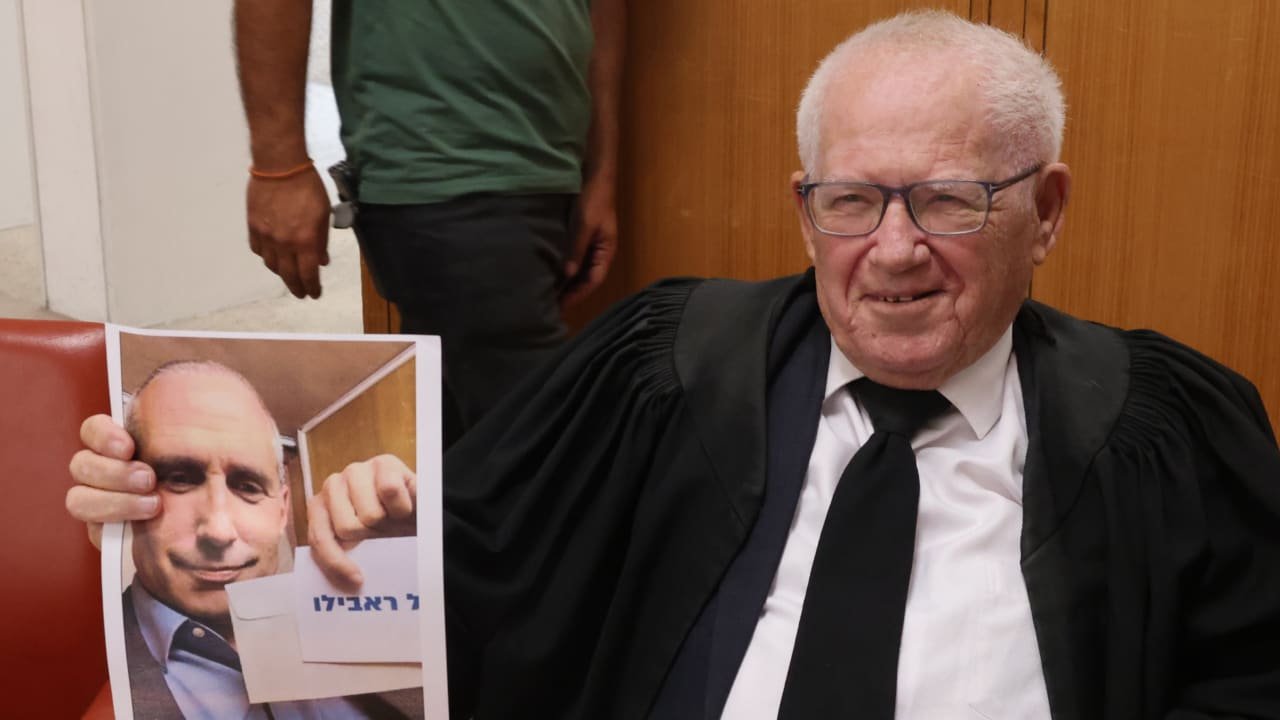
The High Court of Justice proposed on Thursday that the Knesset hold a repeat vote for state comptroller after justices said an “undesirable cloud” hung over the disputed election of attorney Michael Rabello and gave the Knesset and Rabello until Sunday to respond.
The hearing, held before Deputy Supreme Court President Noam Sohlberg and Justices Gila Canfy-Steinitz and Ruth Ronnen, dealt with seven petitions seeking to cancel Rabello’s election and order a new vote.
At the end of the hearing, the justices said they were considering issuing a conditional order on the secrecy of the vote, but not on the separate argument that Rabello should be disqualified because of his ties to Prime Minister Benjamin Netanyahu.
Sohlberg said there was “an undesirable cloud and a bitter taste” over the vote.
He said some of the votes were problematic, that some MKs had acted contrary to the Knesset legal adviser’s instructions, and that a new instruction had been given during the process, allowing MKs to photograph their vote behind the curtain.

The court’s proposal would allow the Knesset to resolve the issue procedurally by holding the vote again, rather than waiting for a ruling canceling the result.
Rabello, Netanyahu’s longtime personal attorney, was elected on June 3 after a dramatic two-round Knesset vote. In the first round, retired Supreme Court justice Yosef Elron received 60 votes, and Rabello received 57, leaving both short of the 61 votes required to be elected state comptroller.
A second round was then held, during which opposition MKs alleged that coalition lawmakers had been instructed to document their vote behind the curtain, despite the legal requirement that the state comptroller be elected by secret ballot.
After the second round was restarted, Rabello defeated Elron 61-57.
The petitions argue that the vote was not merely politically controversial but legally defective, because the documentation of ballots undermined the secrecy meant to allow MKs to vote freely and according to conscience.
Some of the petitions also argue that Rabello cannot serve as state comptroller because of his years-long professional ties to Netanyahu, the Likud, the Prime Minister’s Office, and ministers whose conduct the comptroller may be required to audit.
Elron, who lost to Rabello in the second round, filed a short position joining the petitioners’ arguments regarding the alleged illegality of the second vote. He did not ask the court to declare him state comptroller or install him in the role but joined the requested remedy of canceling the election.
Rabello state comptroller election faces High Court legal challenge
Sohlberg made clear at the start of Thursday’s hearing that the central issue was the meaning of the secret ballot in the Knesset vote, whether secrecy had been harmed, whether MKs had been instructed to document their vote, and whether the court should intervene in the internal work of the Knesset.
The justices appeared skeptical at times of the sweeping remedy requested by the petitioners, particularly the argument that any photographing of a ballot should automatically lead to cancellation of the election.
Ronnen asked whether such a rule could give people a tool to sabotage elections by filming themselves voting and then demanding the ballot be voided.
At the same time, the bench pressed the Knesset and the respondents on whether the events in the second round could have chilled MKs who may have wanted to break ranks.
Canfy-Steinitz said that if Knesset Speaker Amir Ohana created a “new rule” by saying MKs could document their vote, the court needed to examine whether that may have affected the result, “in the sense that it could chill the position of MKs who maybe wanted to deviate from the line.”
She also said the issue was not only what happened behind the curtain, noting that envelopes used in the vote are meant to be sealed.
In a case where MKs showed their vote outside the curtain, she said, “We are effectively dealing here with the removal of the curtain,” calling it “much more basic” than the question of self-documentation.
Attorneys for the petitioners argued that the filming turned the second round into a loyalty test.
Attorney Eliram Bakal, representing Yesh Atid, argued that MKs changed their vote between the first and second rounds and that there was no explanation for the “burst of self-documentation” in the second round if the documentation was spontaneous.
Ronnen responded that the very existence of a second round assumes that some MKs may change their vote.
Attorney Eliad Shraga, representing the Movement for Quality Government in Israel, argued that “aggressive pressure” led to the loss of support for Elron and that the documentation created an improper “test of loyalty” to the prime minister.
The Knesset’s legal position, represented in court by attorney Yitzhak Bart, was that the petitions should be dismissed because there was no evidence that MKs had been ordered to document their votes.
Bart said a request or instruction from someone able to pressure an MK to document a secret vote would be illegal and invalid but argued that no such instruction had been proven.
Attorney Ilan Bombach, representing Netanyahu and the Likud, also argued that there was no evidence of an instruction to document the vote or of improper pressure that changed the result.
Asked by Sohlberg why four MKs changed their vote in the second round, Bombach said, “These things can happen.”
On the conflict-of-interest arguments, the justices seemed more hesitant to accept the claim that Rabello’s professional ties to Netanyahu require automatic disqualification before a conflict-of-interest arrangement is finalized.
Attorney Amit Mor, one of the petitioners’ attorneys, argued that Rabello had represented Netanyahu in 55 matters, including both civil proceedings and High Court petitions, and had also represented the Likud, the Prime Minister’s Office, and several ministers.
He argued that a conflict-of-interest arrangement would not be sufficient.
Canfy-Steinitz responded that perhaps the court should first wait to see the arrangement, saying the prevailing view is that conflicts of interest can be addressed through such arrangements and that no person has been disqualified from office solely because of such conflicts, however broad.
Ronnen similarly asked why Rabello should be disqualified from the entire role if he could be barred from handling specific issues.
Thursday’s hearing also included repeated interruptions by Likud MK Tally Gotliv, who was warned by Sohlberg before being removed from the courtroom after another outburst.
Rabello has argued in his preliminary response that there is no legal basis to cancel the election, that his professional background was known to MKs before the vote, and that any conflict of interest can be handled through a standard arrangement once he takes office.
The Knesset, Netanyahu, Likud, and Rabello have all asked the court to reject the petitions.