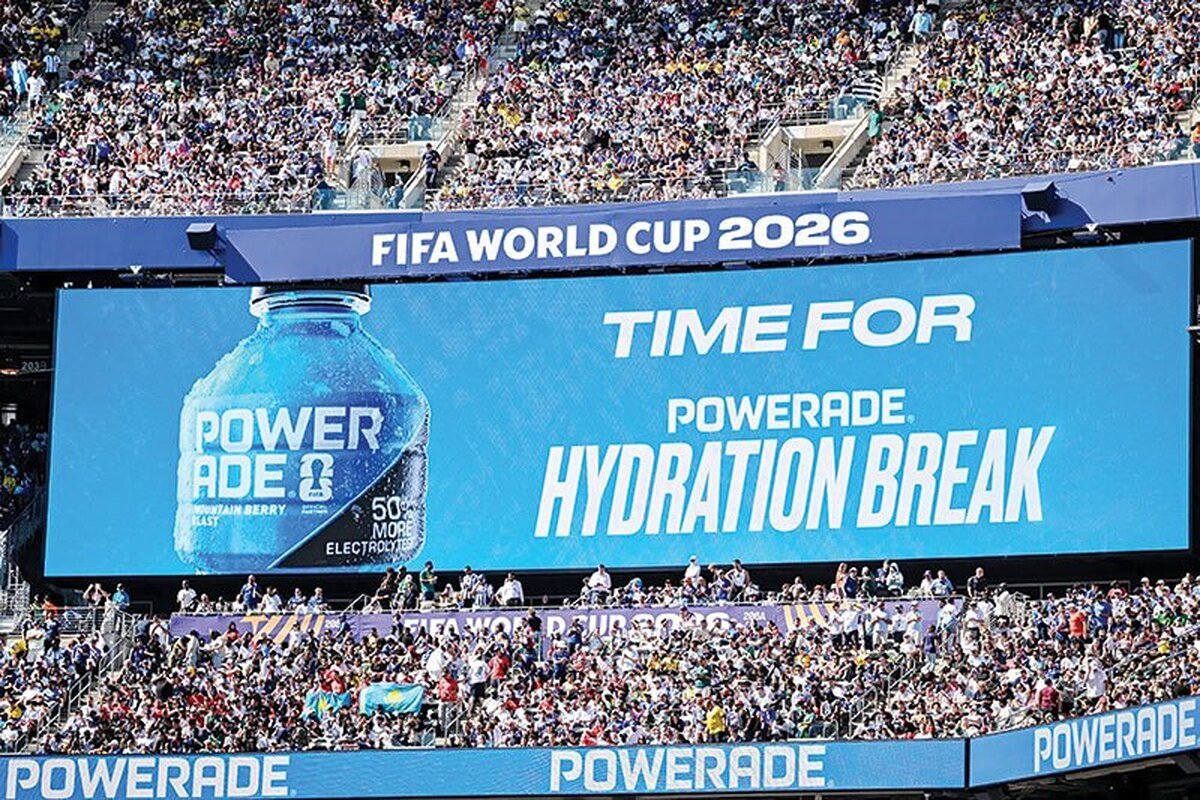
The most important consequence of these interruptions is the creation of new advertising time during the match; Something that did not exist in football until today. TV channels can broadcast about 130 seconds of advertisements in each break. Due to the existence of two breaks in each match, the total added advertising time reaches about 260 seconds per game; The equivalent of eight or nine 30-second ads. In a 104-match tournament, this means thousands of seconds of new ad time and potentially significant revenue for broadcasters and commercial partners.
From the heat of Brazil to the 2026 World Cup
Cooling breaks are of course not a completely new phenomenon. This mechanism was used for the first time in the 2014 World Cup in Brazil and in the match between the Netherlands and Mexico in the round of 16. In that match, the temperature in the city of Fortaleza reached about 39 degrees Celsius. At that time, the implementation of these interruptions depended on specific weather conditions and the WBGT index; An index that, in addition to temperature, also includes factors such as humidity, sunlight and wind speed in its calculations. But the main difference of the 2026 World Cup is that these breaks are mandatory for all matches, regardless of weather conditions.
For many observers, this change is reminiscent of the structure of professional sports in the United States. In major American leagues such as the NFL, NBA, NHL, and baseball, stoppages are an integral part of the game. These breaks provide numerous advertising opportunities for television networks and form an important part of the economic model of American professional sports. On the other hand, traditional football has always been distinguished from other sports due to the continuous flow of the game and the absence of commercial breaks during the halves.
Now FIFA seems to have found a solution that has both a medical justification and a significant economic opportunity. Under the new rules, broadcasters must wait 20 seconds after the start of the break and at least 30 seconds before resuming play. In practice, this time frame creates a valuable opportunity to sell advertising.
Not everyone agrees
The economic value of these new times is so great that some analysts have compared it to the Super Bowl. Michael Johnson, an analyst at S&P Global Institute, believes that the price of advertising in these periods can approach the level of Super Bowl ads and reach $7-9 million per ad spot. Such figures show that new breaks can become one of the most important sources of income associated with the World Cup. However, not all television networks use this opportunity in the same way. American network Fox, which owns the rights to broadcast the tournament, showed from the very opening match that it has adopted a completely commercial approach. In one game, the length of the commercials even caused the referee to extend the timeout. Despite this, the live stream still returned to the match seconds after the restart; An event that brought many critical reactions. On the other hand, some networks have decided to use this time to cover more events inside the ground. Telemundo, the Spanish-language rights holder of the tournament in the United States, has announced that it will show images of players, coaches and highlights during the breaks instead of commercials. In the UK, ITV has refused to broadcast advertisements at this time due to legal restrictions and audience expectations. It appears that the implementation of mandatory cooling-off breaks at the 2026 World Cup is not just a technical or medical decision, but a sign of wider changes in the economics of modern football. Football, which had resisted the commercial models common in American sports for years, is now more than ever moving towards a model where the competition is not only an arena of sports competition, but also a platform for creating new advertising revenues. The main question is whether football fans around the world will cope with this change or whether the 2026 World Cup will start a bigger debate about the future of the sport.