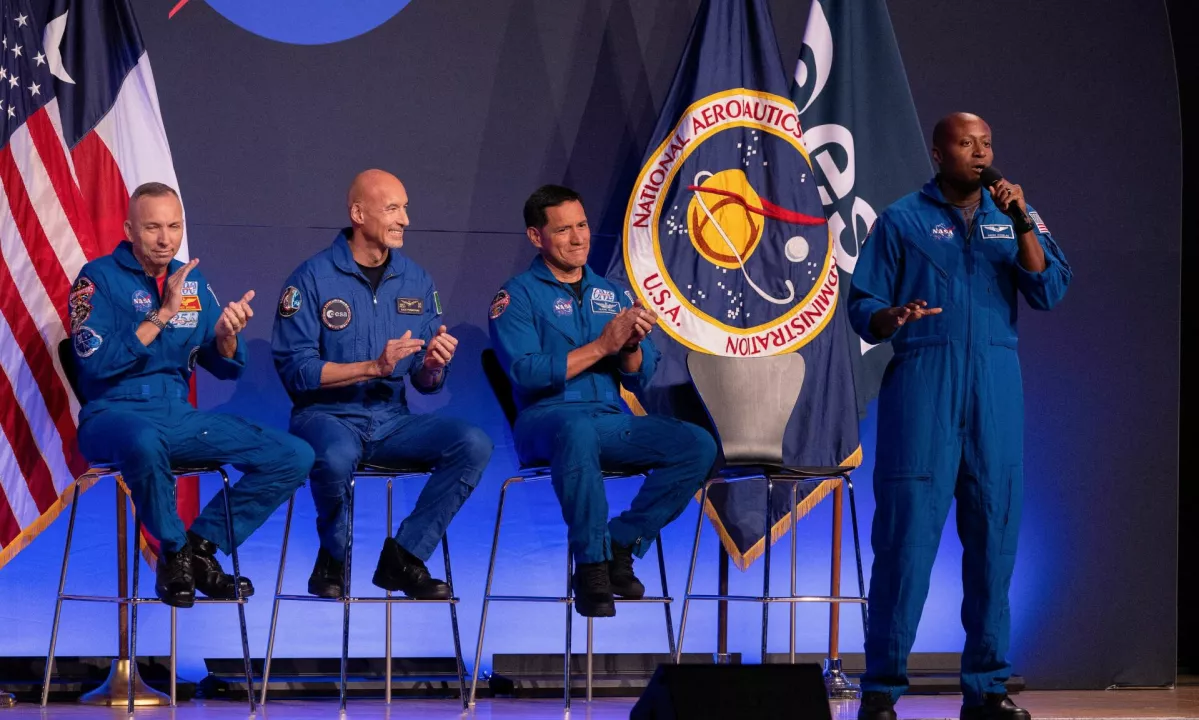
The crew of the Artemis III mission, which will test systems close to home and perform test maneuvers critical to the mission to land a man on the moon. Photo: Reuters
Astronauts will not take off from Earth and land on the Moon
These days, the American space agency NASA presented the crew of the Artemis III mission, which is part of the program to return man to the moon. This mission, which will be commanded by an astronaut with Slovenian roots, Randy Bresnik, is somewhat special.
When the agency presented the Artemis program in 2019, this mission was not planned at all. It was only added in February. Its purpose is to test near-Earth critical systems, technology and spacecraft assembly and separation procedures in space before sending astronauts to the surface of the Moon. After taking off from Earth, they will not directly land on the Moon. The chain of events is much more complicated, which is why NASA decided on an additional test mission.
A rocket that cannot return
Originally, the Artemis program envisaged three missions. Artemis I was an unmanned Orion flyby of the Moon, which was successfully completed in 2022. Artemis II was a four-man crewed Orion flyby of the Moon, which was successfully completed in April. Artemis III was the intended landing of a man on the moon, the first in more than half a century.
However, this path will not be direct, but much more complicated. First, they will launch a rocket into space to land on the moon. It’s called HLS or Human Landing System. The rocket will fly from Earth without a crew, as it is too heavy to carry. It will already fly without a heat shield and with a minimal amount of fuel. This will then be supplied in low Earth orbit from the tanks that will be launched there earlier. Only then will the rocket head towards the Moon, settle into an orbit around it and wait. A version of the HLS rocket is being developed separately by the companies of billionaires Elon Musk and Jeff Bezos, Space X and Blue Origin.
An Orion craft with a crew of four will then be launched from Earth. It will head towards the Moon, similar to the Artemis II mission. When it reaches the Moon’s orbit, Orion will join up with the waiting HLS rocket there.
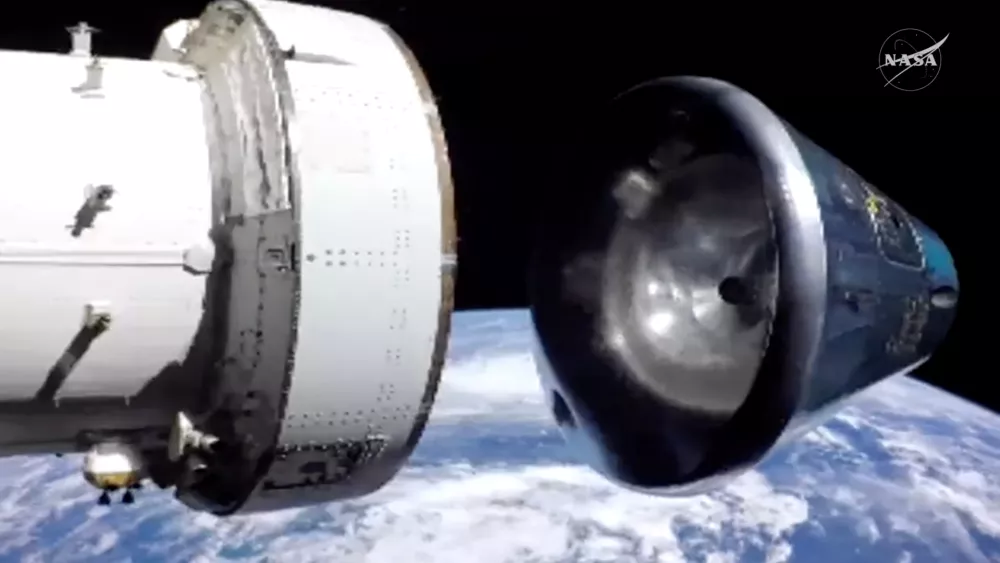
Two astronauts will transfer from Orion to an HLS rocket. It will separate from Orion and head for the Moon and land there and stay on the surface for a week. The other two astronauts will remain in Orion, which will orbit the Moon in support of the surface mission.
Then the HLS rocket will fly away from the Moon and rejoin the Orion spacecraft in its orbit. The astronauts from the Moon will move back to Orion along with all the material they collect on the Moon. Orion will separate from the HLS rocket, head towards Earth with its entire crew and land in the ocean. What will happen to the HLS rocket has yet to be decided, but it cannot return to Earth because it does not have a heat shield.
One of the most complex missions
This year, NASA estimated that it would be good to test the listed procedures closer to home. Therefore, it added the Artemis III mission (the previous Artemis III mission with a crew landing on the Moon became Artemis IV). Artemis III, scheduled for next year, will take place in low Earth orbit. A key part of the mission is to demonstrate the successful docking of the Orion craft with both SpaceX’s Starship rocket and Blue Origin’s Blue Moon rocket, provided both are made, of course, as both companies face significant challenges and delays.

All of this will require three separate launches. Orion will launch from NASA’s Florida Space Center on an SLS launch vehicle. Starship is likely to launch from Space X’s base in Texas, and Blue Moon from the US Space Force base in Cape Canaveral, Florida.
Once everyone is in space, Orion will first merge with the Blue Moon rocket. Two crew members will board it. After two days, the entire crew will be back in Orion, which will separate from the rocket. The crew will then wait for the Starship rocket and Orion will merge with it, but it is not yet clear whether the astronauts will also board it. After separating from the Starship, Orion will return to Earth with its crew. NASA says it’s one of the most complex missions ever because it involves multiple launches, a rendezvous in space, and a merger and separation test.
All of this will be a key test for the Artemis IV mission when they perform the same procedure close to the Moon – before actually landing on it. This is now scheduled for 2028. Namely, the goal of the current administration is to have it happen during the time of President Donald Trump, which will require quite a bit of favor from the stars, as delays are an integral part of space programs.