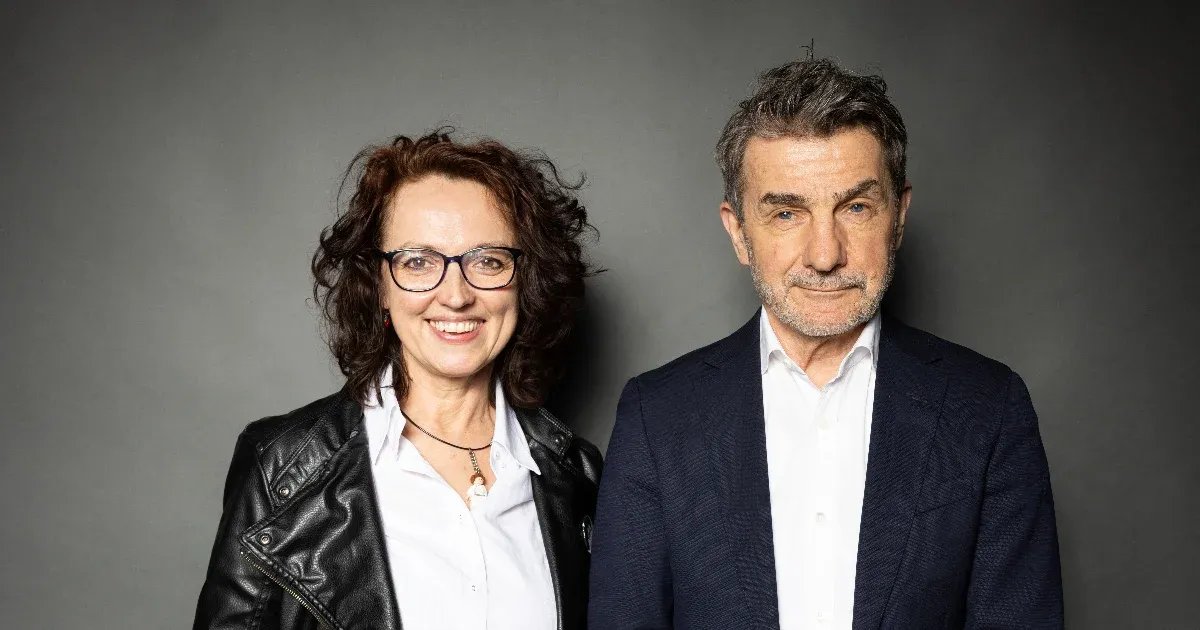
“It was more successful in the West than in the East,” he said in the latest episode of Buksó János Janikovszky, the owner of Móra Könyvkiadó, is the son of Éva Janikovszky, who was born exactly one hundred years ago, about his mother’s work. The indispensable author of Hungarian children’s literature, his books have been published in 35 countries, he has millions of readers worldwide, and his timeless humor, cult stories, and writing voice are unmistakable, making him a standard for generations. Although Évá Janikovszky, both as an author and editor, was most interested in and inspired by the opinions of children, this time she also asks Krisztián Nyáry’s guests, including Andrea Lovász, the editor-in-chief of Móra, about his entire oeuvre, his books for adults. Buksó talks about the legendary volumes illustrated by László Réber, but also about what makes Janikovszky really valid and popular today. The most likely explanation for the latter is that he was an accomplice, a true ally of the children.
“A small child asked him: how do you know that children are just small and not stupid?!
Andrea Lovász recalled. – This was accompanied by the liberation of children’s literature as a whole, so there was such an anti-authoritarian wave that rippled all the way from Western Europe to us, and it involved us discovering how good-natured, funny, and how wise a child can be at the same time, and this could only prevail in such a way (…) if the adult’s counterpoint is such a small fool, a clumsy, less smart, less wise, because that’s the only way this couple works.”
According to János Janikovszky, the visual style created by the Réber-Janikovszky duo was considered genre-creating, as they unusually changed the proportions of the image and text in the books compared to the previous best practice. “Perhaps it was also considered special in Western Europe, since before there was a storybook and then there were color or black-and-white drawings at certain points, but here the text and graphics worked together and lived together.”
The relationship between László Réber and Éva Janikovszky is undoubtedly legendary, although in private life it was quite formal. According to Andrea Lovász, based on the books, this may be surprising, since Réber not only illustrated, but also thought the stories further. “You might think that they were together, and drank together, and invented jokes together, but no, they kept very strong boundaries. This makes their relationship very special, because they actually met on the pages of the books. (…) It wasn’t such a friendly relationship as we imagine based on the books, even though the texts were written very much with the same spirit,” concluded the editor-in-chief.
However, Magda Szabó was a really good friend of Janikovszky, and he edited quite a few of her volumes. “He was the editor of such important books as late as the sixties, such as all of István Fekete’s books that were published at Móra (…) then there are the Lázár Ervin dedications, the Zoltán Zelk dedications, not to mention Magda Szabó. (…) They were friends, and I say this because Magda also wrote in her obituary that we were not girlfriends, but friends and this is a different category, and this mostly means a friendship of principle, which is strange in many ways, because “Magda was the popular and deified author of Reformed Debrecen, and Mom was not. (…) The minister did not even bother to respond to my request that 2026 be the 100th anniversary of Éva Janikovszky. So they are not judged equally by the system,” explained János Janikovszky, and then continued by saying that after his mother could not change the system, he tried to deal with what he had influence on.
“As the editor-in-chief of Móra Könyvkiadó, he constantly encouraged authors to write. If it hadn’t been for the publisher, ten times as many people would know the name of István Kormos today, because then there was no Vackor, no Funny Teddy Bears and many other things. In the same way, Magda Szabó would not have had 5-6 children’s books, Lázár Ervin would not have written Bifi-Bukfenc-Bukference, and the Seven-Headed Fairy, and A square-shaped forest. These are the results of the fact that at that time a forbidden or not very popular writer could write for children.”
Andrea Lovász also sees that Janikovszky had a lion’s share in the fact that many important authors, from Ervin Lázár to Pál Békés, turned to children’s literature. The works that he lured to the Móra now form the basis of classic Hungarian children’s literature. His most important editorial legacy, in addition to the discovery and support of authors, is the “dotted” and “striped” series, which have become cults.
Éva Janikovszky especially liked it when the children dared to rebel. “He was talking to the kids at eye level. He
he thought that the difference between a child and an adult was that the child was not yet an adult, and the adult was already a child.
So one of them knows what’s coming, the other doesn’t yet.” The biggest inspiration for Janikovszky’s children’s literature was his son.
“It is surely not a coincidence that the main character of all the books is a boy and not a girl. Today I watched the animated film that is being made from the book If I were an adult, (…) and it was an elementary realization for me that the adults are sitting at the table and waiting for the child to come over because the soup is getting cold (…) I simply recognized again that I washed my hands as a child, imitating the washing of hands in the bathroom until they started eating, because I hated watching other people eat, and it’s in the book. (…) This is all confirmation that I did something here, which is in the book.”
The special moment of the conversation is when János Janikovszky reads one of his mother’s first poems, written when he was only ten years old, which nobody found for many decades, but recently a journalist came across it after extensive research.
Éva Janikovszky is still a sought-after and popular author, and not only here. Several of his volumes were recently published in Croatia, and soon there will be new Bulgarian and Romanian editions. “The most heartbreaking experience for me was when Whom did this child hit in Kyiv in January 2026? (…) On the occasion of the publication of the book, 52 Ukrainian libraries were given information on the occasion of an online call for tenders, telling them what kind of literary and drawing competition they were launching in connection with the book. While there were bombings, power outages, no heating, so you can’t imagine the conditions they live in, and Éva Janikovszky: The Hungarian ambassador from Kyiv writes to us about who this child is, and thanks us for the opportunity,” said János Janikovszky.
You can watch the full video here: