Finland closed its eastern border in December 2023 after signs that Russia was using instrumentalised migration.

Western observers are too quick to predict the collapse of Russia and its president, Vladimir Putin, according to two independent Russia experts interviewed by Yle, neither of whom is sympathetic to the Kremlin.
Arkady Moshes, who heads the Russia, Eastern Europe and Eurasia programme at the Finnish Institute of International Affairs (FIIA), argued that Russia’s political system is evolving further in a totalitarian direction. Dan Storyjev, a Russian-American who worked for years at OVD-Info, a Russian rights group, offered a similar assessment.
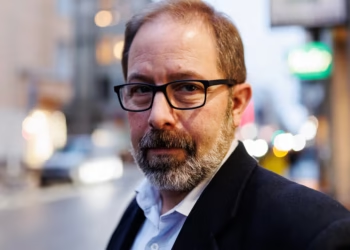
Finland needs to understand Russia better, Dan Storyjev argues:
Both told Yle that a genuine collapse is a distant prospect.
“The Soviet Union collapsed. The economic system fell apart, the political system changed, and in some regions, civil war broke out. None of that is happening in today’s Russia,” Storyjev said.
Both experts argued that Western countries, and Finland in particular, need to improve their understanding of Russia.
A commonly cited view in Finland and elsewhere is that Russia is heading for an economic crisis.
Arkady Moshes said this is not the case. While Russia’s budget deficit is widening, the state still has the capacity to borrow domestically. Moshes noted that Putin can always tap into the wealth of oligarchs. Russia has also been confiscating assets from the country’s super-rich and selling them on.
Western analysts have been too eager to predict Russia’s collapse, says Arkady Moshes:
Military not collapsing
Russia is also not on the brink of military collapse.
Right now, Ukraine holds the advantage both on the home front and through increasingly deep drone strikes inside Russia. If this continues, Moshes argued, the balance could shift more decisively in Ukraine’s favour.
Moshes, however, noted that Putin can always dip into the pockets of oligarchs.
“Russia’s large corporations have been asked to contribute larger sums to the war effort than they did in the past. These are effectively donations and transfers from the elite to the state,” Moshes explained.
Within six months, Moshes said it is highly likely Russia will be better able to defend key infrastructure such as oil refineries, which have been recent targets of Ukrainian drone strikes.
According to Moshes, Russia could be brought under serious military pressure if Ukraine were able to blockade Crimea. But said he does not believe the West would accept such an outcome.
“That would be like the siege of Leningrad during the Second World War. Two million people would face starvation,” Moshes noted.
Putin holds on
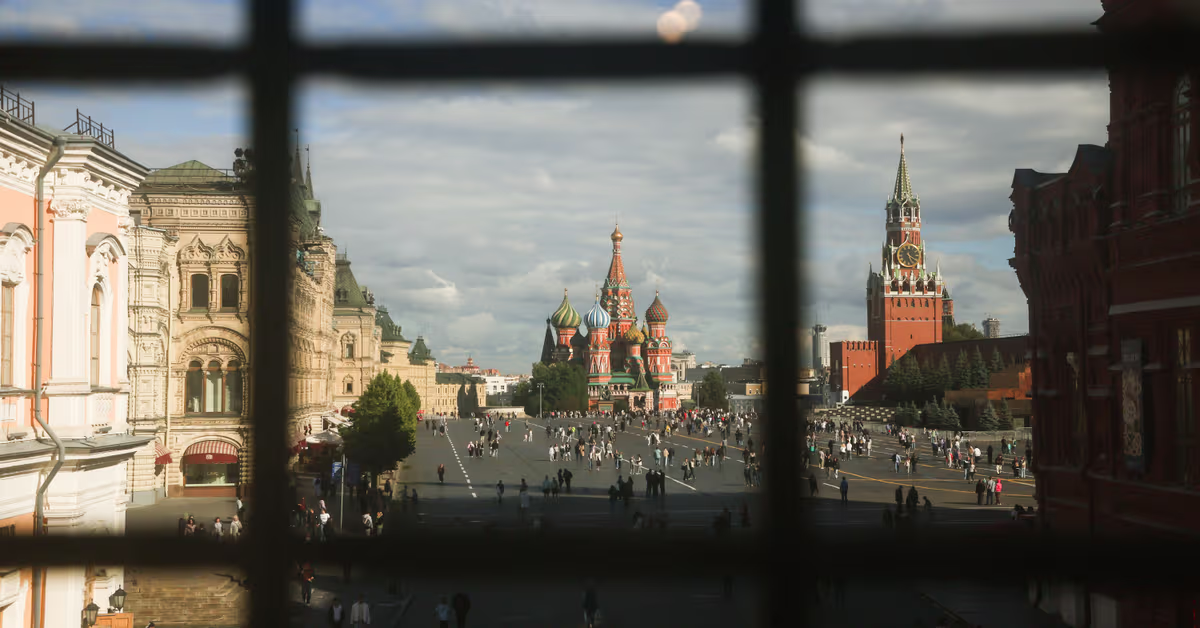
From time to time, speculation surfaces about a possible coup being plotted behind the Kremlin’s closed doors against Vladimir Putin.
Moshes is sceptical. In his view, Russia is likely to resemble Belarus, where multiple security services monitor one another in a tightly controlled system.
“I cannot imagine that a large conspiracy leading to a revolution could be organised in Russia without it being noticed,” he said.
Storyjev noted that opposing Putin inside Russia is dangerous. When Russia launched its invasion of Ukraine, security forces responded to anti-war protests with forceful crackdowns.

Finland closed its eastern border in December 2023 after signs that Russia was using instrumentalised migration.
Moshes argued that the closure was justified at the time. In his view, however, the rationale is no longer as compelling.
“Norway’s border with Russia remains open, and Estonia’s is partially open. Neither is facing a migration crisis,” he said.
He argued that keeping the eastern border closed limits Finland’s ability to gain a deeper understanding of Russian society. Cross-border travel and academic cooperation, he said, once provided valuable insights into developments inside the country.