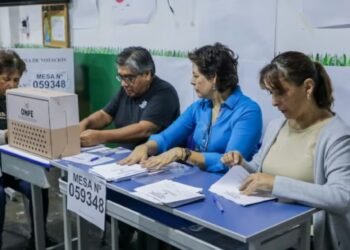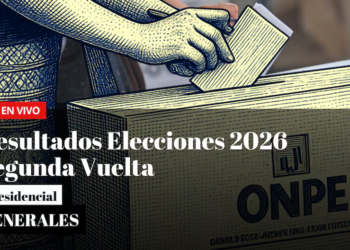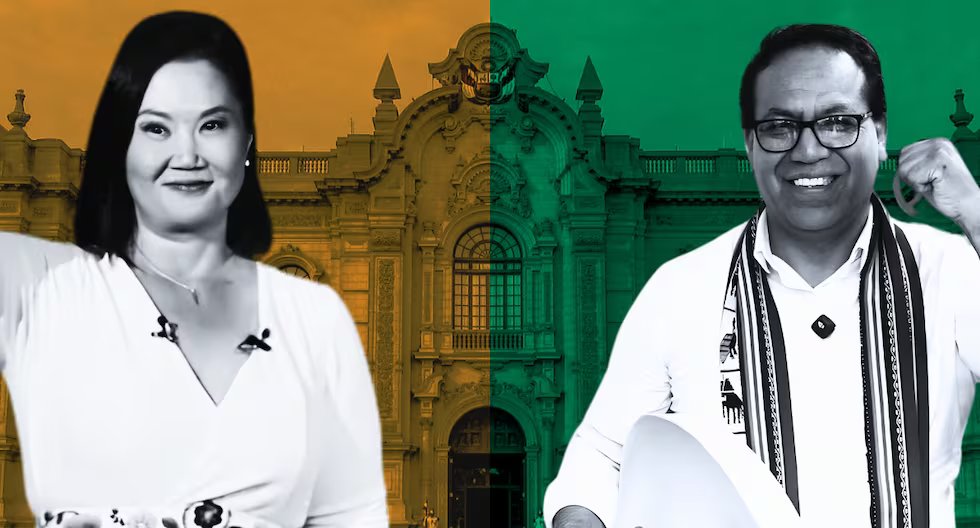
The presidential candidates Keiko Fujimoriof Popular Forceand Roberto Sanchezof Together for Perucompeted yesterday in the eighth runoff in the country’s electoral history.
Although the mechanism came into force since the 1985 elections, it was used for the first time five years later, in 1990, when Alberto Fujimori surpassed Mario Vargas Llosa by a comfortable difference of more than 1.8 million votes; that is, 25 percentage points.
In 36 years, the votes that separate the winners from their opponents at the polls have been reduced to razor-thin margins, but polarization has increased.
In a hyperconnected world, insults, taunts and ‘fake news’ common in electoral campaigns have been amplified through social networks.
The smallest vote gap between presidential candidates was recorded in 2016, when Pedro Pablo Kuczynski He surpassed Keiko Fujimori by only 41,057 votes (0.2 percentage points).
In the following elections, the advantage of Pedro Castillo – sentenced to 11 years in prison for carrying out a coup d’état in 2022 – on the former legislator was 44,263, just 0.3 percentage points.
Regardless of who wins yesterday’s election, projections indicate that the difference in support between Fujimori and Sánchez will also be minimal.
Fujimorism, initially represented by Alberto Fujimori and for 15 years by his daughter Keiko, has contested six of the eight second rounds, 75% of the total.
Its founder, who died at the age of 86 in 2024, won both elections in which he participated. However, his victory over Alejandro Toledo in 2000 was marred by obvious irregularities.
Meanwhile, his daughter has lost three second rounds and is now competing in the fourth. Political scientist Paulo Vilca, researcher at the Institute of Peruvian Studies (IEP), considers that beyond how much the distances between electoral opponents in the runoffs have varied, “It is clear that there is great resistance in society to Fujimorism”.
This opposition, adds the specialist, even transcends the legacy of Alberto Fujimori.
“Anti-Fujimorism is transversal: it is not only associated with the left, nor does it correspond to a single socioeconomic sector. But it is not only territorial: not only the south is anti-Fujimorista. The resistance to Keiko Fujimori crosses ideologies, social sectors and (regional) territories”stands out in dialogue with El Comercio.
Sociologist Danilo Gago, professor at the Antonio Ruiz de Montoya University (UARM), comments that although political parties change, electoral preferences remain on a regional scale.
“There are consistent patterns. Keiko Fujimori has the vote of the north coast and the east. In addition, she has an important vote in Lima (in the runoff elections)”tells this newspaper.
For example, in the second round of 2021, he won in Tumbes, Piura, Lambayeque, La Libertad, Lima, Callao, Ica, Loreto, Ucayali and the constituency made up of Peruvians abroad.
Regarding the current electoral process, political analyst Mabel Huertas indicated: “We are not voting for someone, but against someone. (…) There is also an emotional factor that makes us decide at the last minute. There is a factor of anti-Fujimorism, but there are also other antis that play an important factor”asserts the also partner of the consulting firm 50+Uno.
There is an irrefutable reality: despite the defeats of the former congresswoman, Fuerza Popular has established itself as the most organized and solid party in chaotic national politics.
“Fujimorism has a structure and vocation for (party) education. In addition, it represents a political and institutional project that can give it validity over time, something in which the rest of the parties are weak”Vilca points out.
Finally, the history of the ballots in Peru shows that since 2011, the white and tainted vote has not exceeded 6.5% of the total votes cast.
In 2001, when journalists and writers Jaime Bayly and Álvaro Vargas Llosa promoted a campaign to invalidate the vote, they reached 13.8%. In those elections, the first after the fall of Alberto Fujimori, Alan García and Alejandro Toledo contested the runoff.
“If the blank vote and the flawed vote constitute a high flow, we will have sent a powerful and unequivocal message to Toledo and García, we will have told them on election day that Peru distrusts you, but will be attentive and vigilant to the possible excesses, transgressions and debaucheries that you perpetrate from power”Bayly then said.
A quarter of a century later, distrust still marks Peruvian politics.