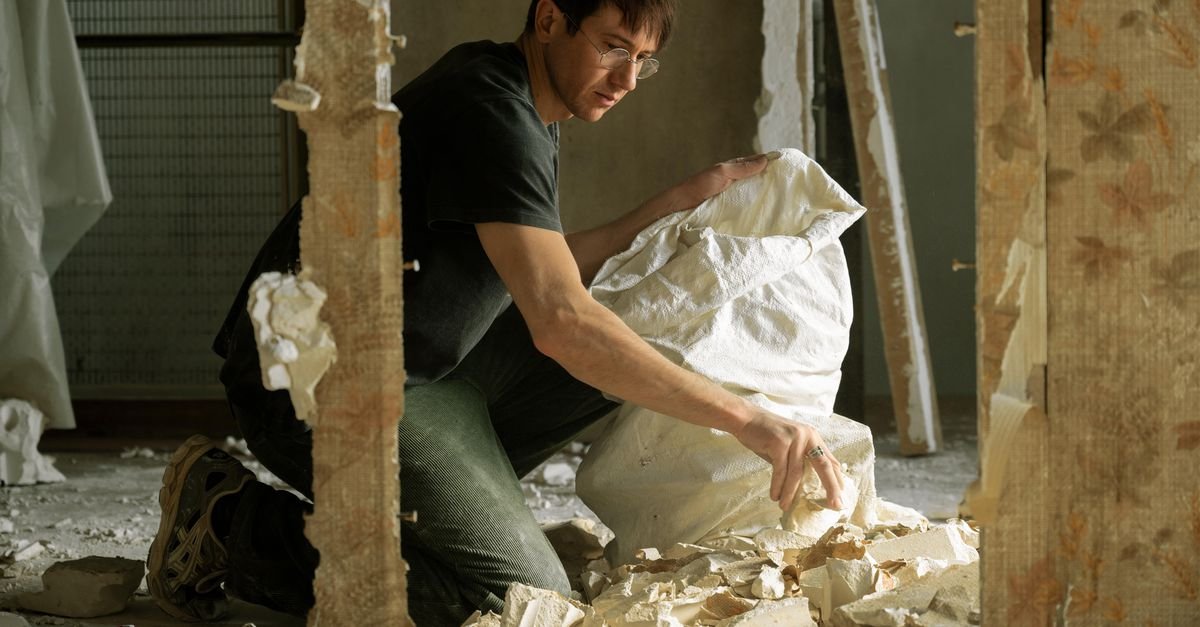
In the movie A pied d’oeuvre the almost pathologically good-natured Paul Marquet suffers for his art. The writer and handyman previously wrote two solid books that are collecting dust in the better bookstores with rave reviews on the back cover. Now the publisher expects his Grand Novel. As both his advance and ideas run out, Marquet must make real sacrifices for his art. He gives up his home, gets a haircut, steals from his parents, and fights for jobs on the job platform Jobber, also known as Karl Marx’s worst nightmare.
Does that suffering really produce a good book? A pied d’oeuvrea sharply observed film about flexible work and artistry, occasionally seems to relish the romantic idea of the starving artist. Director Valérie Donzelli, however, does not believe that you should suffer for art, she says in a Parisian hotel room in January – but that suffering is simply the fate of the artist.
“Art comes from the need to create,” says Donzelli. “Look at Picasso, he created beautiful works of art when he was successful, recognized and prosperous. But poverty follows from the social status of the artist. Writers are not paid enough because people think they are lucky to be able to do what they do. That doesn’t work: an artist has to wander, think and walk around until he is immersed in doubt and no longer knows what to do. Then there is a flicker.”
Dog tracks for the scribbler
Donzelli and co-writer Gilles Marchand won the screenplay prize at the Venice Film Festival for their script, which they based on the memoirs of the same name by writer Franck Courtès. Just like in the book, most of the film is about dog jobs with pitiful wages. Writer-friendly jobs as a night watchman no longer exist. For the scribbler there is only ‘the platform’ – the online employment agency Jobber. For example, Marquet spends five hours on his knees cutting grass with a hedge trimmer. For 20 euros. He writes between garden work and Ikea cupboards.
:format(webp)/s3/static.nrc.nl/wp-content/uploads/2026/06/12105433/160626CUL_2034425702_pied3.jpg)
Director Valérie Donzelli at the Cannes Film Festival, May 2026. She and co-writer Gilles Marchand won the screenplay prize at the Venice Film Festival with ‘À pied d’oeuvre’.
ANP/EPA
The gig economy is crazy, says Donzelli. “It’s total anarchy. Workers have to compete with each other for jobs and therefore constantly lower their asking price to stay competitive. They even have to pay to work for the platform. It’s the world turned upside down. There is no worker protection.”
So what’s the appeal? The film describes the platforms as “the perfect mixture between freedom and the deprivation of freedom.” Donzelli: “They make people believe that they are free because they do not work for a boss and choose their own hours. But in reality they have to be ready twenty-four hours a day and are constantly assessed by voters on the platform.”
Hypercapitalism damages the film world
Donzelli also encounters this in the film industry. “This hyper-capitalism will damage the film industry. Look at the type of films that Netflix makes: algorithm work, intended to feed the beast that always remains hungry. It is fast food of the film world.”
:format(webp)/s3/static.nrc.nl/wp-content/uploads/2026/06/12105342/160626CUL_2034425702_pied2.jpg)
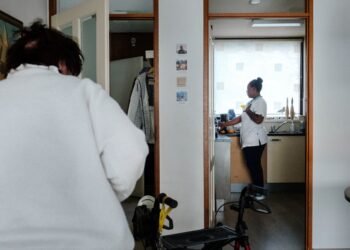
Scene from ‘À pied d’oeuvre’.
It’s all because of the US, she says: “We have been suffering from the US since the end of the Second World War. We are under their influence, we continue to copy them, while we have a completely different culture, taste and needs in Europe. Just look at the cars. The last time I was in a taxi it was a gigantic Tesla. We don’t live in the desert: you don’t need a four-wheel drive Ranger in Paris!”
We have been suffering under the US since the end of World War II. We are under their influence and continue to copy them, while we have a completely different culture, taste and need in Europe
In this conversation, Donzelli seems ready to either proclaim revolution or make a suicide pact. But her film does neither. A pied d’oeuvre is hopeful in tone. The main character Marquet, played by Bastien Bouillon, is almost laughably cheerful, because he does what he wants to do. “He doesn’t see himself as poor because it’s his choice,” says Donzelli.
In A pied d’oeuvre there is hope, just like in the real life of writer Franck Courtès, on which the film is based. He no longer has to take dog jobs, partly thanks to this film adaptation of his memoir, says Donzelli. “I cannot make a film that is completely closed, with a dark vision. For me it is important to go to the light. Because that is my mind, my character: I believe in life.”