
Listen to this article
Estimated 4 minutes
The audio version of this article is generated by AI-based technology. Mispronunciations can occur. We are working with our partners to continually review and improve the results.
Mexican officials have unveiled new details surrounding the shooting at Teotihuacán pyramids that killed one Canadian woman and injured 13 others.
The woman, who has not been officially identified, was among eight people who were shot by a lone gunman at the tourist site in Mexico province.
Six of the seven others were released from hospital, said Cristóbal Castañeda Camarillo, the security secretary for Mexico state, at a news conference this morning alongside Mexican President Claudia Sheinbaum.
Among them are another Canadian, as well as citizens of the United States, Colombia, Russia, Brazil and the Netherlands. A six-year-old boy and a 13-year-old were injured.
“We want to show solidarity to the victim, who lost her life, and all the people who are in hospital and who went through the situation yesterday,” Sheinbaum said in Spanish.

Cristóbal Castañeda Camarillo, the state security secretary, provided a timeline on Tuesday of the response to a shooting at the Teotihuacán pyramids outside Mexico City on Monday, which left several people injured and a Canadian woman dead.
Canadian Prime Minister Mark Carney told reporters on Parliament Hill in Ottawa Tuesday morning he “very much” appreciates Sheinbaum’s “personal attention to the matter.”
“Our hearts go out to family and friends of the individual who was tragically killed,” Carney said. “It’s a sad day.”
Foreign Affairs Minister Anita Anand said Global Affairs is in “close contact” with Mexican officials and “we are examining all issues related to the bilateral relationship,” though she said there was no indication cartel violence was involved in the event.

Foreign Affairs Minister Anita Anand said Mexico committed to investigate the death of a Canadian woman killed in a shooting which wounded multiple people at the Teotihuacán pyramids outside Mexico City on Monday. Anand said she would leave no stone unturned in both supporting Canadians abroad and ensuring the coming investigation uncovers facts.
U.S. found no info on firearm in records dating to 1968
Mexican government officials told reporters at the news conference in Mexico City that the assailant was holding 52 cartridges of a special calibre in a plastic bag while firing, and that in his backpack police found pamphlets related to an April 1999 shooting in the U.S.
The shooting in Mexico state on Monday coincided with the anniversary of the Columbine High School massacre in Colorado, in which two students opened fire and killed 13 classmates and one teacher.
Investigators attempting to trace the origin of the .38-calibre firearm used at Teotihuacán were informed by the U.S. Bureau of Alcohol, Tobacco, Firearms and Explosives that there was no trace of the weapon in its records dating back to 1968.
Castañeda Camarillo provided a timeline of the shooting, noting the first report came into police at 11:20 a.m. local time Monday at the archaeological site north of Mexico City.
By 11:30 a.m., armed members of the National Guard arrived and shot the assailant, 27-year-old Julio Cesar Jasso Ramirez, in the leg. That’s when he turned his weapon onto himself and later died of a self-inflicted gunshot wound, Castañeda Camarillo said.
It’s unclear how the other injured people were hurt, but officials explained that many people had fallen down when the shooting started, some while climbing on the pyramids.
Lynne Forbes of Vancouver was visiting the Teotihuacán site when the shooting happened.
She was down below, and said that when looking it up, it was “like a waterfall” of people trying to get down the pyramid and away from what was happening.
As It Happens5:51Canadian witness describes deadly shooting in Mexico
“All of a sudden, somebody yelled: ‘It’s a shooter, run,'” Forbes told CBC Radio’s As It Happens on Tuesday.
The Teotihuacán pyramids, a UNESCO World Heritage Site, are a series of massive structures on the outskirts of Mexico City built by three different ancient civilizations. One of Mexico’s most important touristic destinations, the site drew more than 1.8 million international visitors last year, according to government figures.
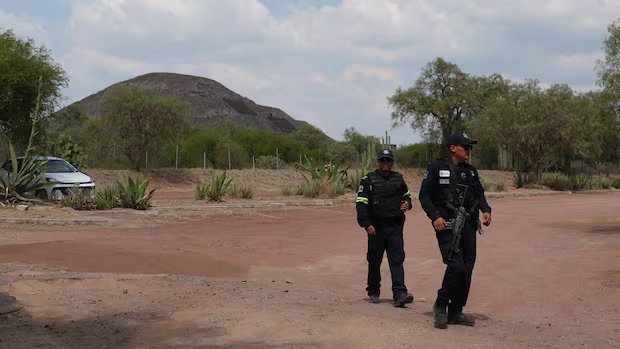
The Mexican president said the site would reopen on Wednesday with reinforced security.