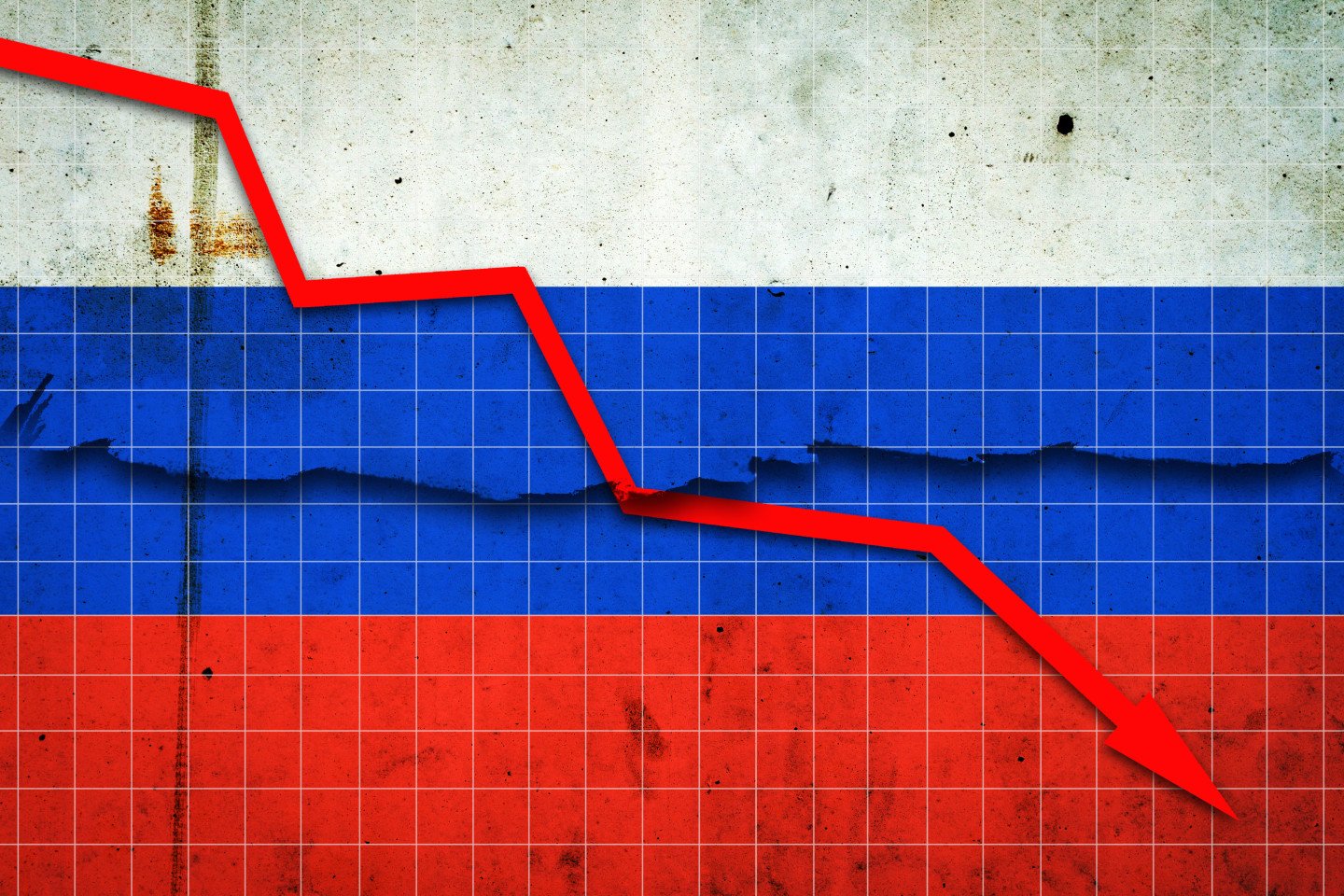
The war economy has led Russia to an explosive situation, European intelligence services warn, noting that the banking sector of the aggressor country is overloaded with hidden debts and the Central Bank is losing its independence.
The Russian economy has reached an “explosive state” as the country moves to war, the German newspaper “Frankfurter Allgemeine Zeitung” reported on Thursday, referring to the conclusions of a European intelligence report. According to experts, “an economic shock such as a large-scale package of sanctions against banks or a prolonged drop in oil prices” could be the final straw and act as a detonator.
A European intelligence report says that the Russian banking sector is particularly vulnerable. Bank balance sheets are artificially inflated. In order to attract investors in an environment of high interest rates – the base rate is still 14.5% – banks have lowered the threshold of acceptable risks.
The “mass issuance” of government-subsidized mortgages has caused real estate prices to rise, creating the risk of a bubble and a wave of defaults. The practice of transferring public-private partnership debts of Russian regions to banks has become an additional burden, due to which banks “suffer losses from low-profit projects and cover the difficulties of repaying the debts of the regions”.
The situation is further exacerbated by the “hidden debts” that are formed when banks “under pressure from the Kremlin” issue loans on concessional terms to defense companies with “colossal financial needs”. By September 2025, “signals of weakness in the banking sector” had become so frequent that Russian authorities began to fear that a banking crisis could erupt within the next 12 months “despite the Central Bank’s efforts to control the situation”.
The report says that Russia continues to maintain “the impression of a dynamic economy”, although this no longer corresponds to reality. The government itself officially recognizes at least two years of stagnation: the growth forecast for the current year has been reduced to 0.4%. Economists at the Kiel Institute for the World Economy and the Stockholm Institute for Transitional Economics consider this target to be “overly optimistic”.
The new European intelligence report does not call for tougher sanctions or a special customs duty on imports from Russia to the European Union (EU) in favor of Ukraine. However, it gives politicians arguments why the current moment is favorable for action – sanctions or at least a more confident stance against Russian dictator Vladimir Putin, Frankfurter Allgemeine Zeitung said.
The newspaper reported that the report should be considered a set of political tools. It adds dangerous scenarios to the list of well-known difficulties that are discussed even in Russia itself, but does not support them with its calculations.
The document says that banks’ credit portfolios will deteriorate due to the difficulties of entrepreneurs in repaying their debts and that the economic slowdown could accelerate the wave of bankruptcies. According to experts, the state supports only the defense industry, turning away from civilian companies that are in refinancing problems.
According to the intelligence report, the Central Bank considers 10% of corporate loans to be problematic, stressing that this is significantly more than the 2024 target. However, the regulator itself had previously estimated an 11.5% share last spring. Russian analysts also pointed to the sharp increase, but attributed it in part to a change in methodology and saw the figure as a warning sign rather than a sign of disaster.
The picture with problematic consumer loans is even more surprising. The report claims that the Central Bank of Russia recognizes the proportion of such loans at 6%, and blames the regulator for a “possible underestimation of reality”. In fact, the Central Bank itself estimated the proportion of problematic consumer loans at 13.1% in April.
The authors of the report expressed that it is increasingly difficult for the Central Bank of Russia to mitigate the economic consequences of the war in Ukraine, and the pressure on it is increasing. Since the beginning of June, the head of the regulator, Elvira Nabiulina, has officially missed several public events due to illness, including the St. Petersburg Economic Forum and Putin’s video conference with the government last week. At that meeting, Putin called for a cut in the base rate. “Inflation is coming down,” he declared. “How big is it? A little more than 5%. I think we have every right to expect a reduction in the base rate,” said the dictator.
Putin’s move was as unusual as the Central Bank’s reaction. One of Nabiulin’s deputies pointed out that inflationary pressures remain high and the possibility of rate cuts is minimal, especially given that government spending is not falling, but remains high. The German newspaper added that Russia’s parliament had just fast-tracked a bill allowing the finance ministry to increase its debt above the budgeted level without parliamentary approval.
All this is taking place against the backdrop of the rising costs of war. According to government estimates in February, the cost of Russia’s war is at least 24 billion euros higher than planned this year.
The new law risks increasing the debt burden, undermining budgetary discipline and reducing transparency. After Putin advocated a rate cut, the question has arisen as to how much independence the Central Bank itself still retains, Frankfurter Allgemeine Zeitung said.