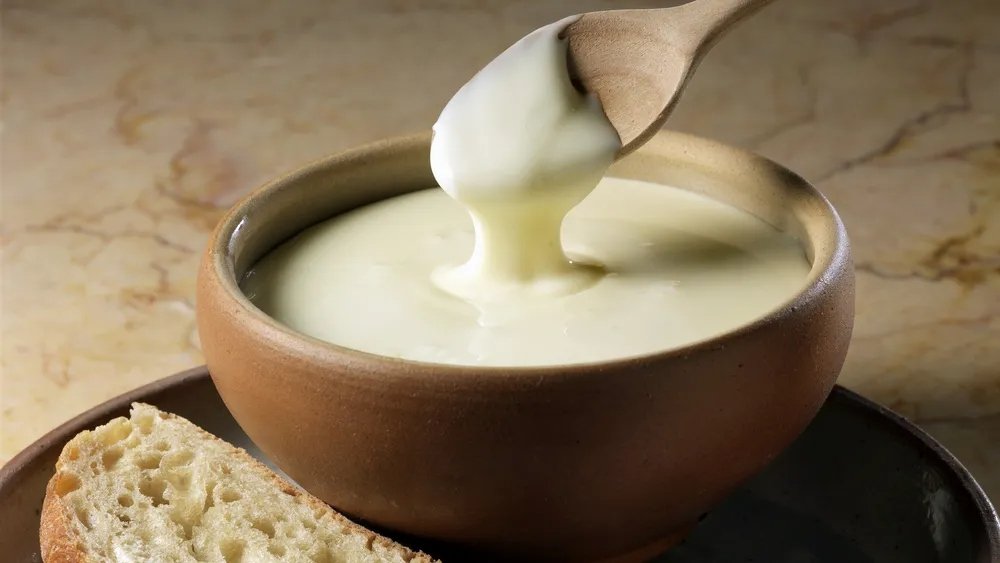
An almost unknown French cheese has suddenly found itself at the center of interest of those who want to lose weight without removing cheese from their menu. Cancuyot, a traditional cheese from eastern France, stands out for its low fat content and relatively high protein yield — a combination that makes it break from the norm of fattening cheeses.
It is a traditional cheese from the Franche-Comté region of eastern France, it is made from skimmed cow’s milk and stands out for its low fat content and relatively high yield protein.
The result is a lean, soft and almost runny cheese that can be eaten as a spread, dip, topping or even on bread.
Because it has been in the forefront of interest
Kankuyot is made from the so-called mettona product derived from skimmed milk. The metton is heated and mixed with water, salt and a small amount of butter, giving the cheese its special, soft texture.
Compared to more popular cheeses, such as cheddar, it has clearly lower fat and fewer calories.
For example, one 28 gram serving of cankuyot contains about 41 calories, 2.7 grams of fat and 4.3 grams of protein. An equivalent amount of cheddar contains about 110 calories, 9 grams of fat and 6 grams of protein.
Can it help with weight loss?
Experts appear moderately positive, but not overly so. Kankuyot is not a food that causes weight loss by itself. However, can be more easily integrated into a program dietbecause it combines taste, lower fat and a sufficient amount of protein.
Cow’s milk protein is mainly casein, which breaks down more slowly than whey protein. This means that can contribute to a greater sense of satietyhelping some people feel fuller for longer.
The dietician Kristen Kuminskibased in New York, described the kancuyot as a “interesting choice” for dieters, reports the DailyMail.
The comparison with cottage cheese
Cancuyot is often contrasted with cottage cheese, a food already considered popular in high-protein diets. A 30 gram serving of cottage cheese contains about 20 calories, 1 gram of fat and almost 4 grams of protein.
However, cancuyot has a different texture and flavor, which may make it more appealing to those looking for a cheese more like a spread or melted spread.
What should we keep?
It is not a “miracle” food nor does it replace a balanced diet. But it is an example of how a traditional product can be in the limelight, when it matches modern trends.
For those watching calories and fat, but they don’t want to go without cheese altogetherthe kankuyot can be an interesting alternative. The question, as always, is quantity, overall nutritional context, and whether a choice can support a sustainable diet.