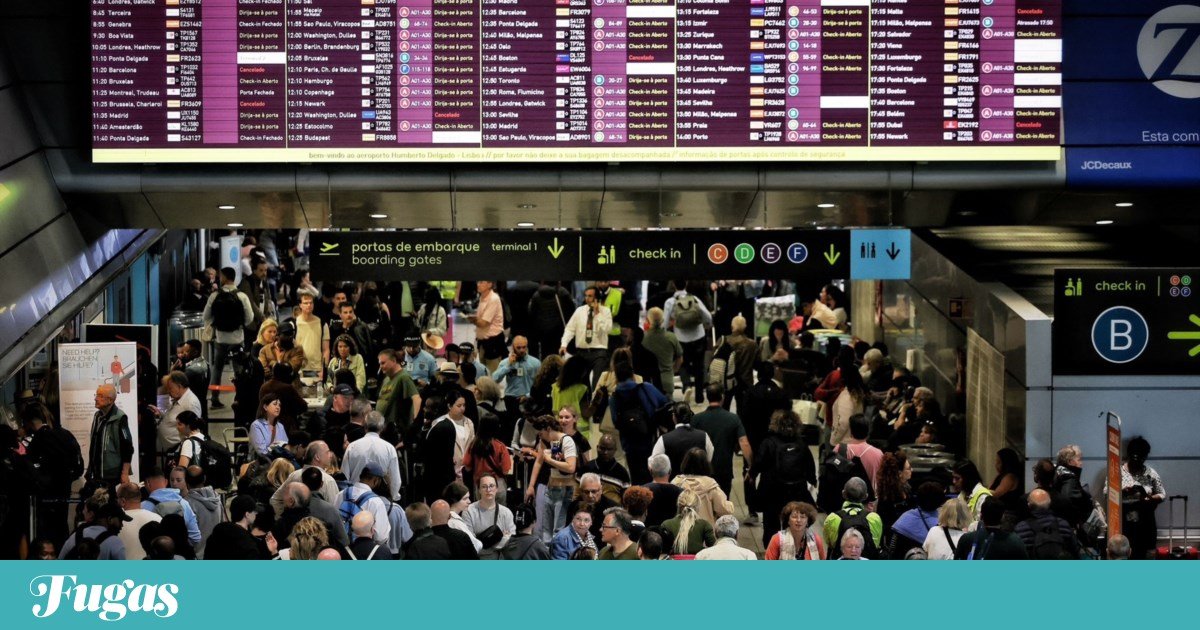
The Council of the European Union and the European Parliament reached an agreement on Monday on the review of air passenger rightsimposing, among other aspects, that the cost of hand luggage be included in the initial price presented to the passenger when they make a reservation.
According to the Council, this will bring “transparency” and will “facilitate price comparisons between airlines”. Along the way, we came up with the idea of hand luggage (the one that goes in the cabin, above the passengers) be free on all airlines.
For Deco, “a fundamental right of passengers”, that is, the guarantee “that consumers can transport a personal item and a hand luggage of reasonable dimensions without any costs”. In a statement, Deco said it fears that consumers will continue “to face constraints and bear additional costs in the future”.
Furthermore, airlines that charge for hand luggage can, after presenting the base fare, apply a discount to those who do not wish to carry this luggage, as Paulo Fonseca, from Deco, explained to PÚBLICO.
This official also warns of the importance of knowing the final legal text, as there is a risk of confusing the hand luggage that goes in the cabin, on top of the passengers, with the small suitcase or backpack that is placed under the seat.
Ryanair reviews
Ryanair has already reacted critically, stating in a statement that the new rules “force airlines to announce higher fares”, including, it argues, “a second hand luggage when more than 50% of passengers (of this company) opt for lower fares and do not travel with a second hand luggage”.
On the consumer side, there were those who feared a reduction in compensation for airline delays, but the final agreement did not bring any new changes to what is already practiced today, based, in particular, on jurisprudence of the Court of Justice of the European Union.
“Maintaining the compensation rules in situations of cancellation and delay is, in itself, a victory, as it allows the level of consumer protection to be maintained”, says Deco.
After a European negotiation process that began 13 years ago, the regulation clarifies that if there is a delay of more than three hours, the passenger is entitled to compensation ranging from 250 euros to 600 euros, depending on the distance in question.
The rules, says the Council, apply to passengers traveling within the European Union (EU), regardless of the origin of the airlines, to those arriving in the EU with a European airline and to those departing the EU, whether on a European airline or not. Thus, they remain from outsidefor example, the cases of passengers traveling to the EU on a US airline.
Some progress on the rules
For Deco, there were “important isolated progress”, such as “the introduction of a deadline for the payment of compensation”, the “prohibition of clauses at the show (no-show) that prevent passengers from boarding the return flight when they have not used their outbound ticket”, and “the prohibition of fees for seat selection in reservations that include minors or to correct spelling errors in the name”. However, he emphasizes, the regulation remains “below what is necessary, not reviewing its scope, and reducing the assistance that must be provided to passengers”.
According to the EU Council note, in the event of a delay that gives rise to compensation (that is, if it is not due to extraordinary circumstances), passengers must be informed “up to 96 hours after arrival”. “The airline must provide passengers with information about their rights and clear instructions on how to request compensation”, says the Council.
Afterwards, companies must acknowledge receipt of the complaint and have a maximum of 30 days to respond, paying the amount in question or “providing a clear justification for refusing the complaint”.
Airhelp, a company specialized in negotiating with airlines amounts owed to passengersadds that the changes to the current regulation should be applied “from the second half of 2027”. For Airhelp, thanks to the European Parliament, the “biggest setback” in the history of air passenger rights was avoided.
Linked to the Association for the Defense of Passenger Rights (APRA), the company also highlights changes to the rules such as the fact that passengers can “leave the plane during long waits on the tarmac”, that “the responsibility of airlines is clarified in the event of a missed connection flight” and that, “in case of interruption”, airlines must “offer the fastest alternative available”. Furthermore, he highlights, there is a “new period of nine months to claim compensation”.