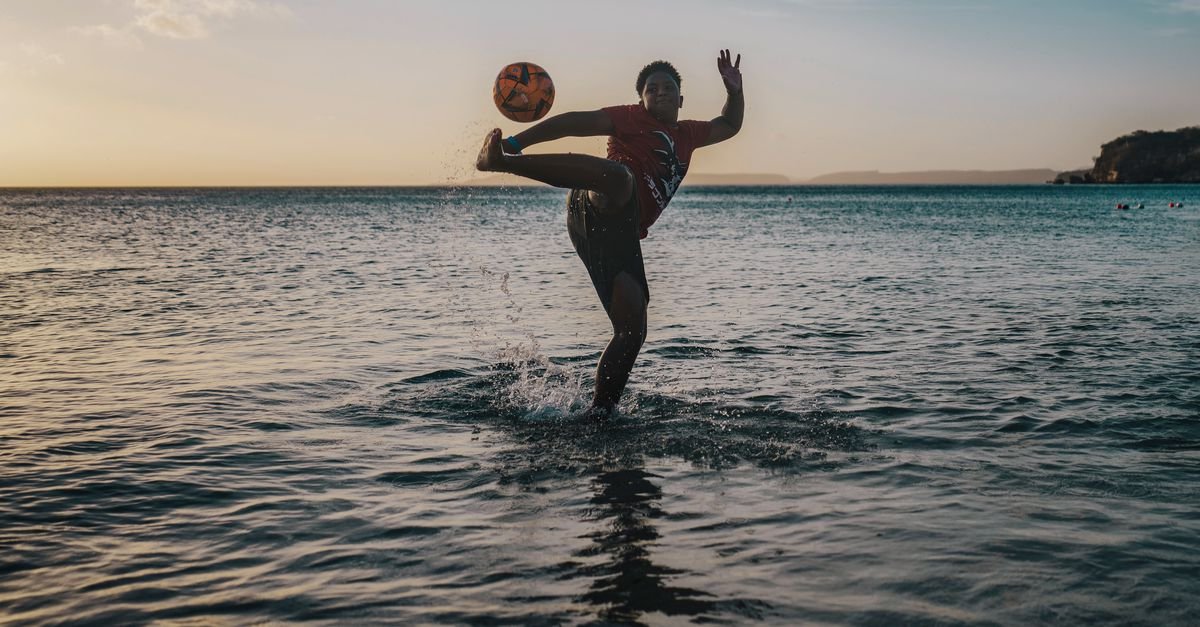
When he saw which countries were in Germany’s group after the World Cup draw in December, Mario Heller blinked for a moment. “I saw the name Curaçao. I thought: what kind of country is this? I had never heard of it.”
The Swiss photographer went to investigate and drove around the island, where 150,000 people live, for a week in April. He learned that Curaçao is a country within the Kingdom of the Netherlands. And that all players of the national team grew up in the diaspora, so in the European Netherlands, where approximately 140,000 Curaçaoans live.
“I thought that was strange. How strongly are they connected to the island? And what does this say about colonial relations?” Many people he spoke to in Curaçao are not concerned with this. “It is mainly hoped that the World Cup will put Curaçao on the map and attract tourists.”
Curaçao is full of the Blue Waveas the national team is called.
Everywhere you see slogans like: ‘Small island, big dreams‘.
But the road to the fulfillment of those dreams often leads through the Netherlands.
Bryan Anastatia (33), captain of Jong Holland, champion of Curaçao, also knows this. He once played for the national team.
But since FIFA allows players to also play for the country of their (grand)parents, that is over.
National coach Dick Advocaat only chooses Curaçao professionals from the Netherlands.
Qualification therefore tastes bittersweet for Bryan Anastatia. “A World Cup is the best thing you can experience as a football player. But we cannot be completely proud of this team. Many good players from here did not get the chance to be part of this success.” He hopes that Curaçao does well. And that FIFA money is invested in the youth competition. “Otherwise nothing will change.”
:format(webp)/s3/static.nrc.nl/wp-content/uploads/2026/06/08181518/120626WEE_2034140570_33.jpg)
In 2020, there was contact between Jong Holland football club in Curaçao and Ajax about setting up a football school. So far this has not gotten off the ground. Ajax does supply balls and goals to primary schools on Curaçao.
:format(webp)/s3/static.nrc.nl/wp-content/uploads/2026/06/08181040/120626WEE_2034140570_14.jpg)
Training of youth players in Willemstad. Young people with talent will sooner or later leave for the European Netherlands because there are football schools there that offer them a better chance of a career as a professional footballer.
photos Mario Heller
Just like Anastatia, the famous goalkeeper Ergilio Hato, the ‘Black Panther’, after whom Willemstad’s national stadium is named, never left Curaçao, although he played for the Dutch team several times in the 1950s. The current national goalkeeper, Eloy Room, has a tattoo of Hato on his arm.
:format(webp)/s3/static.nrc.nl/wp-content/uploads/2026/06/08181431/120626WEE_2034140570_29.jpg)
Photo of the legendary goalkeeper Ergilio Hato, the ‘Black Panther’, after whom Willemstad’s national stadium is named.
Photo Mario Heller
“Ajax and Real Madrid were interested, but Hato did not want to become a professional,” says cultural anthropologist Valdemar Marcha (82), who supports former football players. Marcha is a football fan, but sees unequal opportunities. “If we had the same facilities as in the Netherlands, the talents would stay here.” For him, the inequality also lies in who will soon claim a possible World Cup success. “If Curaçao wins, it is a Dutch victory. If we lose, we are the other one.”
:format(webp)/s3/static.nrc.nl/wp-content/uploads/2026/06/08181113/120626WEE_2034140570_16.jpg)
Cultural anthropologist Valdemar Marcha (82) was president of the Antillean Aviation Company ALM. For him, World Cup qualification mainly means recognition from Curaçao, although he is somewhat concerned about expectations being too high. “Suppose we lose by double digits to Germany, then we come back traumatized.”
Photo Mario Heller
Stephany Seinpaal (39) is more optimistic. She was there in Jamaica when Curaçao qualified for the World Cup. “I almost cried with joy.” She will be in Houston on Sunday for the match against Germany. The costs are high: $3,000. She will pay this off in installments.
She lives outside Willemstad with her mother and two children.
Her neighbor lives with four children on the minimum wage. Sometimes she asks Seinpaal for food.
“Everything is becoming more expensive: petrol, electricity, food. The money is gone before you get it in your hands.”
The Netherlands offers young Curaçaoans opportunities for a better life. Seinpaal studied in the Netherlands, and now her 16-year-old son Qmany wants to go there to become a professional. He had just arrived, with a youth team from Curaçao. They lost their matches.
“It was cold. And the Dutch were fast.” Still, he is enthusiastic. Does he want to play for Curaçao or the Netherlands later? He laughs. Then he says: “The Netherlands. I have always dreamed of that.” And if Curaçao plays a good World Cup? He thinks. “Maybe.”
:format(webp)/s3/static.nrc.nl/wp-content/uploads/2026/06/08181237/120626WEE_2034140570_21.jpg)
Qmany Seinpaal (16) dreams of a professional career as a footballer in the Netherlands. If he had to choose a national team, it would be the Dutch national team.
PHOTO Mario Heller
:format(webp)/s3/static.nrc.nl/wp-content/uploads/2026/06/08180735/120626WEE_2034140570_2.jpg)
Drone photo of the training complex of CRKSV Jong Holland, the oldest football club in Curaçao, founded in 1919, which has been national champions twelve times. The club finished third in the Promé Divishon this year.
:format(webp)/s3/static.nrc.nl/wp-content/uploads/2026/06/08180823/120626WEE_2034140570_5.jpg)
Spectators at a match this spring between Jong Holland and Victory Boys in the Promé Divishon, the highest football class in Curaçao. The match attracted almost a hundred viewers.
photos Mario Heller
:format(webp)/s3/static.nrc.nl/wp-content/uploads/2026/06/08181012/120626WEE_2034140570_12.jpg)
Former Dutch international Patrick Kluivert poses for visitors to the Legends Tournament that was held in Willemstad in April, in which Brazilian Ronaldinho and Wesley Sneijder also participated. Kluivert’s mother comes from Curaçao and Kluivert was national coach here a few years ago.
Photo Mario Heller
:format(webp)/s3/static.nrc.nl/wp-content/uploads/2026/06/08180953/120626WEE_2034140570_10.jpg)
Jong Holland players during the warm-up before a match.
Photo Mario Heller