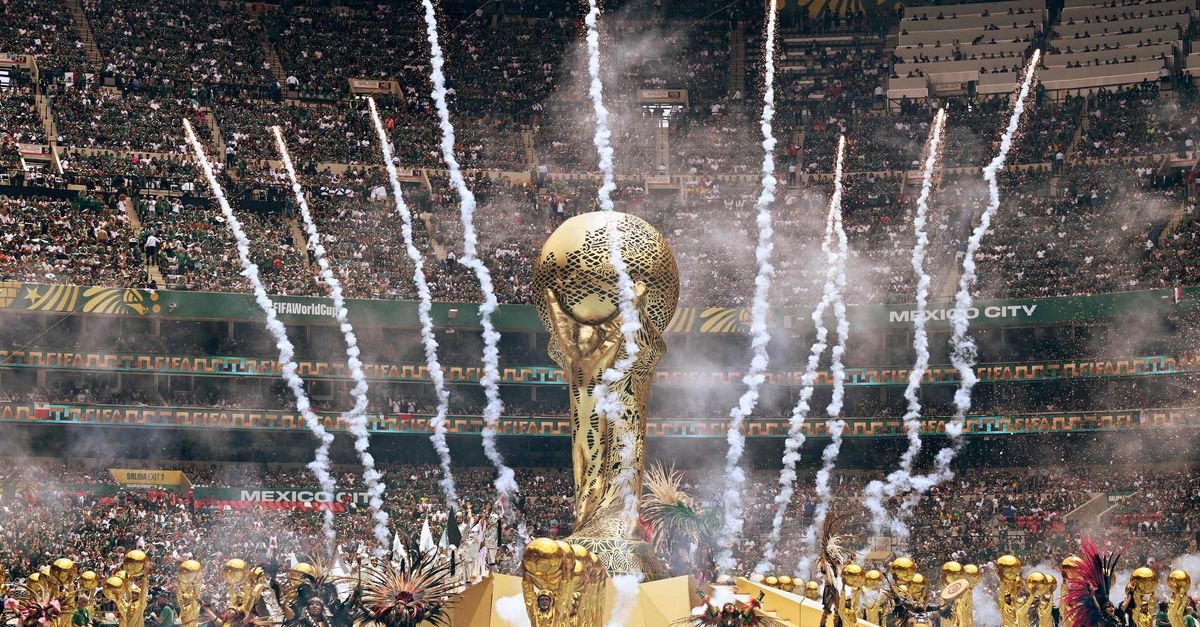
When the United States, together with Canada and Mexico, was awarded the 2026 FIFA World Cup in 2018, Donald Trump noted that he would no longer be there as president. “Or maybe they will extend my term.” Eight years, a storming of the Capitol after his lost election in 2020 and a successful re-election in 2024 later, Trump is here after all – and his shadow hangs over the tournament, which kicked off on Thursday in Mexico but will largely be played in the United States.
In the days before the start of the tournament, which football association FIFA likes to emphasize that it promotes ‘unity’ in the world, Trump again bombed Iran, a tanker in the Strait of Hormuz was attacked by the Americans and border guards sent a Somali referee, on his way to his first world cup, back home.
:format(webp)/s3/static.nrc.nl/wp-content/uploads/2026/06/12091521/100626VER_2034363180_3.jpg)
Donald Trump in December 2025 during the draw.
Photo Getty Images
Will this also be the ‘MAGA World Cup’, as Cas Mudde, the Dutch political scientist who teaches in America, calls it with horror? Will Trump thrust himself into the center of attention, just as he stood center stage for far too long a year ago to celebrate the Club World Cup with the Chelsea players? Or will the tournament actually show that this emperor wears no clothes?
Autocrats and dissidents
Football World Cups have never been non-political. “From its birth, the World Cup has been a vehicle for much more than just football,” writes British journalist Jonathan Wilson in his recently published book The Power and the Glorya history of the tournament. For Jules Rimet, the FIFA president who initiated the first World Cup in the 1920s, a global football tournament was a way to leave the horrors of the First World War behind him – he had served in the trenches for a long time.
The World Cup, he thought, would be a peace project that could bring peoples closer together. Or at least Western and South American peoples; it took decades for colonized and, later, post-colonial countries in Asia and Africa to gain a serious place in the tournament.
Rimet’s belief in the unifying effect of football was politicized by dictator Benito Mussolini in 1934. He saw the World Cup that his Italy organized that year as a way to unite Italians under the fascist ideal. The rest of the world, he believed, would then see the power of that ideal. That is why the matches did not take place in one city, as in 1930, but in eight places that, for Mussolini, represented the power of fascist Italy. For the same reason, eight matches started at exactly the same time: something like this had never been seen before, except by the courageous Italians.
Mussolini’s World Cup was the first example of what is now sportswashing is mentioned, using a major sports tournament to improve the image of a country in the rest of the world. After 1934, Mexico followed in 1970 (two years after three hundred demonstrating students were shot dead), Argentina in 1978, Russia in 2018 and Qatar in 2022. Saudi Arabia followed in 2034. World Cups are a way for autocrats to gain global legitimacy and to show that things are not as bad as dissidents claim. In a sense, they succeeded: 1970 is remembered as Pelé’s tournament, 2022 as Messi’s.
Threats from Trump
But the crazy thing about this World Cup is that Trump has made no attempt sportswashing do, wrote journalist Simon Kuper last weekend Financial Times. There are no soothing words from his government to distant peoples, or attempts to refute the image of an advancing autocracy. On the contrary: strict border controls for fans and players are actually defended by the government. The feared anti-migration service ICE will also be active around stadiums, the government previously announced. And although this would mainly be to support other security services, there are fears in immigrant communities that match days will be used to arrest and deport people.
:format(webp)/s3/static.nrc.nl/wp-content/uploads/2026/06/12092135/100626VER_2034363180_1-1.jpg)
:format(webp)/s3/static.nrc.nl/wp-content/uploads/2026/06/12091553/100626VER_2034363180_2.jpg)
Left: Mexican football fans celebrate their team’s first goal against South Africa. Right: Isaac Martinez during a protest for immigrant rights at a FIFA office in Los Angeles.
Photos Eugene Hoshiko/AP, Reuters
Meanwhile, fans from Iran, Senegal, Haiti and Ivory Coast are unable to visit the World Cup due to long-standing travel bans. Due to uncertainties about their visas and Trump’s threats that they should stay at home, Iran’s national team departed for their training camp to Mexico; After their matches in the US, they have to leave the country immediately. Referee Omar Abdulkadir Artan from Somalia, another country with an entry ban, was turned away at the border last week. Palestinian football chairman Jibril Rajoub said he has been denied a visa to attend the World Cup in the US.
Never before has a World Cup host country been at war with one of the participants
“For the billions of people who cheer (the tournament) from a distance,” wrote Algerian football journalist Maher Mezahi“one question becomes increasingly unavoidable: How long will FIFA let Trump’s United States disrupt a party that is not his to disrupt? How long will we let one man ruin world football?”
The war in Iran, one war of choice whose rationale and strategy prove to be more unpredictable and ill-considered every day, also casts a shadow over the tournament. Never before has a World Cup host country been at war with one of the participants. The war also seems to distract Trump from the tournament; He has barely mentioned the World Cup on social media for weeks and this week the White House announced that he will not be at the first match of the US against Paraguay (the fear of being booed, like last weekend at a basketball match, may also have played a role). Meanwhile, his country’s prestige in the rest of the world continues to decline.
Dancing police officer in Cleveland
But countries are never just their leaders, and tournaments are never just the illusions of their own greatness that autocrats portray in them. The 1978 World Cup (Argentina) was not just Videla’s; it was also that of the Mad Mothers whose stories during the tournament were relayed by Western journalists on TV screens and in newspapers on the other side of the world.
:format(webp)/s3/static.nrc.nl/wp-content/uploads/2026/06/12092916/100626VER_2034363180_4-1.jpg)
:format(webp)/s3/static.nrc.nl/wp-content/uploads/2026/06/12092158/100626VER_2034363180_5.jpg)
Left: Argentinian fans cheer in Buenos Aires after the World Cup final against the Netherlands in 1978. Right: A demonstration of the Foolish Mothers in Buenos Aires during the World Cup in Argentina.
Photos Getty Images
This World Cup will not be Trump’s alone, if only because nine of the eleven American host cities have a Democratic government (and the other two cities vote predominantly Democratic). In the country where abortion and trans rights are restricted, a ‘Pride’ week is also organized during the World Cup; in Seattle, with Egypt – Iran as a ‘Pride’ match (both countries have indicated that they are not enthusiastic about this).
The mayor of New York arranged thousands of affordable match tickets
Also opposing Trump is Zohran Mamdani, the mayor of New York whose love for football is as great as his love for socialism. While Trump seems to have been zapped away from the World Cup, Mamdani cannot be kept away from social media. In welcomed a flashy video he had foreign football fans in his city this week; With a ball under his foot he explains how the metro works, and that you have to stop on the right on escalators so that you can continue on the left. On X he talks to football fans every morning updated with weather forecasts and traffic information. That’s not just performance: he also arranged thousands of affordable match tickets for New Yorkers and organizes them for free fan zones in the city.
Trump’s travel bans and FIFA’s exorbitant ticket prices undermined the promise of the World Cup as a celebration of connection and solidarity. But that spirit has not disappeared. Images of a dancing police officer in Cleveland who encouraged Egyptian fans to sing louder at the players’ hotel viral. And across the US, diaspora communities will proudly wave their flags in the coming weeks: Iranians in Seattle (perhaps with anti-regime banners), Senegalese in New York, Haitians in Miami, last weekend at an exhibition match in St. Louis tens of thousands of Bosnians. Trump likes to see himself as the center of things. But this World Cup he can also find himself on the reserve bench.
Correction June 13, 2026 (3:38 PM): The previous version stated that it was not clear how Iran and Egypt would react to the ‘Pride’ match in Seattle. That’s not right. Both countries appear to have previously indicated that they do not like LGBQT expressions during their mutual competition. This has been adjusted in the text.