Hidden inside an old building just north of the bustling Tuol Tompoung market, visitors must navigate a narrow walkway and climb three flights of stairs to find one of the city’s best-kept culinary secrets.
There, on a balcony overlooking the open market, Khara Coffee and Indigenous Food is serving up a vibrant, authentic taste of Cambodia’s highlands.
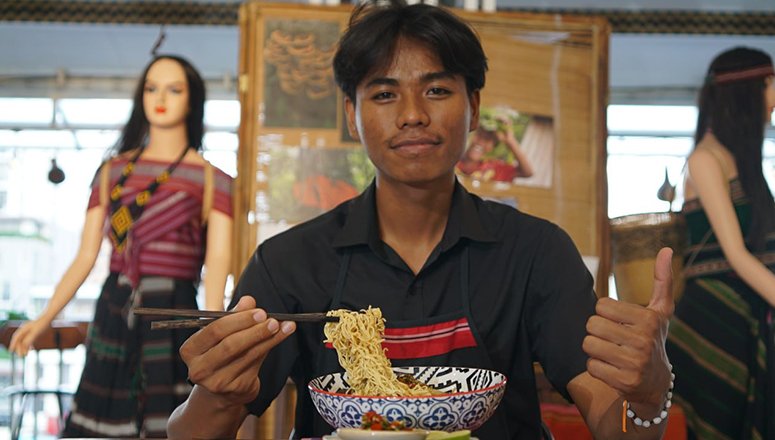
At the centre of it all is Kim Phea, a young indigenous man on a passionate, one-man mission to bring the traditional flavours of the provinces straight to the capital.
Phea belongs to the Kuoy indigenous group, originally from Preah Vihear province. His path to the kitchen wasn’t a straight line. He first moved to Phnom Penh in 2019 to pursue a degree in tourism, but when the COVID-19 pandemic hit, he dropped out and returned to his hometown.
The detour, however, sparked a new calling. In 2022, Phea returned to the capital to earn a two-year diploma in cooking both Khmer and Western cuisine. He then spent time volunteering with an indigenous non-profit organisation, using the opportunity to learn traditional recipes from various tribes across Cambodia.

Today, his restaurant serves as a cultural archive, mixing different highland culinary traditions from Preah Vihear, Ratanakiri and Mondulkiri.
While Phea’s menu features unique traditional items like bok trob, Isan-style sausages and bok lgngor, the undisputed star of the kitchen is chanang.
To the uninitiated, chanang looks like a noodle soup, but its preparation reveals a complex, ancient recipe that relies on foraging and patience. The broth owes its distinct, earthy aroma and deep, ink-black colour to the leaves of coffee senna (sloek sandek khmoch), also known in some regions as sloek sarieng. The plant is registered with the Ministry of Health as a traditional medicine and must be brought in directly from Mondulkiri or Ratanakiri provinces.
Phea simmers these rare leaves for hours until the broth becomes thick, yielding a complex flavour profile that is both bitter and aromatic.
Every bowl is topped with bok pakreave, a fiercely flavourful paste of pounded chillies, green onions and local spices that perfectly cuts through the earthy richness of the broth.
“Originally, we didn’t eat it with noodles; we ate it with rice, and the broth was incredibly thick,” Phea says. “But we adapted it by adding noodles so that the people in Phnom Penh could easily enjoy it.”
The adaptation has been a massive hit. Enjoyed by locals who miss the tastes of home and diners seeking genuine flavours, chanang has rapidly become the restaurant’s best-seller.
Operating a restaurant solo is a monumental task. Without any workers, Phea is a true one-man show, acting as the head chef, cleaner, manager, accountant and supply buyer.
Though Khara Coffee and Indigenous Food has been open for a year, its hidden location means it remains relatively unknown.
But word of mouth is spreading. Phea is frequently surprised by groups of adventurous foreigners who manage to find the narrow stairs, drawn by the promise of a truly authentic meal.
“My dream is for the people of Phnom Penh to know what kind of food indigenous people eat every day in our villages,” Phea says. “Even if they haven’t been to Ratanakiri, Mondulkiri, Preah Vihear, or Kampong Thom, they can still come and experience the provinces right here.”